
The most anticipated upgrade for Terra Protocol is coming.
 Copyrighted Logo of Terra
The development team of Terra Protocol is actively working on the mainnet upgrade -Colombus-5. This brings a table full of upgrades to the mainnet.
Simplifying treasury module logic- Seigniorage burning proposal
In the central bank of terra protocol which is the treasury, when luna is burned to mint new Terra stable coins, seigniorage is created which currently goes to
- A keyless on-chain wallet which is controlled by Luna governance to fund various activities and innovative by terra ecosystem
- Goes to reward pool, to delegators to validators over a one-year distribution.
As the minting of Terra stable coin becoming exponential, the community rewards and the oracle reward pools become overfunded by the seigniorage distribution.
The Columbus-5 proposal is to-
Burn all remaining funds in the community pool. But the community will be well funded, as proposals are in the voting phase.
All future seigniorage to be burned so that it won't get routed back to community rewards. Also, limit the oracle reward pools. So, minting 1 UST will burn 1$ worth of luna, and the transaction fees go to Staking rewards. This plan will keep the staking fees attractive but not insane.
Other changes in seigniorage distribution
- In col-4,
reward_weighta portion of the seigniorage is placed in a buffer that rewards faithful oracles over a period of 3 years, and1-reward_weightis sent to the community pool.reward_weightis calibrated every 1 month by thetreasurymodule to calibrate burns vs staking returns. - Currently
reward_weightis set to 0, such that all seigniorage is being directed to the community pool - To keep the narrative simple to “staking rewards come from fees, all seigniorage is burned, we suggest the following change:
reward_weightto be set to 1max_changeofreward_weightto be set to 0 - the treasury module will refrain from further changing thereward_weightparameter arbitrarilyreward_weighta portion of the seigniorage to be burned1-reward_weightparameter to go to the community pool
Ozone Insurance v2.1
Ozone provides insurance to the Terra DeFi ecosystem. If any technical risk happens at the Terra DeFi ecosystem the mutual protocol facilitates a levered coverage to the insurers.
Key System Components
- Global insurance pool: the pool of deposited UST.
- Covered vault: A covered vault is the insurance agent in Ozone. It's a smart contract that wraps a Terra FInance(TeFi) contract and gives yield. How it works is The Covered Vault(CV) deposits UST on behalf of the insuree to the yield contact, Eg: Anchor protocol.CV also takes a cut of the resultant yield due to staking. If any technical failure happens to the yield contact CV acts as the insurance agent and claims UST against the global insurance pool. If insurers can deposit Y UST, it can provide coverage up to N*Y UST to cover various contracts, N being the leverage constant decided by the governance.
- Ozone UST(oUST): A virtual balance of UST that insurers can allocate to covered vaults(CV) to provide coverage.
Mechanism
End users can do the following in Ozone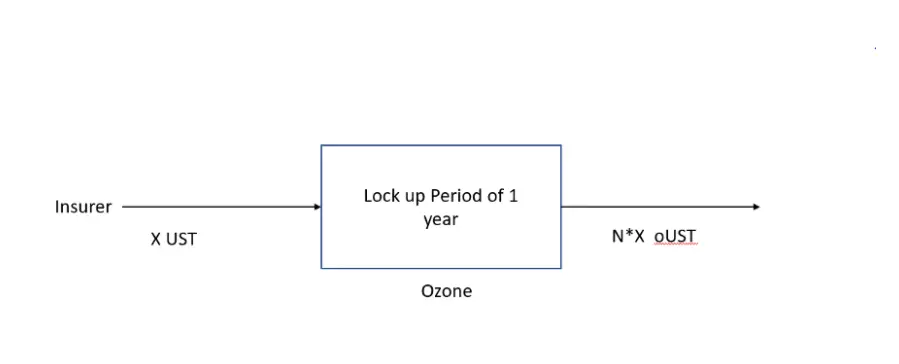
- Provide coverage. User/insurers need to provide X amount of UST to become coverage providers. Ozone then will mint this provided UST to oUST with a multiple of target leverage ratio(X). It's important to take note that the deposited UST has a lockup period of 1 year. The cover_fees is a function of the utilization ratio of the CV which is a new addition to V2.1. The insurer then provides the oUST into the various CV of his choice.
- Buy coverage. Depositing into a CV allows the user to purchase ozone coverage for TeFi yield farming in exchange for paying a fee to the resultant yield. Meaning users won't get 100% of the yield generated if insurance is claimed.
Recover target leverage
As claims are made against the insurance pool, the real_leverage_ratio is going to at times climb higher than the target_leverage_ratio . The protocol aims to return the real_leverage_ratio to the target over time, by:
- Waiting: As new insurers enter and mint oUST at the target_leverage ratio, the real_leverage_ratio will organically converge to the target.
- Rerouting fees: While
real_leverage_ratio > target_leverage_ratio, the UST revenues ofcover_fee - (1-climate_tax) from each vault is routed directly to the insurance pool to increase the AUM, which in turn reduces the real_leverage_ratio. As the cover fees are routed to the insurance pool periodically, an equivalent value in $OZ is minted (inflated) by the governance contract and given out to insurers instead of the normal UST fee. → Removed in v2.1
The $OZ Token the governance token of Ozone
Supply: 10B, no max supply
Distribution:
- 15% — Luna airdrops (5% genesis, 10% over 1 year)
- 20% — OZ-UST LP incentives over 4 years
- 20% — Community pool
- 45% — Insurer incentives over 4 years (divided in weekly installments to insurers)
Stargate update in cosmos ecosystem
The biggest upgrade of the Cosmos ecosystem- the Starlight Upgrade is on the horizon.
Stargate will enable higher transaction throughput, accelerated UI development, cross-chain transactions, and much more.
IBC protocol (Inter Block Chain) is set to launch with the Stargate update.IBC will enable the interoperability of the cosmos network. This will allow to securely and trustlessly exchange data and tokens between sovereign chains that support IBC. Even Non_tendermint blockchains like ETH and BTC will be connected to the cosmos with IBC.
Let's say Chain B wants to transfer the token to Chain A, Chain A locks the token and relays proof to Chain B. Once Chain B is verified, it will itself mint token which will be later be destroyed and at the same time unlock token at Chain A.
Protobuf for a better Cosmos future. Protobuf will enable performance improvements, Reliability, composability, and better UIs.
Developers are excepting a 10x to 100x increase in transaction speed, which will, in turn, enable Cosmos to handle the increasing volume of cross-chain transactions.
Protobuf will enable developers to develop reliable front-end UI that works with other UI.
State Sync Current practice to sync a node is to take/download a public snapshot, which makes syncing of the new validator much easy, but the issue is with security. State Sync solves this issue and enables a node to start securely run within minutes.
Chain Upgrade Module During the cosmoshub-2 and cosmoshub-3 upgrade the was an hour of disruption. This issue will be solved by changing to a new auto-upgrade system powered by Regen Network, which reduces the coordination complexity, human error, etc.
Other Upgrades
Swap fees as dividends instead of burns. Increasing $LUNA prices have lowered staking yield to below dollar. To bring it above 10%, the swap fees dividend mechanism will be introduced instead of burning them.
Optimize gas efficiency of oracle voting. This is achieved through seigniorage burning
Charge gas fees for log size. Contract log size occupies a large portion of the local storage of the operator. By charging gas fees, spamming of local storage can be removed.
Separate mint/burn swap base pools in the Market Module. To prevent arbitrageurs from frontrunning the Terra oracles, a simulation of virtual AMM happens which swaps that mint/burn terra, to prevent the on-chain market from becoming more “liquid” than the off-chain market.
Under the hood changes for wallets and exchanges
- terrad & terracli => terrad
- terrad home path has been changed to ~/.terra from ~/.terrad
- New proto signing logic added, but still support legacy amino signing
- No coins returned for account query
- Need to add Bank SendEnabled(per denom) params at oracle whitelisting; if not specified, DefaultSendEnabled of bank parameter will be used
- EstimateFee interface change
- EstimateFeeRequest now receives BaseReq (with gas == “auto”) instead of StdTx
- EstimateFeeResponse now return StdFee
- New grpc removed estimate_fee endpoint but can use
/cosmos/tx/v1beta1/simulate1 and/terra/tx/v1beta1/compute_tax1 to get gas and tax amount - Legacy EstimateFee’s request & response format changed to use BaseReq and return StdFee
- (client) #7246 The rest server endpoint
/swagger-ui/is replaced by/swagger/, and contains swagger documentation for gRPC Gateway routes in addition to legacy REST routes. Swagger API is exposed only if set inapp.toml. - REST API
/market/terra_pool_deltaremoved and/market/mint_pool_delta&/market/burn_pool_deltaadded [Feature] Separate mint and burn swap pool by YunSuk-Yeo · Pull Request #467 · terra-project/core · GitHub 15 - tx log msg.sender now can be
terravaloperaddress - oracle/MsgDelegateFeedConsent
- staking/MsgEditValidator
- slashing/MsgUnjail
Comparing Columbus-4 and Columbus-5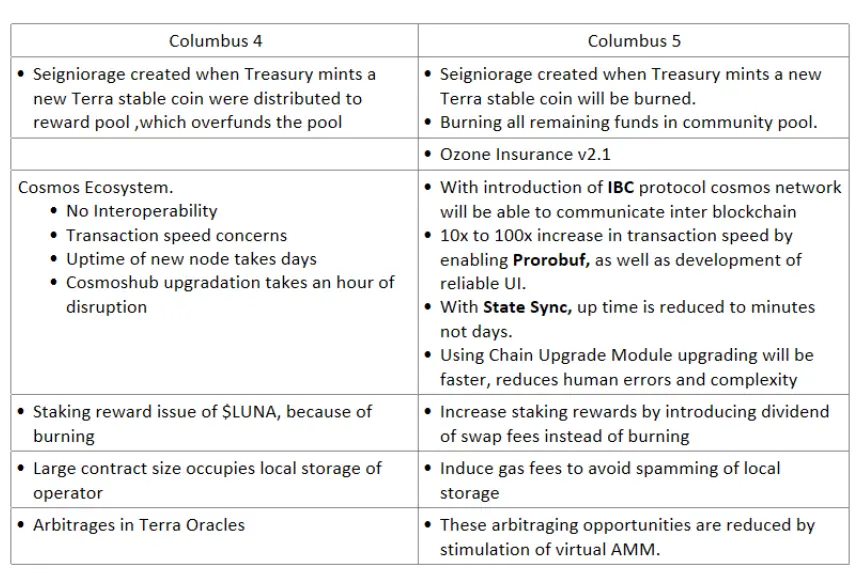
Orginally publiched in my medium handle
https://theguywhowrites.medium.com/columbus-5-mainnet-upgrade-for-terra-protocol-is-on-the-horizon-62ea4e224cf6






