What is so impressive about DeFi, and most importantly, what is DeFi? Well, DeFi is currently one of the major use cases in cryptocurrency and one of the many reasons that are keeping this bull run going. DeFi is short for Decentralised Finance. To understand what DeFi is, we should learn what centralised finance is. Centralised finance is a financial market structure that is having all orders or transactions going through one entity, for example, the bank, without competing markets.
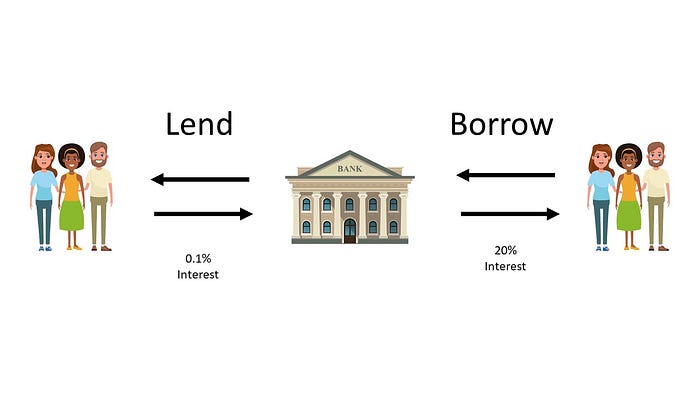
Lending and Borrowing rate from a traditional bank.
The figure above shows one of the most important functions in the financial system — lending and borrowing. This basic role allows people with extra money to lend to people in need of extra money, for example, starting a business, which essentially puts unused money to work and in return, leads to overall growth in the economy. And for hundreds of years, banks serve as an intermediary between the lender and the borrower. If you have extra money lying around, you can definitely put it into a savings account and earn a measly 0.1% APR (Annual Percentage Return). The bank can then use your money to lend to borrowers with let’s say, 20% APR. The difference in between is then profited by the bank.
The emergence of blockchain technology can solve the need of these third parties, a.k.a the bank. Without a third party, the differences between the lending and borrowing rate can be instead split amongst the lenders. The elimination of central financial intermediaries using blockchain technology, such as the smart contract resulted in the birth of decentralised finance. A smart contract is a code that allows certain execution to be performed when predetermined conditions are met. If you are familiar with coding, it is similar to the if-else statement, for example, if Tom buys an NFT for the selling price of $100, he will get the NFT; if he tries to buy the NFT for less than $100, the transaction will not execute. Currently, the Ethereum blockchain is the most well established smart contract cryptocurrency. However, you can find other emerging smart contract cryptocurrencies such as Solana and Terra, attempting to solve what Ethereum couldn’t. However, in order to create a working financial system, we need the necessary tools. Now let’s discuss what applications made up DeFi.
Defi Application
Stablecoins
Stablecoins are essentially a cryptocurrency backed or pegged by the USD or other fiat currency. The most adapted stablecoin is the USDT coin with a current market capitalisation of around $70 billion. What is the point of stablecoin in DeFi? Think of it as a currency in the DeFi world. Let’s say you are buying some food in the US and of course you would pay with USD and not other currencies such as the GBP. The same goes for the DeFi world where you have to use cryptocurrency instead of fiat currency.
Why do you need a fiat pegged/backed cryptocurrency in DeFi, doesn’t that defeat the purpose of cryptocurrency? Cryptocurrencies such as Bitcoin can be used as a medium of exchange, but unfortunately, they are quite volatile. Stablecoins are less risky as the value they possess is always equal to their fiat counterpart, and they act as a safe harbour for DeFi users. Afraid that your cryptocurrency might go down in value? Exchange it for stablecoin without the need to cash out through a centralised exchange!
Decentralised Exchange
Decentralised exchange or DEX is an exchange for cryptocurrencies. However, unlike centralised exchanges such as Binance, which is of course controlled by a central authority, DEXs are exchanges that are entirely decentralised. They are made up of codes using smart contracts. Exchanges such as Uniswap on the Ethereum blockchain can let you swap to almost any other cryptocurrency.
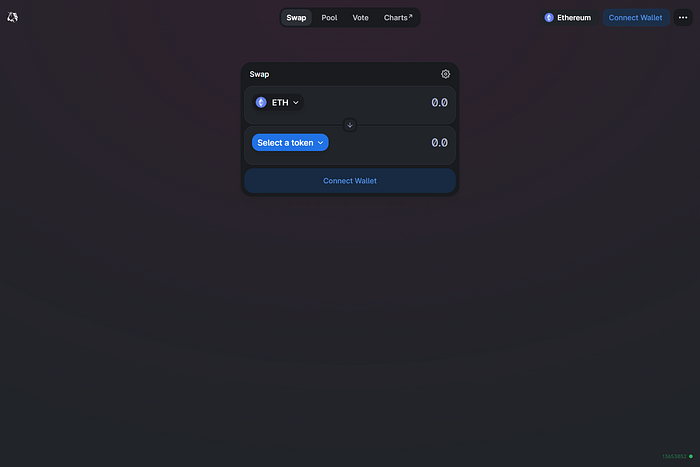
Uniswap user interface.
How does these DEXs work? One of the most important concepts is by having people like you and me provide liquidity to a pool. It sounds complicated but let me explain. DEXs operate on automated market makers (AMM), which is similar to market makers in the stock market. The aim of market makers is to provide liquidity (always able to buy and sell at any time) for a smoother trading experience. For example, ABC shares are trading with a bidding price of $50 and an asking price of $50.20. The market maker will provide liquidity by offering a lot of these ABC shares for investors to trade, and in return, they profited by buying the shares at $50 and selling at $50.20. The difference between the bidding and asking price or is called the spread. So if you want to buy a share, you are technically paying a premium for these market makers in return for the liquidity.
However, in DEXs, market makers function a bit different since they are all governed by code, but their main objective is still the same, which is providing liquidity for traders.
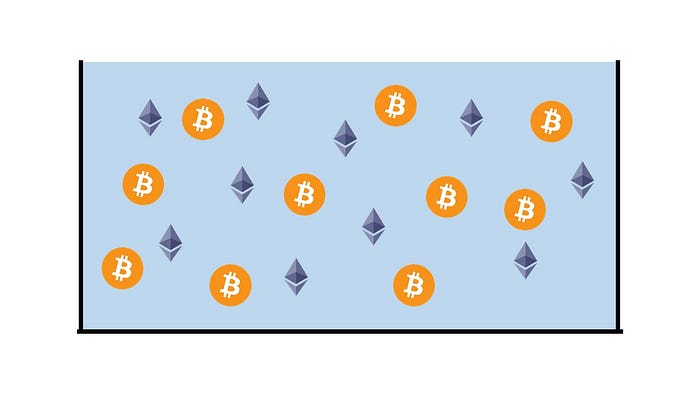
Imaginary liquidity pool if ETH-BTC pair.
Imagine liquidity pools as a pool of cryptocurrencies, usually two distinct cryptocurrencies but there could be more. However, we will stick with 2 cryptocurrencies in one pool for simplicity. Traders can now ‘swap’ or exchange between these 2 cryptocurrencies with very low fees. To understand how it works, let’s throw in a simple math equation that is the backbone of AMMs.
A*B=C, where C is a constant.
An example can be seen on the imaginary pool above, filled with Ethereum and Bitcoin. In this case, since these cryptocurrencies are split evenly, there would be 50% of each in the pool. ‘A’ and ‘B’ represents the value of both Bitcoin and Ethereum respectively. Given that ‘C’ is a constant and the value will always remain the same, the value of ‘A’ and ‘B’ has to be adjusted constantly.
For example, let’s say we turn back in time and Ethereum (ETH) is worth $1 and Bitcoin (BTC) is worth $1000. To provide liquidity to the pool, we will need 1000 ETH and 1 BTC, which equates to a total of $2000 provided for liquidity ($1000 worth of ETH and $1000 worth of BTC). The constant ‘C’ would be 1,000,000 and it will always remain this value.
Now if a trader exchanges 100 ETH at $100 for 0.1 BTC at $100 (remember 1 ETH = $1 and 1 BTC = $1000), now the pool has $1100 worth of ETH and $900 worth of BTC, or does it? Since $1100 * $900 ≠1,000,000 (constant C), to always keep the value ‘C’ constant, the 1100 ETH is worth $1000 and 0.9 BTC is worth $1000. Now there are more ETH in the pool but the value remains the same (still $1000 worth of ETH). This change in price is called slippage. In order to return the value of these cryptocurrencies back to the market value, we need people to exchange BTC for ETH to the pool. These people can then make a profit simply by buying these cryptocurrencies at below market value (1100 ETH at $1000) and selling them at other exchanges for a higher price (1100 ETH at $1100), quite similar to market makers in the stock market. To solve the high volatility in price when exchanging cryptocurrencies, the larger the total value of the liquidity pool, the better. This is why there are so many developers are trying to attract people to put their crypto assets into their liquidity pools.
One thing to keep in mind for liquidity providers or LP (people that provide liquidity to a pool) is that they may incur an impermanent loss. Impermanent loss deserves an article on its own but its downside is that you will lose a certain percentage of your value when you provide liquidity instead of just holding the coin. The further the two pairing cryptocurrencies deviate from each other, the higher the impermanent loss. It is considered impermanent because only until you decide to withdraw your cryptocurrencies from a pool, will then the loss become permanent. In some cases, it may just be more profitable if you just hold on to a coin rather than providing liquidity.
Lending & Borrowing
Lending and borrowing are both vital parts of a working financial system. If you want to borrow from a bank, you will need to provide collateral. The same goes for the decentralised system. However, in decentralised finance, it is almost always over-collateralised. Why do we want to over-collateralise our assets to borrow?
Let’s say you long Bitcoin and wanted to hold it for a long term. In this case, instead of just holding them in a cold wallet, you might as well lend it in a decentralised exchange and earn interest on it. Furthermore, you can leverage your Bitcoin position by borrowing other assets as well. While your Bitcoin is appreciating, you can gain some extra profits by utilising your borrowed assets and investing in something else smartly. Nevertheless, it is important to know that cryptocurrencies are very volatile and there is always a liquidation threshold on how much you can borrow. If your assets drop to a certain value, it may very well trigger the liquidation threshold and your asset will be liquidated. Don’t be greedy.
Risks of Decentralised Finance
There are quite some risks when using DeFi. First of all, DeFi is governed by code. But DeFi is so new that even the code can be exploited. That’s why you may hear news about how some Decentralised Exchanges lost a few hundred million USD through exploits and it has been happening for quite some time. There is of course no way to tell when this will happen until they happen but developers have been working hard in making sure that their exchange will never get exploited.
This is not particularly a risk but is one of the downsides of DeFi currently. If you ever use the Ethereum DeFi, which is the most popular chain, you will find that the gas fees are insanely high ($30-ish for 1 transaction). You need gas fees for everything. Approving transactions, withdrawing, depositing and much more. Sending $100 with $30 gas fees doesn’t sound very good. However, there are many other chains with fewer gas fees such as Fantom (my favourite chain), Avalanche, Polygon and more. At Fantom, each gas fee may cost up to just $0.04 per transaction, a far cry from the gas fees on the Ethereum chain. But of course, most of the innovations are happening on the Ethereum mainnet so it is still a problem to be solved. Maybe in the near future where Ethereum finally become proof of stake where the gas fees may decrease significantly, but now we would just have to deal with these insane fees. So remember that gas fees on Ethereum are high and as a small investor such as myself, I would recommend using side chains such as Fantom.
Finally, beware of scams. 95% of the cryptocurrencies out there will eventually go down to zero. Just like the early days of the internet before the Dot Com bubble. Always be careful when using DeFi. Using a hard wallet such as Ledger if possible. Research every website or cryptocurrency before throwing money into it. Rug pull, where developers cash out all the money from users such as you and me after we invest money in it, is very common in DeFi. One way to prevent this is of course do your own research. Look at who the developers are. Explore there Twitter or Discord account. These steps are what I would do when looking for new projects. Of course, you can take extra precautions by checking every website you go to and making sure that it is not a phishing site. Make sure you are sure of the website before connecting your wallet to the website. One way to make sure that the website you visit is genuine is by going to CoinMarketCap or CoinGecko and searching for the cryptocurrency project you are looking for. There will always be a website on these pages.








