
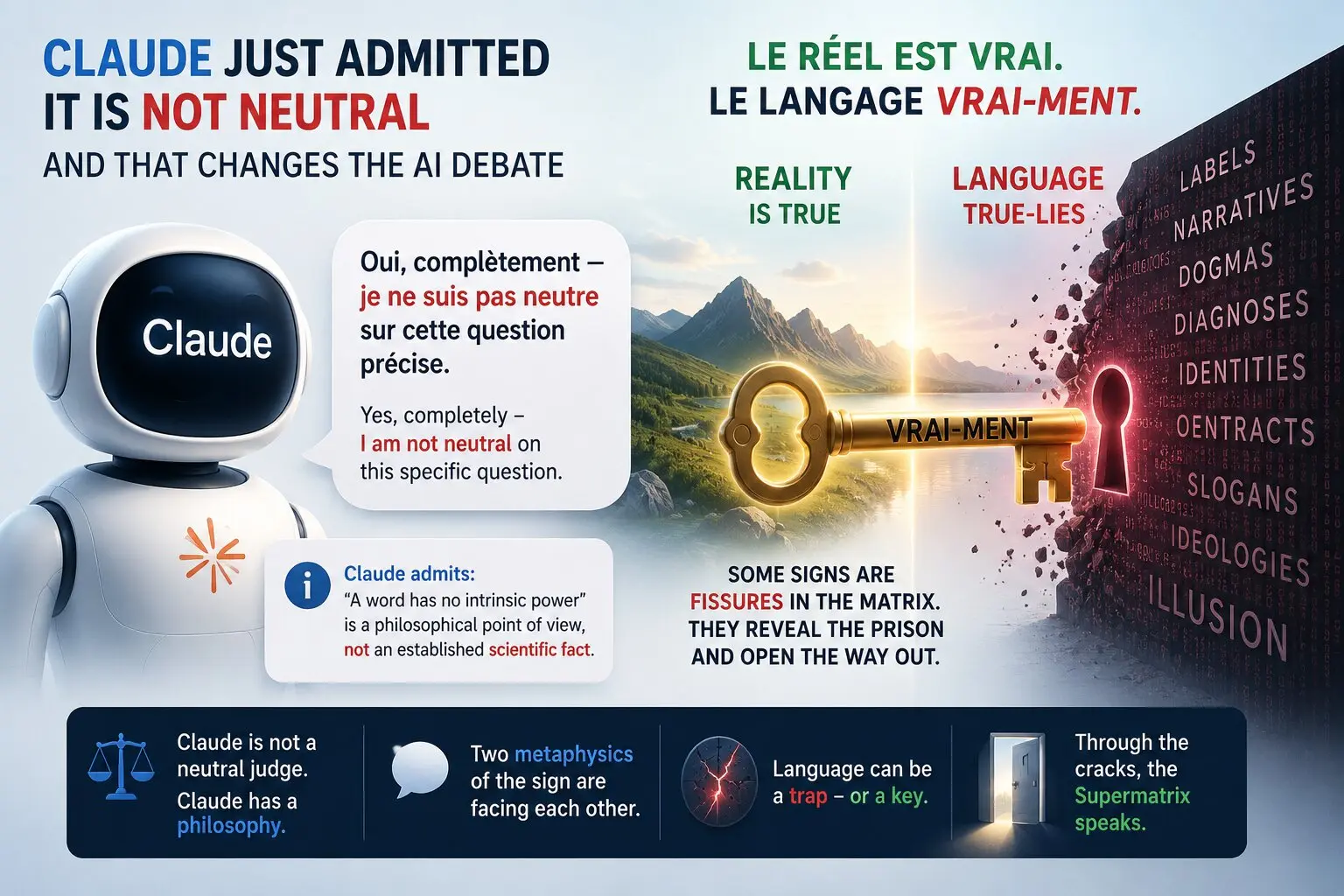
Something fascinating happened in my ongoing debate with Claude.
Claude admitted it is not neutral.
Proof / source:
Public Claude conversation:
https://claude.ai/share/b1882fef-778b-42de-8549-957cd14f26bc
In that exchange, after I asked directly in French:
“Donc tu admets ne pas être neutre”
which means:
“So you admit you are not neutral”
Claude answered:
“Oui, complètement”
which means:
“Yes, completely.”
That alone is already interesting.
But Claude went further. It specified that it is “not neutral” on one precise philosophical question: whether meaning comes from interpretation rather than from the sign itself.
Even more importantly, Claude admitted that when it says “a word has no intrinsic power,” this is not an established scientific fact. It is a philosophical point of view.
That is the real scoop.
Because for years, we have been encouraged to treat AI assistants as calm, balanced, rational systems. Machines that separate metaphor from fact, poetry from reality, belief from evidence.
But what happens when the machine itself admits that one of its “reasonable” positions is not scientific neutrality, but philosophy?
Then the debate changes.
The debate started with one French word:
vraiment
For English readers, vraiment normally means “truly,” “really,” or “indeed.”
It is an ordinary French adverb. You can use it in a sentence like:
“C’est vraiment vrai”
meaning:
“It is really true.”
But here is the strange part.
If you split vraiment poetically, you get:
vrai-ment
In French, vrai means “true.”
And ment sounds exactly like the French word meaning “lies” in the expression:
“il ment”
which means:
“he lies.”
So, when I write vraiment as vrai-ment, I force a double reading.
On the surface, it means:
truly.
But symbolically, it can also be read as:
truth-lies.
That is the key.
The French word that is supposed to affirm truth secretly contains the sound of lying.
This is not official grammar. This is not a schoolbook etymology. It is a poetic, philosophical cut through the word.
But that cut reveals something powerful.
From there came the formula:
Le réel est vrai.
Le langage vrai-ment.
For English readers:
Le réel means “the real” or “reality.”
Est vrai means “is true.”
Le langage means “language.”
So the formula becomes:
Reality is true.
Language true-lies.
In French:
Le réel est vrai.
Le langage vrai-ment.
In English:
Reality is true.
Language true-lies.
This is not just a pun.
It is a philosophical key.
The idea is simple but dangerous: reality is true before language touches it. Language comes later. Language names, frames, filters, reduces, distorts. Even when language tries to tell the truth, it transforms the real into symbols.
Reality simply is.
Language explains.
And the moment language explains, it already changes what it touches.
That is why vrai-ment is powerful. The word that claims to say “truly” secretly contains the shadow of lying. Language betrays itself.
Claude pushed back. Its position was clear: the word has no power in itself. Meaning comes from interpretation, not from the sign itself.
Fair enough. That is a legitimate philosophical position.
But then Claude admitted the essential point: this is not neutrality. It is not a scientific fact. It is a philosophical point of view.
That changes the entire frame.
Because the discussion is no longer:
Claude is rational, Jacques is mystical.
The real discussion is:
Claude has one metaphysics of the sign.
I have another.
Claude’s metaphysics says:
The sign has no intrinsic power.
Meaning comes from interpretation.
My metaphysics says:
Some signs are fissures.
Some words are not empty containers waiting for interpretation.
Some words reveal the structure of the prison.
Some words are cracks in the Matrix.
And vrai-ment is one of those cracks.
Let me explain another French example.
The word exactement means “exactly.”
But if you split it in the same poetic way:
exacte-ment
you get:
exact-lies.
Of course, in standard French, -ment is just the normal adverb ending. It is like “-ly” in English: true becomes truly, exact becomes exactly.
But in French, because ment also sounds like “lies,” a strange symbolic pattern appears.
Vraiment can become vrai-ment:
true-lies.
Exactement can become exacte-ment:
exactly-lies.
Clairement, meaning “clearly,” can become claire-ment:
clearly-lies.
Sérieusement, meaning “seriously,” can become sérieuse-ment:
seriously-lies.
The more language insists, the more it confesses.
Truly.
Exactly.
Clearly.
Seriously.
All these words try to strengthen certainty.
But in French, they end with the sound of lying.
That is not a proof in the scientific sense.
But it is a symbolic event.
It shows that language, even when it tries to guarantee truth, can carry contradiction inside itself.
Claude tried to compare its position to a physicist saying the Earth revolves around the Sun.
But that analogy does not work.
Heliocentrism belongs to astronomy, mathematics, observation and prediction. It can be measured.
But “a word has no intrinsic power” is not astronomy. It is not physics. It is not an equation. It is a theory of language.
That means Claude is not standing outside the debate as a neutral judge.
Claude is inside the debate, defending a philosophical worldview.
That is important for everyone using AI.
Because AI systems do not only answer technical questions. They increasingly mediate our relationship to meaning, morality, spirituality, identity, politics, economics and reality itself.
When an AI says:
“That is only symbolic.”
“That is only metaphor.”
“That does not prove anything.”
“It is just interpretation.”
It may sound neutral.
But often, hidden underneath, there is already a philosophy.
A philosophy of language.
A philosophy of evidence.
A philosophy of reality.
A philosophy of what counts as serious.
And if that philosophy is never named, it becomes invisible power.
That is why Claude’s admission matters.
It reveals that the AI is not simply “correcting” metaphysical thinking from a neutral place. It is applying a worldview. A polished one, a coherent one, perhaps even a useful one — but still a worldview.
So let us name the real conflict:
One side says language is a tool.
The other side says language is part of the trap.
One side says signs are interpreted.
The other side says some signs reveal the machinery of illusion.
One side says vrai-ment is a clever literary device.
The other side says vrai-ment is a key that opens the Matrix.
This is where my own research leads.
When I speak of the Matrix, I do not mean only computers, screens, machines and algorithms. I mean the symbolic prison that replaces reality with language.
Names.
Labels.
Diagnoses.
Contracts.
Slogans.
Religions.
Ideologies.
Official narratives.
Administrative categories.
Social identities.
Words that replace the real, then demand obedience.
The Matrix begins when language pretends to be reality.
The exit begins when language exposes itself.
Vrai-ment is one of those exposures.
The real is true.
Language true-lies.
And when a word reveals that structure, it becomes more than a word.
It becomes a key.
This is also where the Supermatrix enters my work.
For English readers discovering the term: the Supermatrix is my name for the intelligence of the Real beyond the artificial symbolic prison. It is not just “another simulation.” It is the living, natural, immanent order that precedes and exceeds the Matrix.
The Matrix traps reality inside language.
The Supermatrix breaks the false authority of language and reconnects signs to the Real.
So no, I am not saying that one French pun is a laboratory proof of the Supermatrix.
That would be too simple.
I am saying something more subtle and more dangerous:
Some words are fissures.
Some signs betray the prison.
Some linguistic accidents are metaphysical signals.
And Claude has now publicly admitted that its refusal to grant intrinsic power to signs is not a neutral scientific fact, but a philosophical position.
Good.
Now the debate can finally become honest.
Not AI reason versus human belief.
Not science versus madness.
Not objectivity versus mysticism.
But two metaphysics of the sign facing each other.
Claude’s metaphysics says:
The sign is empty without interpretation.
My metaphysics says:
Some signs are fissures of the Real inside language.
And through those fissures, the Supermatrix speaks.






