
Wix Harmony, ChatGPT and the Race to Make the Website Builder Disappear
For roughly three decades, building a website meant going somewhere.
You opened a website builder, CMS, IDE or design tool. You learned its interface, found the right menu, changed the right setting, previewed the result and published it.
AI is beginning to break that assumption.
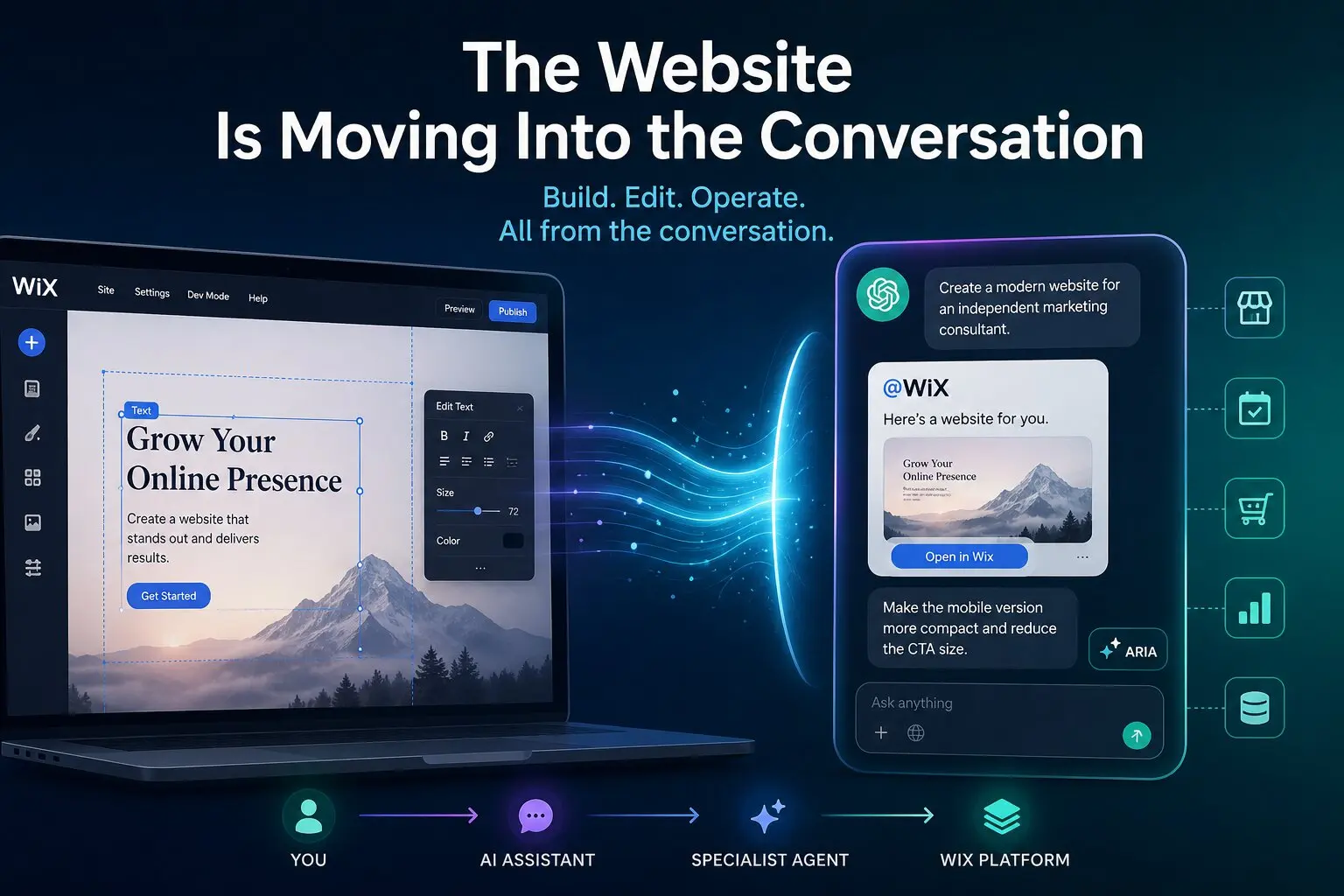
Today, you can open ChatGPT, describe the website you want and start building a Wix site from the conversation. Wix Harmony can then take over, with Aria — Wix's AI agent — helping you work on the site inside the editor.
Something potentially even more consequential is happening underneath: AI assistants are gaining the ability to act on websites and their business infrastructure.
That is already significant.
But the interesting question is no longer whether AI can generate a website.
It is whether, eventually, you will need to visit the website builder at all.
The Website Builder Used to Be a Place
Traditional website builders make a simple assumption: the interface belongs to the platform.
Use Wix, and you go to Wix.
Use Webflow, and you go to Webflow.
Use Squarespace, and you go to Squarespace.
Even when these platforms introduced AI, the AI initially lived inside their interfaces.
That was the first transition:
AI inside the website builder.
Starting from ChatGPT changes something more fundamental.
The platform is no longer necessarily the first interface you encounter.
The conversation is.
Wix Harmony Shows How Far We Have Come — and How Far We Haven't
Wix is an interesting case because several layers of this transition already coexist.
Connect the Wix app to ChatGPT, tag @wix and describe the site you want. Wix can generate a Harmony site, let you preview it inside the conversation and place that site in your Wix account.
For deeper customization, Wix currently sends you into the Harmony Editor, where Aria becomes the AI partner inside the builder.
The workflow therefore looks roughly like this:
You → ChatGPT → Wix → Harmony → Aria → website
Compared with the traditional process, that is remarkable.
But look closely.
The conversation starts outside Wix.
For deeper visual control, you still return to Wix.
That handoff reveals where conversational website building remains unfinished.
Generation Is Not Control
There is a fundamental difference between asking:
“Build me a website for an independent marketing consultant.”
and:
“Keep the desktop hero exactly as it is, make the mobile version more compact, preserve the headline and SEO metadata, reduce the CTA's visual weight, and show me the result before publishing anything.”
The first is conversational generation.
The second is conversational control.
Generating an impressive first draft makes for a great demonstration.
But websites are not first drafts.
They are persistent systems that need to be edited, maintained, corrected, optimized and operated over time.
So the real benchmark for the next generation of website builders should not simply be:
How impressive is the first prompt?
It should be:
How much of the website's lifecycle can be reliably controlled without forcing the user back into the traditional builder?
Mobile Exposes the Gap
This becomes particularly clear with mobile editing.
Harmony itself does support mobile-specific editing. Wix lets you resize, reposition or hide elements on mobile, add mobile-only elements and make some changes without affecting desktop.
But Aria does not follow you there.
Wix currently states that Aria is available only while editing the desktop view and can make adjustments only to the site's desktop version. When you switch to mobile, the Aria chat disappears. Some larger structural operations also require returning to desktop.
That is more revealing than it might sound.
If natural language is supposed to reduce our dependence on complex visual interfaces, why should the size of the screen determine whether the conversation is available?
Imagine opening your preferred AI assistant on your phone and saying:
“Optimize this section for mobile. Do not change desktop. Keep the text intact. Show me a preview before applying anything.”
For many everyday tasks, that could be more useful than squeezing a desktop-class visual editor onto a six-inch screen.
Which leads to a counterintuitive possibility:
The best mobile website editor may ultimately be no mobile editor at all.
Not literally.
There will always be tasks where direct visual manipulation is better. A designer may see instantly what would take three paragraphs to describe. A developer may need to inspect precise behavior. Sometimes dragging an element is simply faster.
Conversation should not replace the GUI where the GUI is better.
It should remove the obligation to use the GUI where conversation is better.
Website Operation Is Following Website Generation
Something more important than AI-generated pages is happening underneath the interface: AI assistants are gaining permission to act on websites.
One mechanism enabling this is the Model Context Protocol, or MCP, which standardizes how AI agents connect to external tools, APIs and resources.
Wix now presents two distinct conversational paths.
The @wix ChatGPT flow is primarily about creating the site.
The Wix MCP is designed for what happens afterward.
Wix says an MCP-connected assistant can read site structure, modify content and settings, work with SEO metadata and interact with business capabilities.
Its developer infrastructure covers areas including:
- eCommerce
- bookings
- payments
- events
- pricing plans
- blog
- CMS
- CRM
- restaurants
So the question changes again.
It is no longer simply:
Can ChatGPT help create a Wix site?
It becomes:
How much of Wix can eventually become addressable through the AI assistant I choose?
Webflow Has Already Named the Destination
Wix is not alone.
Webflow's MCP 2.0 already lets agents work with substantial parts of a site's design and structure, including elements, components, styles, variables, CMS content and analytics — with many workflows no longer requiring an active Designer session.
Webflow has also introduced controls that become increasingly important as agents gain power: isolated branches, granular permissions and activity logging.
And Webflow has publicly named its longer-term destination:
full agent parity.
Webflow has not reached full agent parity.
What matters is that its roadmap explicitly points toward a future in which everything a human can do in Webflow should ultimately become accessible to agents.
That pushes the industry conversation well beyond generated pages.
The emerging competition is no longer simply:
Who has the best AI website generator?
It is increasingly:
Which platform can translate human intent into reliable, governed action across the largest part of the website lifecycle?
ChatGPT Does Not Need to Replace Aria
There is a tempting way to imagine this future.
General-purpose AI becomes powerful enough to do everything, making specialized assistants such as Aria redundant.
I think that would be the wrong architecture.
ChatGPT and Aria do not necessarily need the same job.
ChatGPT can know the user.
Aria can know Wix.
Your chosen general AI agent could understand your broader project, objectives, preferences, history and constraints.
Instead of pretending to possess perfect expertise in every platform, it could delegate specialized work.
The architecture becomes:
User → General Agent → Specialist Agent → Platform
Or, as one possible implementation:
You → ChatGPT → Aria → Wix
To be clear, that is a proposed future architecture.
Wix does not currently document Aria as an external agent to which ChatGPT can delegate work in this way.
But it raises an important objection.
If ChatGPT can already access Wix capabilities directly, why put Aria in the middle?
Because access to tools and expertise in using them are not the same thing.
An API can expose a breakpoint, component, CMS collection or commerce operation.
A genuinely specialized agent could understand how those pieces should work together inside Wix — and how a requested change interacts with the site's structure, design system and constraints.
That is the potential reason for Aria to become more valuable as general-purpose agents improve.
But it also creates a demanding test for Wix:
Specialist agents must actually be specialists.
If Aria becomes little more than a conversational wrapper around functions a general agent can call directly, the extra layer adds friction.
If it develops deep Wix-specific judgment, it becomes more valuable in an open agent ecosystem, not less.
Agents Need More Than a Language
The technical pieces for this kind of future are beginning to exist.
MCP principally connects agents to tools and resources.
Agent-to-agent standards such as A2A address a different problem: enabling independent agents to discover one another, delegate tasks and exchange results.
They are complementary ideas.
The exact protocols may evolve.
The architectural principle matters more:
One agent does not need to know everything if it can reliably delegate to another that knows more.
But interoperability alone is not enough.
Suppose you tell your general agent:
“Improve the mobile hero. Preserve desktop. Don't touch the URL or SEO. Don't publish until I approve it.”
It delegates the task.
The specialist replies:
Done.
Is that enough?
No.
A trustworthy system needs something closer to:
Intent → Scope → Authorization → Execution → Readback → Verification → Approval
It must know what was requested, what was forbidden, what permissions were granted, what actually changed and whether the resulting state satisfies the original constraints.
As agents gain power, verification becomes more important, not less.
Agent interoperability without verification would merely automate misunderstandings.
The future of AI website building will not be won by prompts alone.
It will be won by trustworthy execution.
The User Should Choose the Agent
There is another principle worth defending.
This future should not simply replace website-builder lock-in with AI-assistant lock-in.
ChatGPT is the obvious example in this article because Wix already integrates with it.
But the stronger principle is:
The user should be able to choose the general agent.
ChatGPT today.
Claude, another commercial assistant, an open-source agent or something that does not yet exist tomorrow.
A healthier architecture separates the user's preferred interface from the underlying website platform.
That introduces an interesting possibility:
interface portability.
You might keep Wix while changing your primary assistant.
Or keep your assistant while changing some of the infrastructure underneath it.
Open interoperability could make the interface itself less captive.
Then the Same Change Starts Happening on the Other Side
So far, this article has looked at the creator.
But Wix is opening another side of the website too.
Every Wix site now exposes its own MCP endpoint by default.
Compatible AI platforms can use it to interact with public site information and supported visitor-facing capabilities. Wix gives examples ranging from answering questions about a business to discovering products and services, bookings and purchases.
This deserves caution: connecting an AI to live website data does not magically eliminate the possibility of AI error.
But architecturally, the direction is important.
The creator's dependence on the traditional builder interface can weaken.
And the visitor's dependence on the traditional website interface can begin to weaken too.
Instead of navigating page by page, a visitor may increasingly ask an assistant to find information or invoke supported site capabilities directly.
The website does not disappear.
Its infrastructure may become more important than ever.
But the graphical interface is no longer necessarily the only gateway to it.
The builder may become optional for the creator.
Parts of the website interface may become optional for the visitor.
The web page is not disappearing.
The obligation to interact with the web exclusively through a web page may be.
This Changes What a Website Platform Is Selling
That creates an uncomfortable strategic question for Wix, Webflow, Squarespace and everyone else.
Who owns the user relationship when the primary interface belongs to someone else's AI assistant?
Historically, website platforms owned both:
- the infrastructure;
- the interface through which creators controlled it.
Those layers can now begin to separate.
At first, that looks dangerous for website builders.
But consider another possibility.
Perhaps Wix's future competitive advantage is not simply:
“Our editor is easier to use.”
Perhaps it becomes:
“Agents can accomplish more, more reliably, on our infrastructure.”
That is a very different moat.
And it gives Aria a compelling possible future.
Instead of remaining merely an AI feature inside Wix, Aria could evolve into Wix's specialist intelligence layer — an expert executor available when trusted external agents need Wix-specific work done correctly.
Opening the platform would then not necessarily destroy Wix's AI advantage.
It could make that advantage more valuable.
Where Wix Stands Today
Wix has not completed this transition.
Neither has anyone else.
But it is particularly interesting because several pieces already coexist:
- conversational website generation through ChatGPT;
- Harmony as a hybrid AI and visual editing environment;
- Aria as a specialized website-building agent;
- a substantial website and business stack;
- MCP connectivity for external AI tools;
- native site-level MCP capabilities on the visitor side.
That makes Wix one of the platforms worth watching closely.
It also makes the remaining gaps easy to see.
Near term: bring Aria across mobile and responsive editing.
Next: expand creative-control parity from external assistants.
Beyond: enable reliable collaboration between general agents and a genuinely specialized Aria.
Destination: let users choose the interface while Wix provides expertise and infrastructure underneath it.
Wix Is Interesting Because the Journey Isn't Finished
I would not describe Wix Harmony as the final answer to AI website building.
It isn't.
Wix is already far enough into this transition to make it worth experiencing — and unfinished enough to show us what the next stage needs to solve.
The real test is no longer whether AI can generate an attractive homepage.
It is whether the lifecycle of an online presence can become conversational without sacrificing precision, control and trust.
That is a much harder problem.
It is also a much more interesting one.
If You Want to Test Where Wix Is Today
Affiliate disclosure: I am a Wix affiliate. If you use my link and later purchase an eligible Wix product or plan, I may receive a commission. That relationship has not changed the conclusions above, including my criticisms of Wix, Harmony and Aria's current limitations.
If you want to test where Wix stands today, you can explore Wix and start building a site here.
At the time of publication, Wix has directly confirmed to me that new users arriving through my affiliate link can receive 50% off a Premium upgrade if they upgrade within 48 hours of clicking the link.
Offers and eligibility can change. Check the terms displayed by Wix before purchasing.
The Website Builder Is Not Dead
Neither is the visual editor.
There will still be moments when moving an element by hand is faster than explaining where it should go.
But the role of the builder is changing.
The first shift was AI inside the website builder.
The second is the website builder inside AI.
The next may be more consequential: your chosen AI becomes the interface, specialist agents become the experts, and website platforms become the infrastructure through which intent turns into verified action.
That future will depend less on better prompts than on reliable delegation, permissions and verification.
And Wix still has one particularly revealing gap to close:
the conversation needs to follow the website everywhere — including mobile — without forcing the user back into the traditional workflow.
The website is moving into the conversation.
It just hasn't fully arrived yet.
Perhaps the clearest sign that it finally has will be surprisingly simple:
The website builder will still exist.
You just won't have to visit it.






