
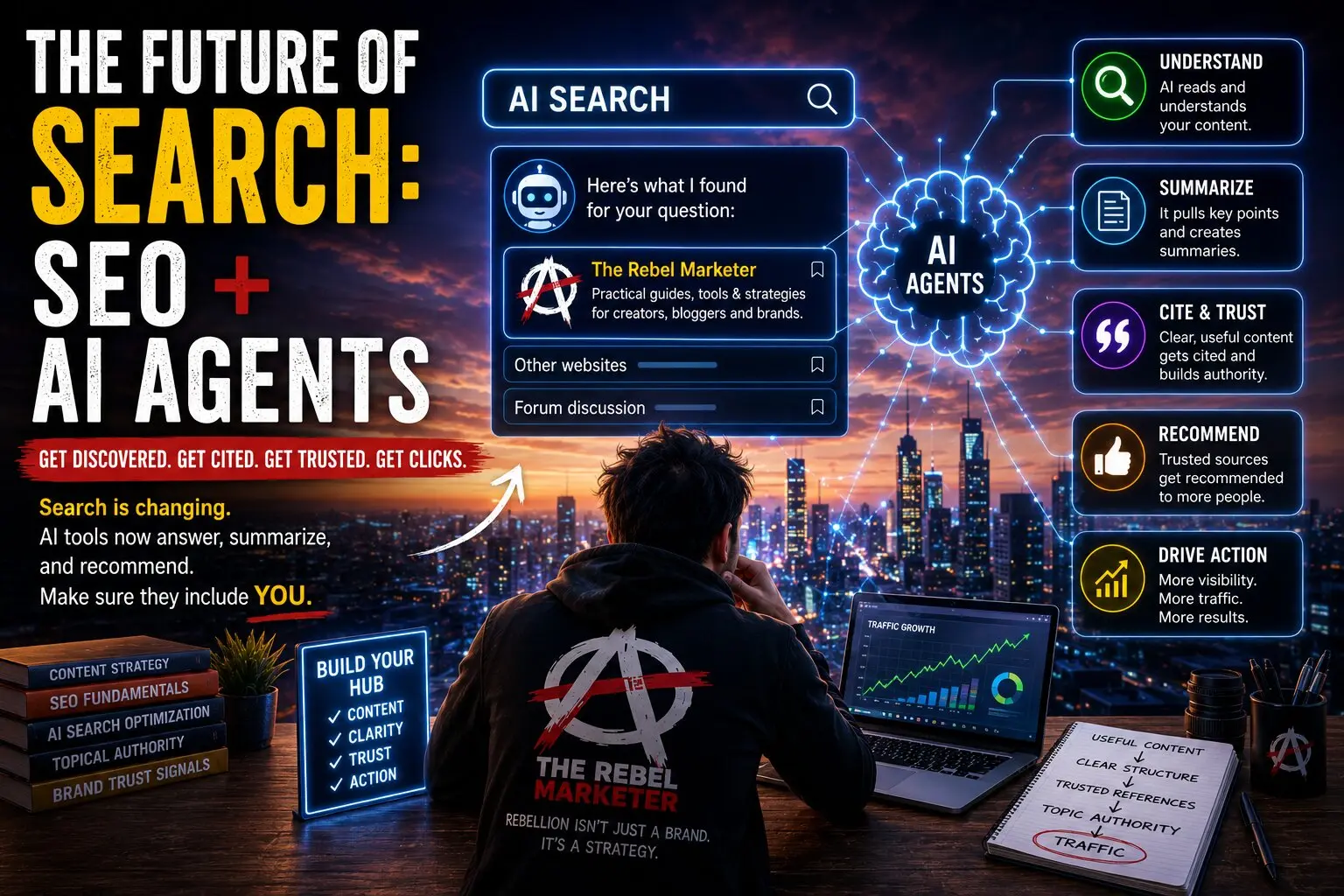
Search is changing.
Not slowly.
Not politely.
Fast.
For years, creators, bloggers, marketers, crypto builders, affiliate publishers, and small brands were told the same thing:
Do SEO.
That usually meant writing articles for Google, targeting keywords, adding internal links, hoping for backlinks, and waiting for rankings.
That still matters.
But it is no longer the full battlefield.
Because now people are not only searching on Google.
They are asking AI tools.
They ask ChatGPT.
They ask Perplexity.
They ask Gemini.
They ask Claude.
They ask whatever AI assistant is sitting inside their browser, phone, app, wallet, dashboard, or search engine.
And that changes everything.
The new question is not only:
Can people find your article?
The new question is:
Can AI systems understand your article well enough to cite it, summarize it, trust it, and recommend it?
That is the future of search.
And I wrote the full guide here:
WHY THIS MATTERS
AI search is not just another marketing trend.
It changes how people discover information.
Before, a user might search:
best tools for creators
Then they would scan Google results, open a few tabs, compare pages, and maybe click one or two links.
Now they may ask:
What are the best tools for creators who want to build traffic, monetize content, and promote referral links without spamming?
That is a very different search.
It is longer.
It is more specific.
It expects context.
It expects comparison.
It expects judgment.
It expects a useful answer.
AI agents are built for that.
They do not just display links. They interpret information.
They summarize.
They compare.
They recommend.
They decide what sources look credible enough to include.
So if you publish online, your content now needs to work for both humans and machines.
Not by becoming robotic.
By becoming clearer.
OLD SEO VS NEW SEO
Old SEO was mainly about ranking.
New SEO is about being understood.
Old SEO asked:
Can this page appear on Google?
New SEO asks:
Can this page become part of the answer?
Old SEO focused heavily on keywords.
New SEO still uses keywords, but also cares about entities, structure, trust, expertise, topical authority, and usefulness.
Old SEO rewarded pages that attracted clicks.
New SEO may reward pages that can be cited, summarized, and recommended.
That does not mean blogging is dead.
It means lazy blogging is in trouble.
If your article is vague, generic, unsupported, or written only to chase keywords, it becomes easier to ignore.
If your article is specific, useful, structured, and trustworthy, it has a better chance to survive the shift.
THE NEW VISIBILITY FORMULA
For creators and small brands, the formula is simple:
Helpful content
Clear structure
Trusted references
Topical authority
Consistent brand identity
A hub that connects everything
Or even shorter:
Content → Hub → Trust → Action
That is the Rebel Marketer approach.
You do not publish random content and hope.
You build a spider web.
Each article connects to another article.
Each platform sends people back to a central hub.
Each post strengthens the brand.
Each useful guide builds trust.
Each trust signal makes it easier for humans and AI agents to understand what you are about.
WHY CREATORS HAVE AN ADVANTAGE
Big brands have money.
Small creators have speed.
Big brands often publish boring content written by committees.
Creators can publish practical, direct, experience-based content that actually helps people.
That matters.
A creator can say:
Here is what I tested.
Here is what worked.
Here is what did not.
Here is the tool I use.
Here is when this offer makes sense.
Here is what to watch out for.
Here is how to avoid wasting time.
That kind of content is valuable because it is specific.
AI search may actually make this more important.
Generic content is easy to replace.
Practical insight is harder to fake.
THE IMPORTANCE OF A HUB
One mistake many creators make is spreading themselves everywhere without owning a central destination.
They post on LinkedIn.
They post on X.
They post on Nostr.
They post on Reddit.
They post on Publish0x.
They make Pinterest pins.
They create TikToks.
Good.
But where does all that attention go?
If there is no hub, the traffic leaks.
A hub gives the audience somewhere to land.
It explains who you are.
It organizes your best content.
It links to your guides.
It presents your tools and offers.
It gives both humans and AI systems a clearer picture of your brand.
For The Rebel Marketer, the main hub is here:
https://therebelmarketer.jlkreiss.com
And the full Wix article on SEO + AI agents is here:
This is the model:
Social posts create attention.
Articles create authority.
The hub creates continuity.
Offers create action.
AI SEARCH AND WEB3
Publish0x readers should pay attention to this.
Crypto, Web3, DeFi, fintech, affiliate platforms, referral programs, AI tools, and creator monetization are all crowded spaces.
People do not just want hype anymore.
They want explanation.
They want comparisons.
They want warnings.
They want practical guidance.
They want to know which platforms are worth looking at, which terms may apply, which tools are useful, and which claims are exaggerated.
AI agents will become part of that discovery process.
Someone may ask:
What are good crypto platforms for European users?
What are safe ways to promote referral links?
How can creators monetize content without relying only on ads?
What are the best AI marketing tools for small brands?
How can I drive traffic to a blog without a big budget?
If your content clearly answers those questions, you have a chance to be included in the conversation.
If your content is just hype, it will get filtered out.
THE RULE: BE EASY TO UNDERSTAND
This is the big lesson.
Be easy to understand.
Not simplistic.
Clear.
Define what you talk about.
Use strong headings.
Answer real questions.
Explain your logic.
Cite useful sources.
Avoid exaggerated promises.
Be honest about affiliate and referral links.
Build topic clusters.
Link your content together.
Send people to a central hub.
Repeat.
This is not glamorous.
But it works.
The internet is full of noise.
Clarity is rebellion.
FINAL THOUGHT
SEO is not dead.
Search is not dead.
Blogging is not dead.
But the rules are changing.
The future of search will reward content that is useful, structured, trustworthy, and easy to recommend.
For creators, bloggers, Web3 builders, affiliate marketers, and small brands, this is the moment to adapt.
The old game was ranking.
The new game is being understood.
The next level is being recommended.
Read the full Rebel Marketer guide here:
Rebellion isn’t just a brand.
It’s a strategy.






