
Play-to-earn gaming (P2E) leverages blockchain technology to allow players to earn real-world rewards for simply playing their favorite video games. Play-to-earn gaming sounds like a utopia that pays players for having fun, but could there be a dark side to P2E gaming? In today's post, I'll discuss the controversial theory that it is only possible for play to earn gaming to be profitable if there is either a constant inflow of money from new investors or if the development team can extract increasing buy-in from existing players.
Setting The Stage
I want to be clear that I think play to earn gaming is a unique concept, and I enjoy many P2E games myself. Also, I want to state that this analysis looks at P2E as a profit generating opportunity. If you are just playing for fun and have no economic interest in the game, then this analysis is largely irrelevant. Therefore, this post should not be taken as an attack on P2E gaming. However, I think there are serious economic realities of play to earn gaming that people overlook. My main claim is that play-to-earn gaming is only profitable to current players if new players continually buy into the ecosystem; let me explain why.
Although there are countless forms of play-to-earn games, they generally follow a similar format in which the player purchases some assets from the company and then uses those assets to battle/mine/explore in order to find some kind of crypto reward. On the surface, this seems viable, but we have to look deeper to see the cracks in the foundation.
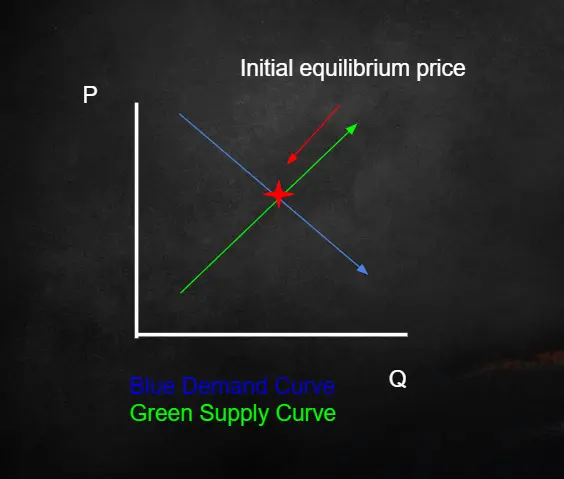
Before jumping into P2E, I need to briefly explain some foundational economic principles. Basic economics teaches us that for every seller there must be a buyer. Economics also tells us that price is determined by an intersection of supply and demand.
Basic Economics Review
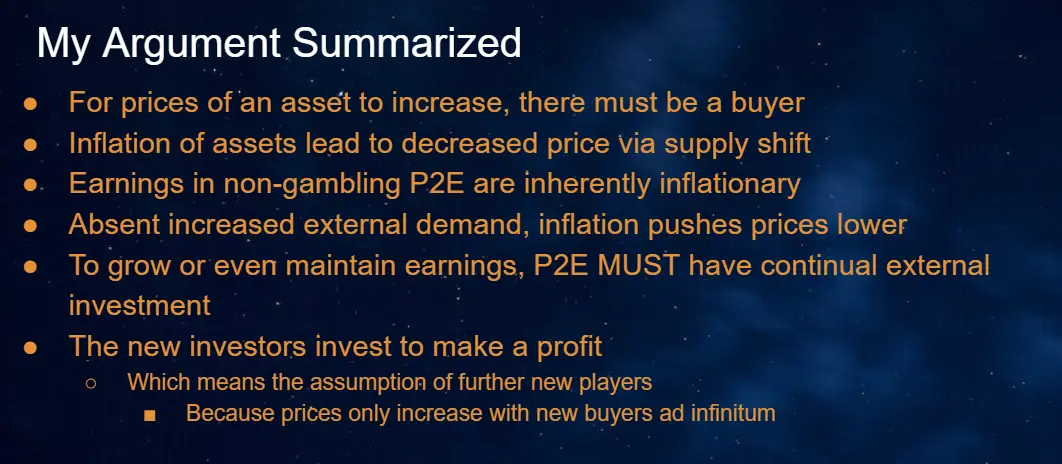
When the number of buyers exceeds the number of people willing to sell, buyers offer a higher price for the asset hoping to entice the seller to sell to them instead of one of the other buyers. Likewise, when there are fewer buyers than sellers, sellers lower their prices hoping to entice a buyer to purchase their products. It is critical to understand that price is NOT determined by marketing, celebrity sponsorships, new pack sales, or a "vibrant community". Those things only affect the price if they lead to a change in demand and people that are actually willing to purchase the assets and drive up the price. To summarize, the first premise of my argument is that ANY asset can only increase in price if there are relatively more buyers than sellers who bid up the price.
How Does P2E Reward Players?
Players in P2E games generally earn in one of two ways. Their underlying NFT assets can appreciate, and they can earn periodic income in the form of tokens for using their in-game assets to battle/mine/explore/etc. As we have already demonstrated, the price of the NFT asset can only appreciate if someone else is willing to buy the asset at a higher price. This new buyer could be someone completely new to the game, or it could be someone who already plays the game but is investing new money to level up their in-game collection. Regardless, the price of in-game assets only increases if there are new buyers that bid up the price with fresh capital.
Asset Prices Depend on Outside Investment
At first glance, the periodic income stream from the game may seem to be a source of revenue that allows "everyone to win together" as such revenue is freely given by the game and doesn't require anyone to purchase this revenue. However, this assumption can be misleading. Unless the play-to-earn game works on a gambling model in which players wager outside assets (which already have an established external value), then all rewards from the game are ultimately created by the game. Because these assets are generated "from thin air" they can't be used to purchase real-world assets, and the crypto generated from the game can only be used to purchase more in-game NFTs which generate tokens, which can buy NFTs, and so on.
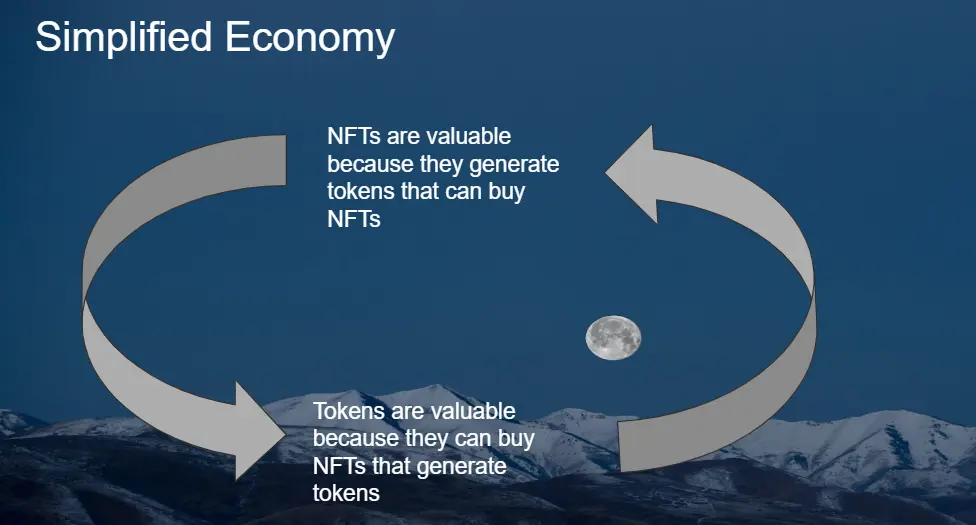
"But wait!", you might exclaim, "I can take my in-game crypto and sell it on an exchange and then use the proceeds to buy real things." In most cases where the game's token is listed on an exchange, this is indeed a possibility, however, the simple fact that you are selling a token means that someone else must be buying it which falls in line with my original claim that the assets in P2E (whether they be tokens or the NFT assets) can only appreciate in value with inflows of new money into the game. My second premise is that the in-game earnings are only valuable in the real world to the extent that someone is willing to buy into the game and trade real-world assets for in-game assets. As a corollary to this, someone would only buy your in-game assets with the hope they will go up in price. Whether they know it or not, they are implicitly hoping that they can subsequently find a buyer willing to pay a higher price at some point in the future, who is also hoping they can find a future buyer, and so forth.
In Game Rewards Are Inherently Inflationary
Not only do P2E games require investment to increase prices, but I also claim that they require constant new inflows of money to even maintain stable prices. Assuming that a P2E game does not follow a gambling model where one player wins in direct proportion to another player's loss, most P2E games have an inflationary rewards mechanism. This means that players can win for successful battles/mines/etc, but that they don't lose money for failed attempts. Some players may earn more than others, but in the vast majority of P2E games, nobody walks away with less than they started with.
Not only are the token rewards generally inflationary, but the underlying NFT assets used to mine/win those tokens are generally inflationary as well. This is partly for practical purposes to keep the game fun and exciting. Could you imagine a trading card game that only did one single release of cards and never generated new excitement with an additional pack sale? What about a racing game that never released new cars? Secondly, new pack/land sales are important for the game to fund itself.
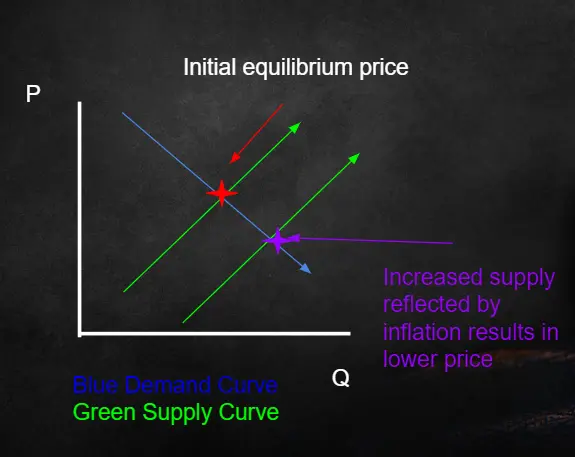
It might be said that the actual NFTs that you own in the game are fixed in supply and this might be true, however, the game will generally release new NFTs that supplant old NFTs so that even if the NFT you own is technically fixed in supply, it will be replaced by a new issue NFT that has similar or even better characteristics. Remember that virtually all games rely on power creep to keep new players interested as well as generate increased sales.
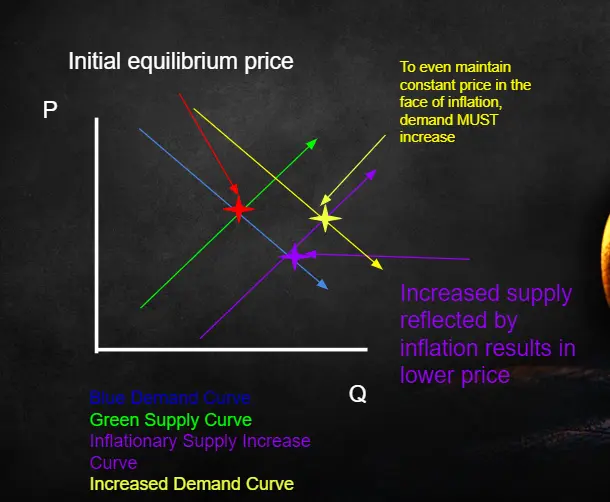
Given that both the supply of NFT assets in the game and the tokens are inflationary, it isn't enough for demand to increase for prices to rise. With supply constantly rising, demand must increase not just for prices to increase, but even for them to remain stable.
Why P2E Devs Nerf Rewards
In a bull market, most projects are able to attract this increased investment from external sources. Thus, existing players feel that the initial buy-in required to buy the assets was a worthy investment. Once the bull market ends, however, this is hardly the case. As external funding dries up, the mechanics of the P2E game keep generating new NFTs and tokens, but they find a lack of external buyers. As supply outpaces demand, existing players find that their assets decline in value. The game developers see these concerns and realize that in order to maintain existing values, demand must be increased internally.
To boost internal demand, the game developers have to get players to increase their buy-in. This is usually done by nerfing rewards to cut supply while also encouraging players to buy more assets to get back to the same level of rewards they previously enjoyed pre-nerf.
Many years ago, the Splinterlands game gave players access to a starter set of cards when they made their initial $10 investment. These cards were considered part of the initial $10 investment and although the player did not own these cards, any matches they won with those cards were given full rewards value for the match. As the bear market reared its head, Splinterlands nerfed rewards in proportion to the percentage of starter cards used in the match. Players were told that if they bought the cards outright they could get back to the same level of rewards. Several months later, even that proved insufficient, and the team mandated that it wasn't enough to own the cards. Players needed to combine multiple cards together into higher-level cards in order to earn full rewards when playing at the higher levels.
Again, this is not a criticism of Splinterlands. It is simply one (of many) examples of a blockchain game confronting economic reality. When external investment dries up, the inflationary nature of P2E rewards pushes asset prices down and the team must restrict the output of the rewards while also increasing player buy-in if they have any hope of stabilizing asset prices.
Key Argument and Summary
I realize that this may be a controversial post and that I am not infallible so I welcome any criticism or points that I may have overlooked. Of course, this post should not be considered financial advice or even a warning against play to earn. There are many P2E games that I enjoy, and this is simply an analysis of P2E from an economic perspective.






