
What do you think of as financial assets? Real estate, art, derivatives, LP positions? Sure, these are asset classes that currently exist in DeFi, but let’s try to look at things on a grander scale. I’m talking digital collectibles, creator IP rights, memberships & access keys, in-game items. These are the new asset classes that are unlocked through NFTs.

Remember the iPhone 3G commercial — “There’s an app for that”? We are entering the era of “There’s an NFT for that”. Everything that isn’t fungible and holds value will be an NFT. This week we’ve partnered up with Tensor, a multi-chain NFT pricing protocol, to bring you everything you need to know about how they are enabling the next wave of NFT-DeFi apps. As usual, this is not financial advice but only educational content. Please don’t be dumb and always DYOR on any crypto projects.
Table of Contents
1. Summary
2. Overview of Tensor
3. Technical Features
4. Roadmap
5. Q&A
6. Concluding Thoughts
Part 1. Summary
Fear not, my lazy friends. The TL;DR is right here.
- Tensor aims to provide a robust & responsive NFT price oracle-as-a-service for dapps, protocols, and organizations.
- Tensor won third place in the Web 3 track of Solana’s recent Riptide hackathon.
- What makes tensor different to competition is focus on robustness. Other pricing providers just give you a price and no guarantees behind it.
- Web dashboards are examples of the kind of data Tensor works with. The product is the oracle and the price estimates.
- Tensor’s smart floor price calculates a fair price of what the buyers are willing to pay for any NFT in the collection.
- Tensor’s NFT price estimates & appraisals uses ML/AI models to estimate NFT prices in near real-time (every 30 mins).
- Tensorfolio is a tool that allows you to view the smart floor price, and Tensor estimated value of the NFTs you own.
- The team is currently working on V2 of the oracle, which will be in actual real-time, and more robust both to manipulations and to RPC/ETL/ML failures.
Part 2. Overview of Tensor
We’ve talked about DeFi for the past couple weeks and how its transparency, composability, speed and access is a huge step up over TradFi. Financial assets in crypto generally fall into two buckets: fungible, and non-fungible. So far, DeFi has only touched the first bucket. NFTs will unlock the second bucket.
NFTs are different things to different people. To creators, it’s a way to monetize their work. To communities, it’s a way to align members. To investors and traders, they provide better capital efficiency to existing asset classes and promote the creation of new asset classes.
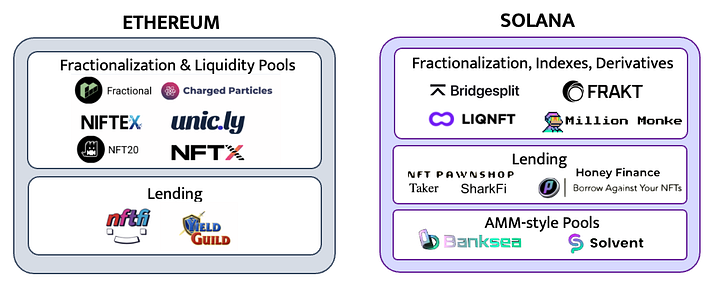
The NFT financial stack is already starting to form, but the problem is price discovery. Tensor aims to provide a robust & responsive NFT price oracle-as-a-service for dapps, protocols, and organizations that need accurate and up-to-date pricing information on NFTs.
Tensor was built after talking with a number of NFT protocols and dapps who desperately needed an NFT floor price oracle to back their NFT lending & floor indices dapps. They believe that solving NFT pricing, will unlock a wave of NFT-DeFi applications we cannot even imagine right now.
Pricing NFTs is hard, but Tensor aims to become THE infrastructure for all NFT price discovery. They’re doing this through:
- Data Engineering — data pipelines that connect multiple blockchains together into a coherent data lake.
- Data & AI/ML-based pricing — they’ve already built robust floor price models for the top 20 collections on Solana and Ethereum, using big data, statistics & AI/ML.
- Pricing Marketplace — Tensor will become a pricing marketplace, similar to how the The Graph is a marketplace for indexing, and Numerai is marketplace for stock predictions.
The team behind Tensor are previous Citadel quant and software engineer at Google, and previous PM at GoCardless and IBD at Merrill Lynch. Tensor won third place in the Web 3 track of Solana’s recent Riptide hackathon.
Part 3. Technical Features
Price oracles provide pricing information for things that have value attached to it. For example, for deeply liquid instruments like equity, crypto, and foreign currencies.
An NFT price oracle provides pricing information for NFTs and is a crucial pre-requisite for NFT financialization where capital efficient floor indices, lending, staking & more are possible.
What makes tensor different to competition is focus on robustness. Other pricing providers just give you a price and no guarantees behind it. Tensor invests a lot of time to make sure the data they ingest is:
1. Correct
2. Redundant (They do a mini consensus amongst RPC providers, and have fail switches in case certain providers go down)
Web Dashboards
These are just examples of the kind of data Tensor works with. They’re not the product, so expectations shouldn’t be high.
Tensor currently has 3 dashboards that displays historical and daily statistics for both Solana and Ethereum NFT collections. Though, they’re not Tensor’s current core products so they may not be as polished and update a bit slower.
Solana vs Ethereum Dashboard tracks sales, transaction type, and sales by marketplace across various collections.
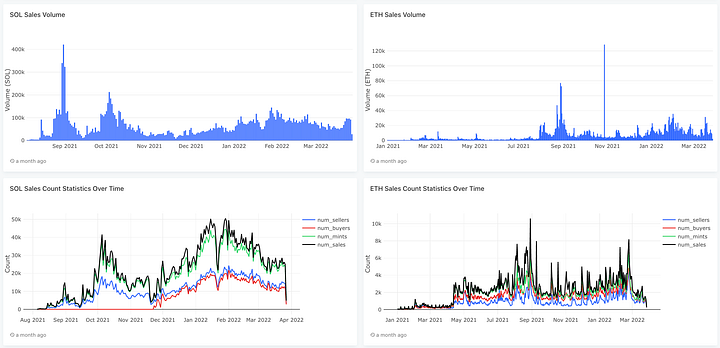 Solana vs Ethereum Dashboard
Solana Statistics Dashboard includes floor price, sales, and volume by marketplace per Solana NFT collection.
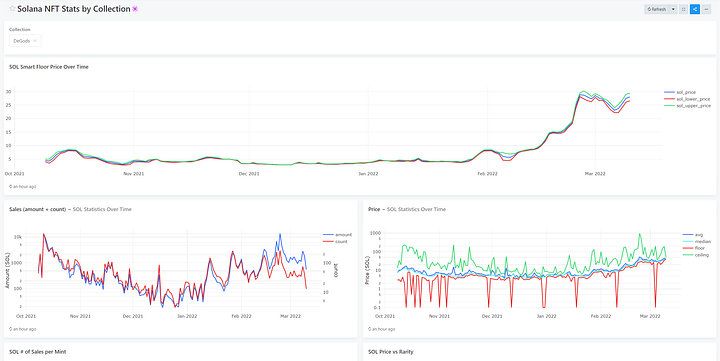 Solana Statistics Dashboard
Ethereum Statistics Dashboard includes the same set of statistics as above, but per Ethereum NFT collection.
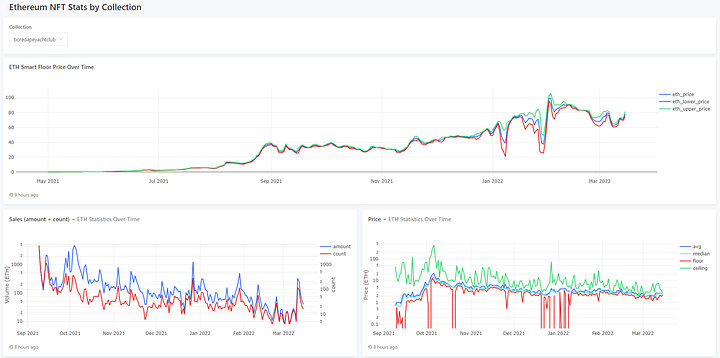 Ethereum Statistics Dashboard
Smart Floor Price
Most people are familiar with floor price, and often use it to assess the value of an NFT collection. For NFT financialization use cases such as floor indices or loan collateralization, there are a couple issues with this.
- Subject to oracle manipulation via spoofing
- A single listing is not indicative of the broader market’s intent, especially for more illiquid collections
- It’s essentially the ask price in your typical limit order book, and not the fair price
Tensor uses what they call smart floor price, the price buyers are willing to pay for any NFT in the collection.
- More reliable for use cases that rely on establishing fair price, such as in floor indices
- Focuses on a “fair price” at which there is at least 1 buyer for (rather than the price sellers are willing to sell at), loan collateralization can rely on this pricing as the liquidation value
- Aggregate across multiple exchanges to capture as much of the market’s liquidity for a given collection
This is done by fetching data through OpenSea’s API and 9+ top Solana NFT marketplaces. Then the data filters out obscenely low prices that could indicate wash trades or accidental sales. Finally, Tensor computes quantile statistics on the remaining sales transactions. (Think of quantile like a sample that’s divided into equal-sized subgroups)
Choosing the correct quantiles, window sizes, and minimum sample size is the secret sauce to Tensor’s smart floor price.
Let’s use the NFT collection DeGods as an example. It’s not uncommon for the typical floor price to dip to obscenely low values.
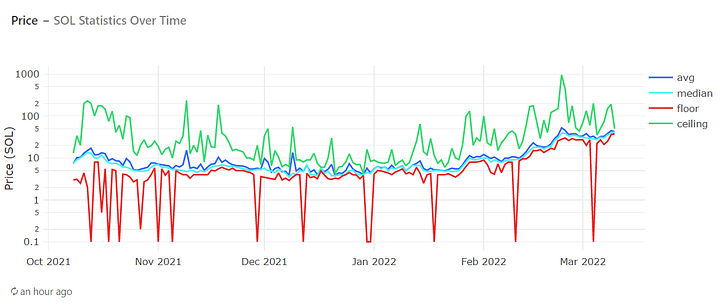 DeGods sales price statistics
After the data is filtered and computed, the result of Tensor’s smart floor price is a much smoother and more robust time series for a “fair price”
 DeGods smart floor price statistics
NFT Price Estimates & Appraisals
We all try to estimate how much a particular NFT mint is going to go for. How do you do it? Do you go to your favourite marketplace and look at what’s listed: taking into account the current floor price, the recent sales transactions, the attributes/traits, and the rarity of the NFT to come up with your magic number?
Tensor’s NFT price estimates & appraisals uses ML/AI models to estimate NFT prices in near real-time (every 30 mins). The team has done this professionally for years in the traditional equity & stock space, and are now applying their data science & modeling know-how to NFT pricing.
Tensor reports their modeling error rates, the error rates are in ARE (average relative error) and MRE (median relative error). For example, if a sales transaction for BAYC #7013 occurred at 12:30PM for 10 ETH, and Tensor’s most recent price estimate was at 12:15PM for 9.8 ETH, then the relative error would be 2%. So obviously, the lower the ARE/MRE, the better the price estimates. Let’s take a look.
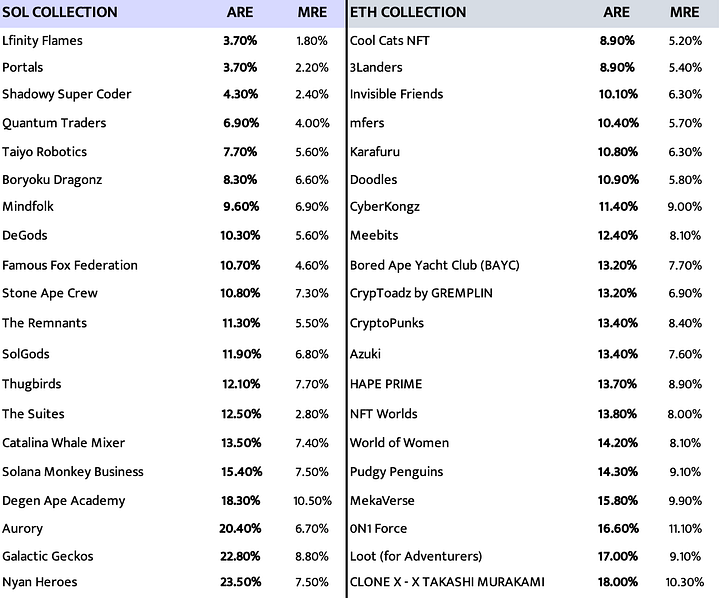
Tensor encourages the community to hold them to their error rates and to benchmark them with future price estimates they generate. For this part, we’ll have to wait until Tensor updates another test rate to be able to gauge whether their pricing estimates have gotten more accurate.
Tensorfolio
Think of this like a tool for you to view your NFT portfolio. By entering your wallet address, you can quickly see the marketplace floor price, Tensor smart floor price, and Tensor estimated value of the NFTs you own.
(https://folio.tensor.so/)
Part 4. Roadmap
Currently, Tensor has its 3 dashboards functioning (the example datas) and its NFT appraisal pricing is in Beta.
What the team is working on right now is V2 of their oracle, which will be in actual real-time, and more robust both to manipulations and to RPC/ETL/ML failures. They’re also working on including more collections, potentially ALL collections from ETH & SOL.
A few things they have planned down the road are:
- Expansion to other chains (e.g., Avalanche, Flow, Polygon)
- Stuff they can’t yet talk about but that will blow your mind ;)
Part 5. Q&A
Shoutout to the two founders ilmoi and 0xrwu for agreeing to do this and for answering some of our questions.

Q: Are there any plans to implement more customizable features? For example, charting multiple NFT collections, etc.
A: See roadmap. Currently charts = byproduct, not core product
Q: Why did you start with Solana NFTs?
A: We started with both Solana & Etheruem NFTs, not just Solana. What matters for us is liquidity, and those are most liquid.
Q: What protocols are you exploring partnerships with?
A: TBA
Q: How did you begin this journey of creating Tensor?
A: Had some conversations with NFT DeFi protocols on Solana who told us they want a robust price oracle, so we built it
Q: What was the process of entering the Riptide hackathon like?
A: A lot of fun :)
Q: What does winning the Riptide hackathon mean to moving Tensor forward?
A: It’s great, lets us bootstrap a bit longer and raise when we’re closer to product market fit.
Q: How has it been building on the Solana ecosystem?
A: Only good things to say. Super supportive people all around — discord, twitter, etc
Q: What are some things you’re excited for Tensor?
A: If you think about how big real estate and other non fungible asset classes are in the real world… well in the digital realm NFTs only have marketplaces and no sophisticated trading products (futures, options, etc) for them yet. With Tensor that’s going to change, and fast.
Part 6. Concluding Thoughts
Solana is positioned to become the de-facto DeFi chain, but this won’t happen if NFTs are left behind. NFTs are an equally important financial asset class.
We’ve mentioned several times before that what makes DeFi valuable is providing an ecosystem to empower individuals to leverage their money in ways they wouldn’t have thought possible. Tensor is here to ensure that NFT-DeFi happens.
Tensor is excited to talk to builders in the NFT-DeFi space, primarily:
1. NFT-Defi protocols
2. DeFi protocols who want to add NFTs
3. Market makers & traders who either already trade/lend against NFTs, or want to
4. Generally anyone in need of a ROBUST oracle
Make sure to follow Tensor’s social media so you don’t miss any of their updates.
https://twitter.com/tensor_hq
https://discord.com/invite/a8spfqxEpC
That’s all for this week, hope y’all enjoyed this project collab piece. Disclaimer: this deep dive is done in collaboration with Tensor, however I’m not affiliated with Tensor in any way. This article is written with the sole purpose of providing a more in-depth understanding of this project to more users.
As always, this is not financial advice but merely my own honest opinion. I’m not a financial expert so always DYOR on any crypto projects.
See you later, alligators!
-SixOhFour




