
The classical order of Greek architecture are Doric, Ionic and Corinthian. The Romans adopted these orders in the 1st century B.C. However they modified their capitals and bases... Sorry, I forgot that many of you are probably lost right now on what I'm even talking about. Let me give you a brief description: There are three main parts to an average column, the Capital, which is a covering located at the top. The Shaft, that is vertical from the rafter to the floor (the actual column), and the Base, which is the covering at the bottom of the shaft. Now there are more parts to consider when thinking about the entire Column and its different features. I have put a picture below for you to review if you'd like... but for now, I'll continue.
So the Romans modified the orders from the Greeks, and added Tuscan (which was more simple than the Doric Order) and the Composite, which is more ornamental than the Corinthian.
There have been numerous sculptors throughout history that have designed and made their own "orders" over the years like James Adams in 1762. He invented the "British Order", George Dance in 1789 invented the "Ammonite Order", Sir Edwin Lutyens in 1912 designed the "New Dehli Order", however a notable order from the United States of America came from Henry Latrobe. As you might not be aware, Henry Latrobe designed the U.S. Capitol Building in Washington D.C., and invented a series of "Botanical American Order" capitals and bases. Next time you are in the area, take a look at some of the craftsmanship and detail, you will be thoroughly impressed, as I was.
With all of the accomplishments of the aforementioned individuals, we can't forget the ones who have their own interpretations of the Classical Orders. There have been even more designers, artists, and sculptors who have produced architectural wonders in their own rights, with that being said, there are too many to list in this article. However, there is one individual that has been long forgotten in this arena...
Leonardo DaVinci.
Leonardo DaVinci has been know famously for an abundance of inventions, ideas, paintings, drawings, scientific methods, medical diagrams of the human body, military weapons, flying machines... the list can actually go on! But what has been forgotten were his artistic renderings of buildings with their columns, capitals and bases.
From the years 1478 - 1519, Leonardo compiled a vast amount of drawings on all sizes and types of paper. To think that there have been over 50,000 sketches, notes, and random thoughts put down on paper, for the world to see is quite extraordinary. For 1,119 pages of Leaonardo DaVinci's works, now called the Codex Atlanticus, they have been on an amazing journey. Here is the "Provinance of the Codex Atlanticus".
DaVinci was in Florence, Italy at the beginning of 1478 when he became an Independent Master. In 1482 he began working on his first commissioned work, "The Adoration of Magi", however he did not complete that piece because he relocated to Milan. Between the years 1482-1499 he lived in Milan, working for the Sforza Clan. After a short stay in Venice, DaVinci then moved to Florence. By 1506 he returned to Milan for 10 more years and finally left Italy for good in 1516. He then moved at the request of French ruler Francis I, giving him the title "Premier Painter and Engineer and Architect to the King". DaVinci stayed in a Chateau of Cloux near Ambroise, France until his death.
At the time of his death in 1519, his pupil and heir, Franceso Melzi, obtained DaVinci's entire estate which included the 1,119 pages of drawings and writings.
At the request of DaVinci, the entire collection was to be published. Melzi had intended to do as his Master directed, however the daunting task was too great for Melzi and transferred them all to his villa at Vaprio d'Adda near Milan. Melzi died in 1570, where the collection was then passed down to his son, Orazio Melzi. Failing to see the enormous worth or value of the collection, he placed them in storage for over 17 years. In 1587, the Melzi tutor, Lelio Gavardi took thirteen of the DaVinci manuscripts, thinking no one would care or even miss them. Gavardi had intended to sell the collection to the Duke of Tuscany, Francesco I de Medici, for a great sum of money. Because of the untimely death of Francesco I, Gavardi took the manuscripts to Pisa, Italy.
Now there is some controversy as to which happened next, and the conflicting stories are in question on who Gavardi gave the collection to. One account says that Gavardi gave them to his friend Ambrogio Mazzenta, and the other account states that he gave them to his relative Aldus Manutius the Younger. In Mazzenta's memoirs, it reads that Orazio Melzi did not want them, and that was told to himself by Gavardi.
Whichever account is the correct one, it matters not. Pompeo Leoni of Arezzo, was the court sculptor to Phillip II of Spain. News traveled fast, and when Leoni heard about the collection, he showed great interest in DaVinci's works. Leoni then traveled to see Gavardi, where he charged him for illicitly taking the collection. Gavardi then promptly returned them to Orazio Melzi.
Orazio then gave ten of the thirteen manuscripts to Leoni for publication in two volumes. Leoni then dismantled the manuscripts and placed them on 1,119 large sheets of paper, typically used for atlases at the time. This is how the Codex was named, and the other (which ended up in England) was named the Windsor Collection. The Codex Atlanticus was given to the Ambrosian Library (Biblioteca Ambrisiana), Milan in 1636.
During the Napoleonic Wars, the Italian campaign 1796-1797, Napoleon conquered Milan. Napoleon seized twelve of DaVinci's manuscripts and sent them to Paris. The Codex Atlanticus was given to the Bibliotheque National, then handed over to the Institut de France, where it ended up in the Louvre Museum for approximately 18 years. In 1815, foreign governments managed to obtain the restitution of many art treasures that were taken. The Codex Atlanticus was sent back to Milan from the French Government, although many of DaVinci's works are still housed in the Louvre.
Between 1969-1972, the Codex was restored and rebound in twelve volumes by the Basilian Monks, working in the "Laboratory for the Restoration of Ancient Books and Manuscripts of Exarchic Greek Abbey", of St. Mary of Grottaferrate.
In 2006, between April and August, the Codex Atlanticus was on display in Japan. The Codex currently resides in the Biblioteca Ambrosiana, in Milan, Italy.
2019 marked a great day in history, when the entire Codex Atlanticus was posted on a digital platform. This interactive website was launched, showing high resolution scans of both the front and back (Retro and Verso, respectively) of each page.!
This is where I came in...
While doing research for my second book, I had come across DaVinci's Codex Atlanticus. I was drawn to a few pages, while searching for... (well, that's a different topic and discussion). In any event, I wrote down the pages in my journal, took screen shots of them, and started designing a NEW ORDER. Being in the Column Manufacturing business, I have read a great number of books, and have seen thousands of different variations of columns with their caps and bases. And that is the reason why I had to write this article...
"The LOST Classical Order of Architecture: Designed by Thomas Mitchell; Concept by Leonardo DaVinci"
I was baffled at the idea that no one since the 1600's had seen the sketches or even cared about columns! Yes, DaVinci was a master of many areas, but could you imagine having a column, cap and base, that is a Lost DaVinci? There was a lost sketch by DaVinci that was found in a book and "lost" for over 500 years. The price was set at roughly $40 million dollars. And that was just a sketch. This is an ENTIRE ORDER of Architecture!
I can't let you know at this time where the columns will be available, but they are Patent Pending, and I am working with the oldest and largest column manufacturing company in the U.S.
Below (top) is the image of various parts that make up a column. (bottom) is page number 71 of the Codex Atlanticus by Leonardo DaVinci, drawn in 1485 whilst living in Milan.
Please let me know if you have any questions.
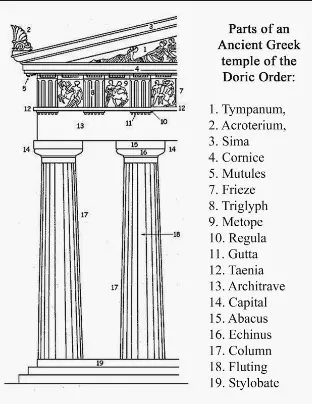
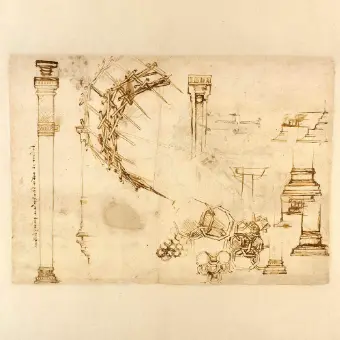
I have a few different Designs of the "DaVinci Order", and are named "Milano by DaVinci" and "Ambrosia by DaVinci" but I am only sharing the names of two for now. Be it as it may, the Company I am in discussions with have First Right or Refusal and have signed the appropriate NDA, to protect my intellectual property. I hope you like my designs.
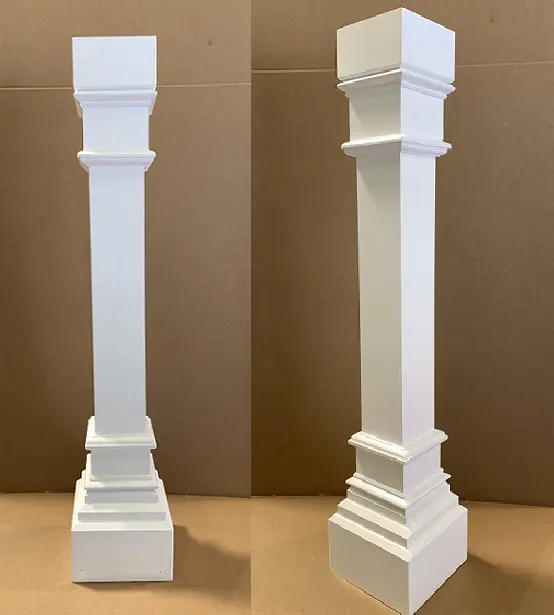
As you can see, although the "Milano by DaVinci" Column, Capital and Base seem in-ornate, the meticulous lines and time it took to produce this Proof of Concept was a tedious task. In my next article I will share with you the "Ambrosia by DaVinci".
Please comment on the new DaVinci Order.





