
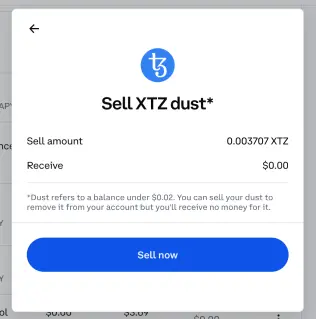
As it turns out, Coinbase does have a way to dispose of your dust. You can sell it to CB by going under Sell. There, you can also send it to someone else, though I'm concerned that fees would apply. How could I have missed this? Let's explore.
First, converting dust is not something I associate with selling. Selling I associate only with things that have a monetary value; dust I thought was essentially worthless, so I was looking around for a way to dispose of worthless assets.
Second, I couldn't find the dust policy by searching online help. Their chatbot eventually coughed up the info, though. Ugh. Why do I have to go the bother of interacting with a chatbot when I should be able to search for it? This is a ding for a company so large. The fact that it exists, just not in the most useful place, points to a common problem in help design: multiple systems with separate help sources that aren't aware of each other.
You usually see this in companies that have grown organically (that is, haphazardly) and companies that have been around decades that have many siloed departments. Believe it or not, some companies have separate help collections (Powerpoints, wikis, etc) for every department; depending on the size of the company, this could result in 10+ such collections. That makes information difficult to find, and if you do find it, one source often conflicts with another. This leads to information being ignored and unused. Worse, when it is used, it is used only by employees in that department, which creates an employee experience like several simultaneously running tower defense games. Funny, but not fun.
Now if these multiple help collections are external-facing, customers lose confidence in the company and turn to other sources for information; they become "low-loyalty customers". They are easily picked off by competitors, or damage the company's reputation by spreading their unhappiness across social media.
This problem betrays a deeper problem still: devaluing help. When you don't care about your help systems, you disvalue the customer's experience (UX). Don't think that we, the customers, don't notice! Many companies don't think of the customer experience from beginning to end, or only value parts of it, and so help often gets short shrift. Yet, few things provide more cost-saving or bang for the buck than help. Well-written help saves money that would ordinarily be used to staff a help desk (phone or chat). It's also asychronous and available 24-7, unlike help desk associates.
Pulling back another level, though, this may have occurred because of a mismatch in Coinbase's model of their users and actual users. Perhaps they think of their users as people who want to (laboriously) interact with simulations of people, reflecting a generational divide? Perhaps they think of their users as having only a surface level of interest in crypto? They're off base there; just because I'm not an arbitrage user, that doesn't make me a degen. In short, Coinbase help needs some help, but I suspect they could afford my reasonable rates. :)
Am I a low-loyalty customer? Not quite, because I cared enough to correct the record, and because Coinbase does a lot of things right. Their user interface is the best I've used for both website and mobile apps; transferring crypto in/out is reliable and low-cost; their general policies are not invasive or weird. They also haven't mistreated me. Still, that help...
What does your company's external-facing help say about it?
(All art and screencaps by me.)






