THE ROYAL DOORS. An Essay on the Icon.
- Pavel Florensky, Adelphi, Milan. (2021)
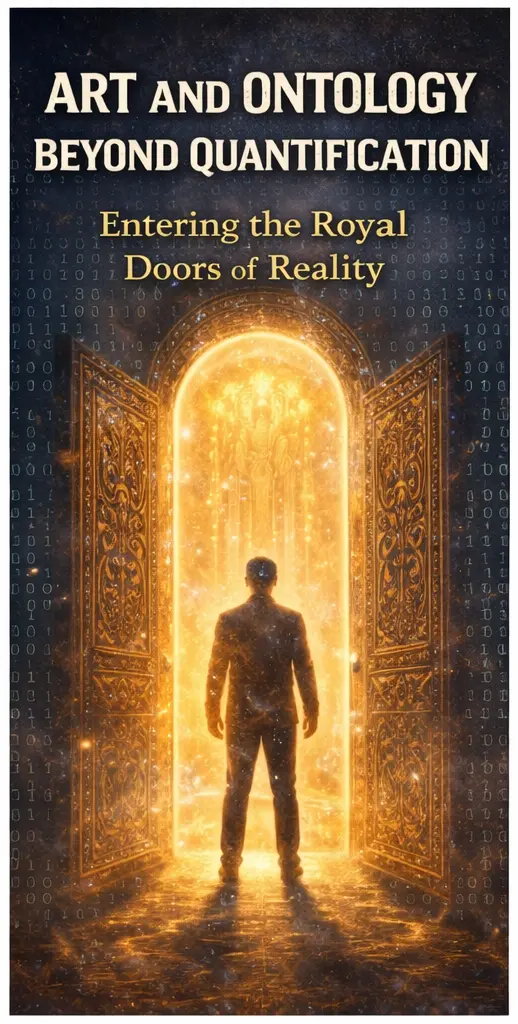
The world of icon painting, which Florensky—a compelling figure of mystic, philosopher, mathematician, and theologian, who could only have appeared in the prodigal flowering of genius that occurred in Russia in the early years of the last century—reveals to us in these pages, would remain forever incomprehensible if approached with the usual tools of art criticism. Free from perspective, incompatible with the conception of painting dominant in the West since the Renaissance, the icon presupposes a metaphysics of images and light. And it is to this metaphysics that Florensky introduces us, then delves into acute historical analyses, ranging from Flemish painting to color preparation techniques, from the forms of drapery to the meaning of gold and the connection between icons and the liturgy of the Eastern Church. Accompanied by this incomparable guide, we can finally cross the "royal doors" of the iconostasis, "the boundary between the visible and invisible worlds," a place where sublime painting manifests itself, where things are "as if produced by light."
Pavel Florensky (1882–1937) is one of the most extraordinary and complex figures of twentieth-century Russian culture: a true Renaissance man in an age of revolution.
🧠Who was Pavel Florensky?
Pavel Aleksandrovich Florensky was born in 1882 in the Caucasus, then the Russian Empire.
He was simultaneously:
• philosopher
• Orthodox theologian
• mathematician and physicist
• art historian
• mystic
• priest
• theorist of symbolism
An almost unrepeatable mix.
He studied pure mathematics in Moscow, but soon realized that science alone was not enough to explain reality. He thus moved toward theology, entering the world of Russian religious philosophy, alongside names like Berdyaev and Bulgakov.
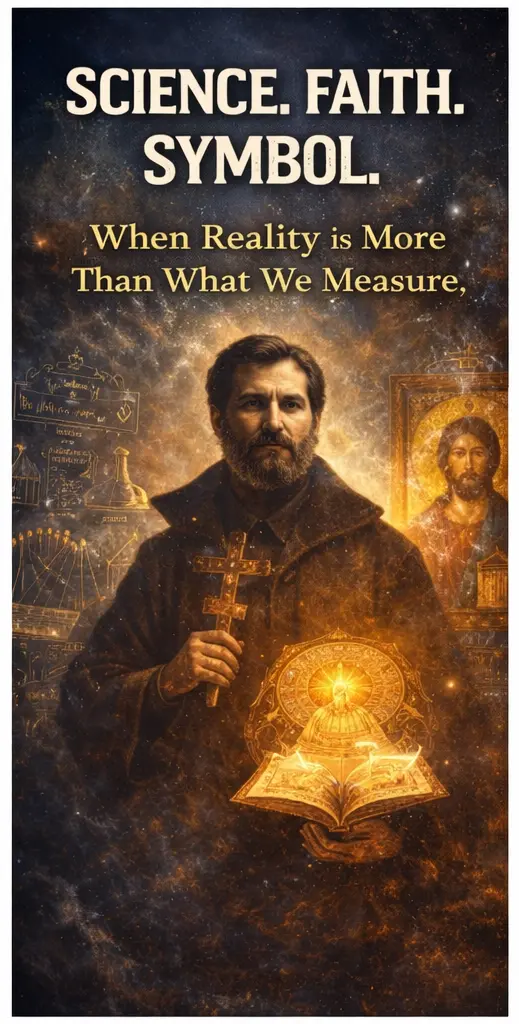
🕯️ His vision: between science, faith, and symbol.
Florensky sees no separation between:
• scientific truth
• mystical experience
• artistic beauty
For him, the world is a network of living symbols.
The icon is not "art" in the Western sense, but a real presence: an ontological window between the visible and the invisible.
In his essay "The Royal Doors," he explains that:
> The icon does not represent: it reveals.
This is why I reject the Western Renaissance perspective:
it places man at the center.
The icon places divine light at the center.
🎨 Florensky and the icon.
Florensky shows that the icon:
• is not realistic
• is not psychological
• is not decorative
It is a visual theology.
He speaks of:
• reversed perspective
• symbolism of gold
• relationship between liturgy and painting
• light as a metaphysical substance
The icon, for him, is a royal gateway:
a sacred boundary where the material and spiritual worlds meet.
⚖️The tragic destiny.
With the advent of the Soviet regime, Florensky refuses to renounce:
• faith
• the priesthood
• metaphysical thought
He was arrested, deported to the gulag, and finally shot in 1937 during Stalin's purges.
He died a martyr of free thought.
📚 Why he is so important today
Florensky is fundamental because:
• he unites science and spirituality
• he anticipates the philosophy of the symbol
• he offers a radical critique of materialism
• he restores an ontological dimension to art
✨In short.
Pavel Florensky was:
> An architect of the bridge between the visible and invisible worlds.
The Royal Doors is not a book about art.
It is a book about the mystery of light taking shape.

The Royal Doors of Reality.
Art, Light, and the Quantification of the Invisible.
In a world increasingly ruled by algorithms, metrics, and quantified reality, we are trained to believe that only what can be measured truly exists.
Clicks. Data. Views. Tokens. Speed.
Yet long before digital systems began reducing experience to numbers, one man dared to say something radically different:
> “The image does not represent reality. It reveals it.”
That man was Pavel Florensky.
Art Before Measurement.
Florensky’s The Royal Doors: An Essay on the Icon is not a book about art in the Western sense. It is a book about ontology—about what is, not just what appears.
He shows us that the icon is not decoration, not psychology, not realism.
It is presence.
Where modern vision tries to quantify the world, Florensky teaches us to qualify it.
Where modern systems turn perception into data, Florensky turns vision into revelation.
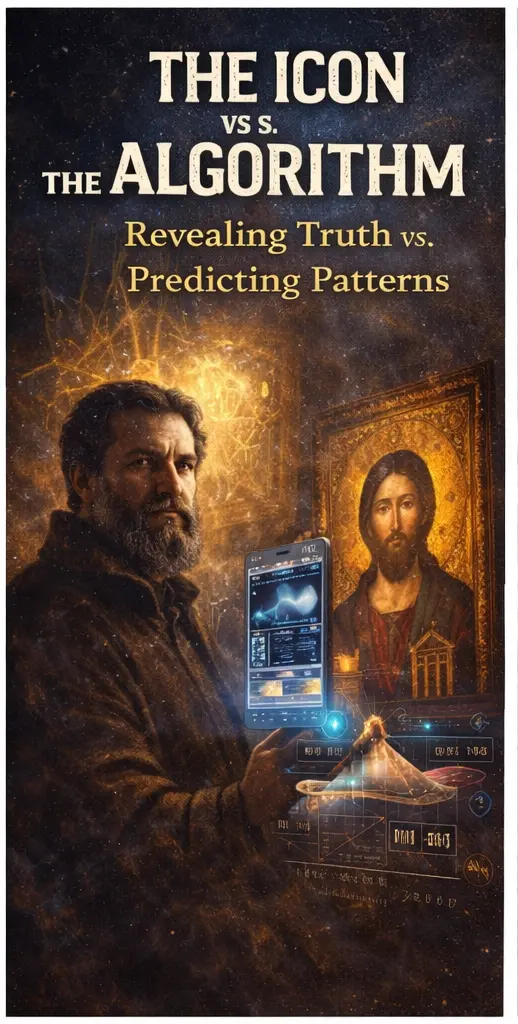
The Icon vs. the Algorithm.
Western art after the Renaissance built its world on perspective:
• Man at the center
• Space measured
• Reality controlled
The icon does the opposite:
• Light at the center
• Space inverted
• Reality opened
Florensky explains that iconography uses reverse perspective — the image expands toward the viewer instead of retreating away. The painting does not invite you to enter it.
It comes toward you.
In today’s digital culture, the algorithm also comes toward you.
But instead of revealing truth, it predicts behavior.
Florensky’s icon reveals being.
The algorithm reveals patterns.
That difference is everything.
Quantification and the Loss of the Invisible.
We now live inside systems that convert:
• Attention into currency
• Emotion into engagement
• Identity into data
Reality becomes something that must be counted before it is believed.
Florensky lived a century ago, yet he already saw the danger:
> When light becomes only physical, and not metaphysical,
> the world loses its depth.
For him, the icon is a Royal Door — a sacred threshold between the visible and the invisible. A place where matter becomes transparent to meaning.
In modern digital reality, we have doors everywhere.
But very few of them are royal.
Science, Faith, and Symbol.
Florensky was not anti-science. He was a mathematician and physicist.
But he understood something modern culture often forgets:
Science explains how.
Art and symbol explain why.
He refused to separate:
• Scientific truth
• Mystical experience
• Artistic beauty
To him, the universe was not a machine.
It was a symbolic organism.
Today we model reality.
Florensky tried to listen to it.
Why Florensky Matters in the Age of Web3.
As a digital artist working between narrative, blockchain, and visual symbolism, I see Florensky not as a figure of the past—but as a guide for the future.
Web3 talks about decentralization.
Florensky talked about de-centering the ego.
NFTs talk about ownership.
Florensky talked about presence.
Technology moves fast.
Symbolism moves deep.
If digital art forgets the invisible, it becomes noise.
If it remembers it, it becomes threshold.
Final Reflection.
The Royal Doors is not a book about icons.
It is a book about how light becomes form.
How meaning becomes visible.
How reality is more than what can be measured.
Florensky was executed in 1937 for refusing to renounce his faith and metaphysical vision. He died as a martyr of free thought.
But his ideas are more alive than ever.
In an age obsessed with numbers, he reminds us:
> Not everything that is real can be counted.
> And not everything that can be counted is real.
Marekiaro
Digital Artist & Content Creator
Publish0x