
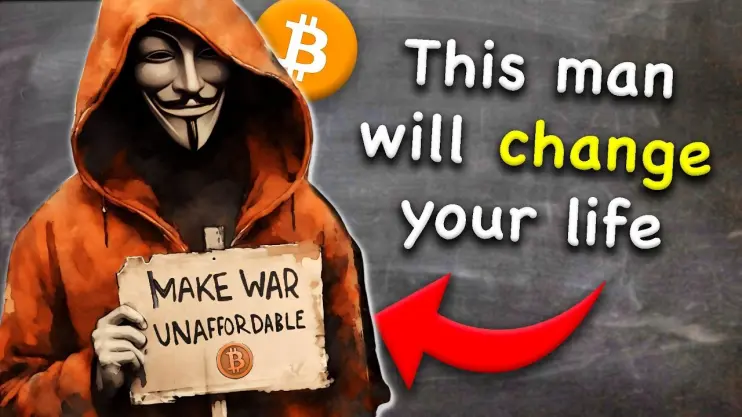
Bitcoin is a concept bold and disruptive.
It wasn’t merely ahead of its time; it slipped through time, arriving before the world even had the language to describe it.
Although, Satoshi offered more than code.
More than a network.
Watch my new video, like and subscribe!
If you enjoyed watching, please also consider turning notifications on for more.
Parts of the transcript follows.
Introduction
Bitcoin was new money. Digital money. Internet money.
And still it is not just about money.
Satoshi gave us more than a new kind of money.
What he unleashed was a question. A challenge buried in the open, for anyone willing to look past the obvious and confront how such an idea existed at all.
The vision, the implementation, the purpose… all of it is laid out in the Whitepaper. This is where it begins — and exactly what the system of trust has spent more than a decade resisting. The very system Bitcoin is rendering obsolete. The banks, the payment processors, the central banks, the endlessly inflating fiat currencies. The entire financial machine, that is mired in stagnation.
Today, we revisit the word of Satoshi. Words buried in old forums, mailing lists, and obscure archives. Through them, the intention becomes clear. You begin to see the purpose. You will begin to understand how Bitcoin was never merely about digital money.
We gathered early communications between cryptographers, developers, early adopters, and Satoshi himself, and shaped them into a single interview.
Perhaps, through this lens, Satoshi’s true vision will come into sharper focus.

Part I: The Whitepaper
Satoshi Nakamoto published the Bitcoin whitepaper on October 31, 2008, on the cryptographers’ mailing list. Before Bitcoin, every previous attempt at creating digital money had ended in failure.
Its release signaled a turning point — one that hinted at a future built on decentralized systems.
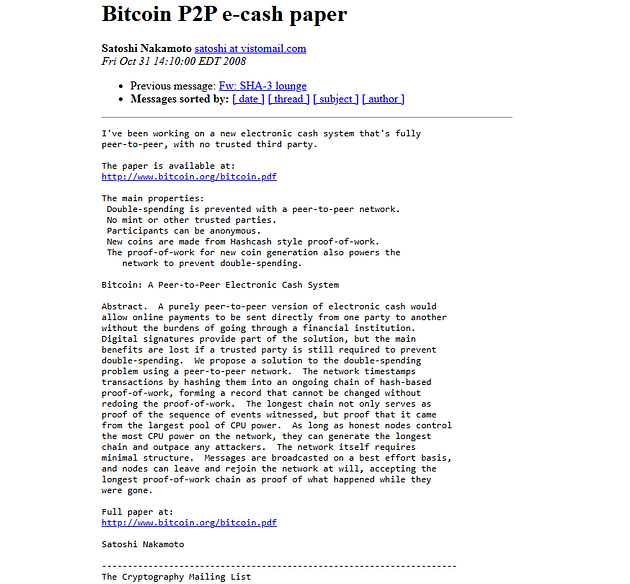
Within days of the whitepaper’s release, several well-known cryptographers responded — among them Hal Finney.
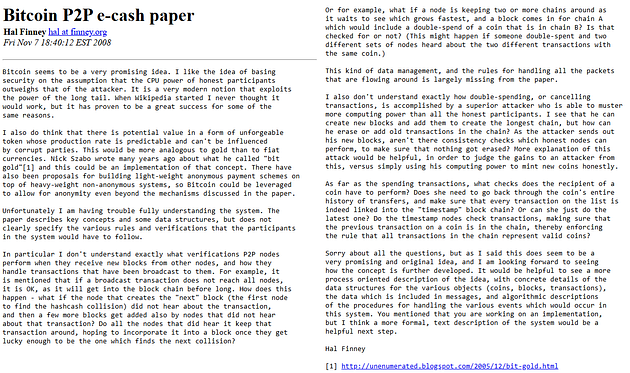
Bitcoin quickly became a hot topic of discussion.
Although the project was still purely theoretical at that stage, Satoshi Nakamoto clearly articulated the reasoning behind Bitcoin and defended its technical design. Many contributors agreed that real judgment would only come once the code could be tested.
The first public comment came from a respected yet anonymous cypherpunk, James A. Donald, who expressed skepticism about Bitcoin’s ability to scale. This sparked a detailed exchange in which Satoshi answered multiple questions.
Satoshi argued that scaling had already been accounted for, explaining that Bitcoin would not hit a practical scaling ceiling thanks to Simplified Payment Verification (SPV), which allowed lightweight clients to verify transactions without storing the full blockchain.
Satoshi:
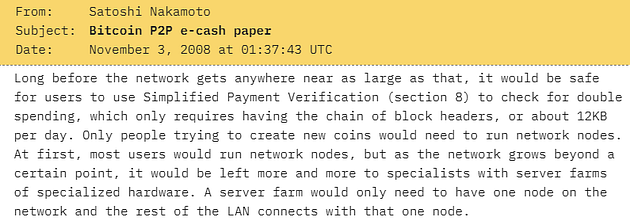
Long before the network gets anywhere near as large as that, it would be safe for users to use Simplified Payment Verification (section 8), to check for double spending, which only requires having the chain of block headers, or about 12 kilobytes per day.Only people trying to create new coins would need to run network nodes. At first, most users would run network nodes, but as the network grows beyond a certain point, it would be left more and more to specialists with server farms of specialized hardware.
A server farm would only need to have one node on the network and the rest of the LAN connects with that one node.
The bandwidth might not be as prohibitive as you think. A typical transaction would be about 400 bytes. Each transaction has to be broadcast twice, so lets say 1 kilobyte per transaction. Visa processed 37 billion transactions in Financial Year 2008, or an average of 100 million transactions per day.
That many transactions would take 100 gigabyte of bandwidth, or the size of 12 DVD or 2 high definition quality movies, or about $18 worth of bandwidth at current prices.
If the network were to get that big, it would take several years, and by then, sending 2 HD movies over the Internet would probably not seem like a big deal.
Hal Finney was the first person to run Bitcoin besides Satoshi, and one of the earliest contributors to the project.
Hal Finney also entered this discussion and expressed his admiration for the idea. However, Hal also wanted to test the software himself, and delve deep into the code before deciding.
On January 10th, 2009, Satoshi launched Bitcoin, and the entire network quietly came to life as the early users began downloading the software and mining the first blocks.
Part II: Running Bitcoin
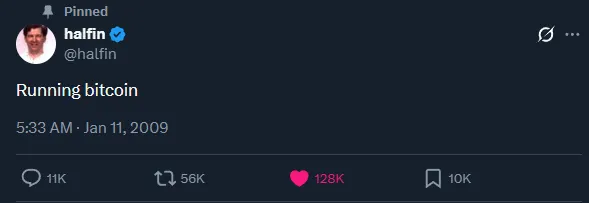
Announcing the release of Bitcoin.
Total circulation will be 21,000,000 coins. It’ll be distributed to network nodes when they make blocks, with the amount cut in half every 4 years.
first 4 years: 10,500,000 coins .
next 4 years: 5,250,000 coins .
next 4 years: 2,625,000 coins.
next 4 years: 1,312,500 coins.
etc…When that runs out, the system can support transaction fees if needed. It’s based on open market competition, and there will probably always be nodes willing to process transactions for free.
Satoshi Nakamoto
Everyone following the cyphers mailing list could run Bitcoin themselves, although only a small number chose to do so in those early days.
Still, within the following months Bitcoin attracted dozens of new enthusiasts to its fledgling community.
Satoshi soon created the new bitcoin forum, bitcointalk, and moved all discussions there. The forum was a beacon for developers, cryptography experts, and curious innovators, early adopters who shared a belief in the potential of a decentralized future.
They contributed ideas and code, and helped lay the foundation for what many believed would become the money of the future.
Part III: Building A Community
Within just a year, the Bitcointalk forum had already become the best place to learn about Bitcoin.
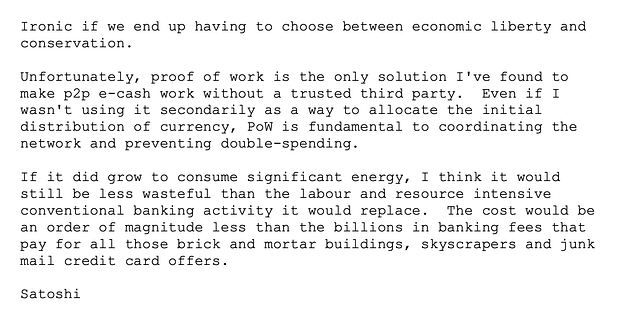
People were mining Bitcoin using their home computers, volunteers were contributing to the project in direct communication with Satoshi, and early attempts at building a financial bridge began to emerge, most notably, the New Liberty Standard Exchange, which aimed to create a PayPal-to-Bitcoin ramp.
The first price Bitcoin traded ever was about one-tenth of a penny, and it was another landmark moment for the community.
However, the major moment for the project came shortly after, when Laszlo Hanyecz made history by purchasing two Papa John’s pizzas for 10,000 BTC, marking the first real-world commercial transaction using Bitcoin.
The community celebrated every small achievement. Interest was growing rapidly, and people from all different fields were becoming captivated by this new digital money. The excitement led to one big question:
Was the moment everyone had been waiting for finally about to happen?
Up until then, no form of money existed outside the traditional financial system. Everything — whether PayPal or any online payment service — was ultimately tied to banks. No currency had ever successfully bypassed the bank-connected payment system.
The early adopters of Bitcoin understood this deeply, yet they held onto the hope that Bitcoin could change everything.
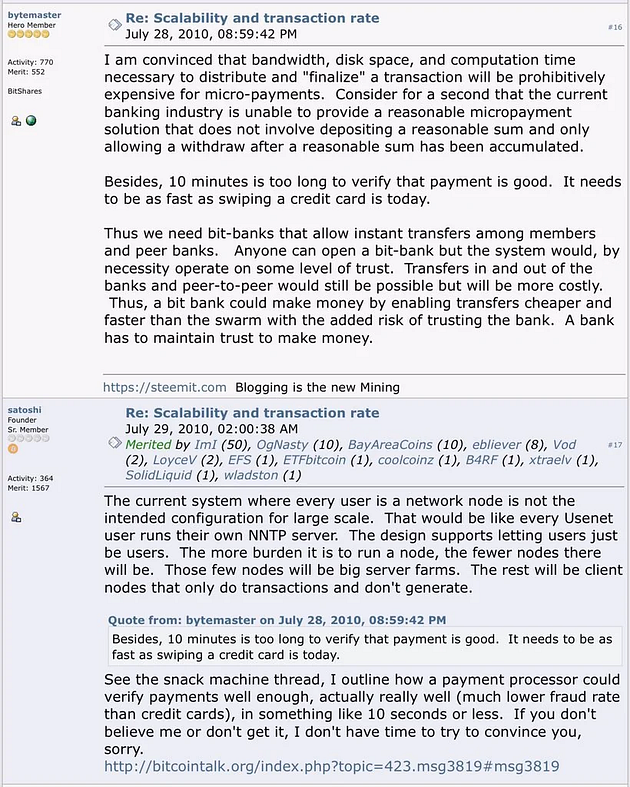
In 2010, an intriguing exchange between Dan Larimer and Satoshi Nakamoto unfolded. That conversation later became emblematic, marking Bitcoin’s history forever.
Dan Larimer was a software engineer that became a pioneer in the blockchain sector, having envisioned and materialized the concept of a decentralized exchange, or Dex, with the creation of Bitshares.
Furthermore he contributed a lot to the development of distributed proof of stake and co-founded Steemit, and EOS blockchains.
Satoshi, certainly knew which buttons to push, and Larimer understood he could also unleash his creativity in a new field, too promising to be true.
During Bitcoin’s earliest days, Satoshi Nakamoto alone steered developments and determined its future.
He controlled the codebase, issued software updates, and refined the protocol, supported only by a small group of volunteers.
Then, in October 2010, Satoshi made what would become one of the most consequential decisions in Bitcoin’s history.
Acting pre-emptively, he introduced an update that imposed a 1 Megabyte limit on size of each block, reducing them from unlimited capacity to a strict cap.
The move was driven by concerns about potential network-crippling spam attacks, a threat Hal Finney had repeatedly warned about.
According to Ray Dillinger, who later described their private conversations, Satoshi accepted Hal’s suggestion, although, all three of them — Satoshi, Hal, and Ray — considered the change only a temporary defense. The intention was clear.
The block size should be raised once the network matured.
In hindsight, this may have been the most dramatic intervention Satoshi ever made.
This, because the 1MB limit never changed.
Despite being meant as a short-term safeguard, it became permanent — shaping Bitcoin’s destiny, constraining its capacity to scale, and undermining Satoshi’s own vision that Bitcoin could serve as a global decentralized currency capable of supporting everyday commerce.
What followed was one of the most pivotal debates in Bitcoin’s history, unfolding across posts on the Bitcointalk forum, and far beyond it.
The community suddenly found itself confronting a decision with consequences that would echo for years.
Here’s the initial reaction of the early Bitcoin community, and the way Satoshi himself stepped in to respond.
JGarzik- We should be able to at least match Paypal’s average transaction rate…
Satoshi- We can phase in a change later if we get closer to needing it.
Freemoney — Satoshi just said it can be changed, so technically the network is capable.
Jgarzik — It is also an incompatible change, as you see…..
- martin — No, it’s incompatible if just a few people change their behaviour. To roll out a change to the network you need to get most of the clients understanding both the old and the new protocol, and then when you have a majority you turn on the new protocol.
- jgarzik You just described a whole-network upgrade. I’d call that an incompatible change. The effort to raise the transaction rate limit is the same as the effort to change the fundamental nature of bitcoins: convince the vast majority to upgrade.
- Satoshi: It can be phased in, like:
if (blocknumber > 115000),
maxblocksize = largerlimit
It can start being in versions way ahead, so by the time it reaches that block number and goes into effect, the older versions that don’t have it are already obsolete.
When we’re near the cutoff block number, I can put an alert to old versions to make sure they know they have to upgrade.- kiba: If we upgrade now, we don’t have to convince as much people later if the bitcoin economy continues to grow.
Appamatto: I agree, especially since generators are both the source of blocks and “votes” in the network. Since a block restriction would allow generators to charge higher transaction fees, they might “vote” against an increase in the max size in the future.
It seems unlikely to be a real problem though.
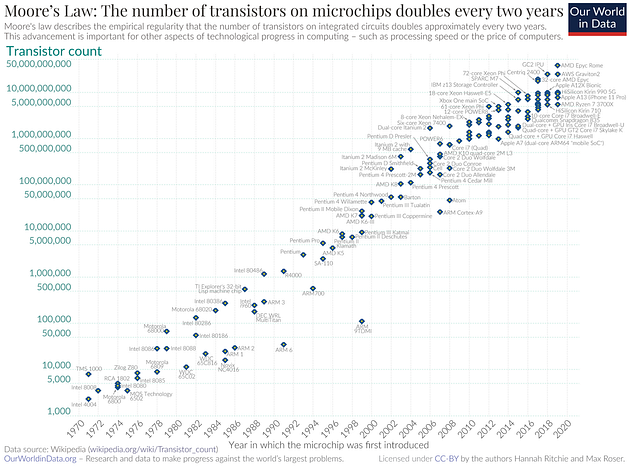
In an email exchange with Bitcoin developer Mike Hearn, Satoshi explained how Bitcoin could scale infinitely and outperform every other payment network.
Citing Moore’s Law, he argued that rapidly increasing computing power would easily support larger blocks and higher throughput, enabling Bitcoin to grow beyond Visa’s capacity and become a major player in global commerce.
Part IV: I’ve moved on to other things
By late 2010, Bitcoin was already becoming a topic of interest among Silicon Valley tech entrepreneurs, especially after Slashdot published its first article about it.
Yet its first major wave of real-world adoption came from an unexpected source. WikiLeaks.
With traditional financial channels blocked, WikiLeaks turned to Bitcoin as an alternative lifeline.
Accepting Bitcoin allowed the group to bypass financial sanctions and continue operating. Bitcoin donations funded core infrastructure and later helped support legal efforts.
However, Satoshi Nakamoto was unhappy about this development.
He immediately realized it might be time to step away before his identity risked being exposed.
Satoshi had created a form of money that could operate outside the traditional financial system. But in the case of WikiLeaks, Bitcoin wasn’t just bypassing banks — it was bypassing sanctions imposed by powerful nations. The implications were obvious: sooner or later, those same powers could come after him.
On the Bitcoin forum, the discussion unfolded.




Satoshi:
No, don’t “bring it on”.
The project needs to grow gradually so the software can be strengthened along the way.
I make this appeal to WikiLeaks not to try to use Bitcoin. Bitcoin is a small beta community in its infancy. You would not stand to get more than pocket change, and the heat you would bring would likely destroy us at this stage.
In the following days Wikileaks had already started accepting Bitcoin donations.
It seemed like mass adoption was on the horizon — along with all the challenges that come with it.
In one of his final posts on the Bitcoin forum, Satoshi wrote:
It would have been nice to get this attention in any other context.
WikiLeaks has kicked the hornet’s nest, and the swarm is headed towards us.Satoshi Nakamoto
And it did.
However, Satoshi had already begun putting his exit plan into motion. What exactly happened to Satoshi, who he really was, or where this person went afterward remains a mystery and most likely always will.
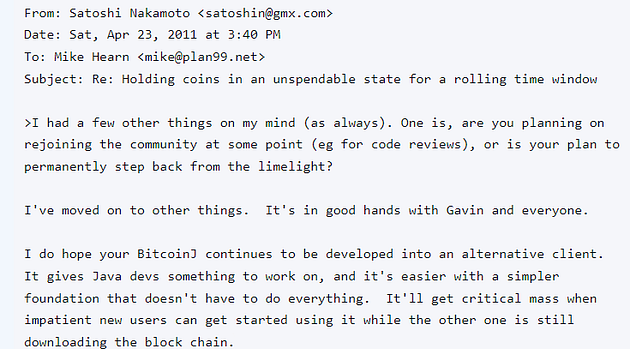
In April 2011, four months later, Satoshi reached out to Mike Hearn in what would become his final communication.
Conclusion
We’ll probably never know who Satoshi Nakamoto is, and most likely the founder of Bitcoin never meant for things to end up this way.
The world still needs a working Bitcoin, a digital currency with no intermediaries.
Maybe one day we’ll all start using an Internet currency that works around the clock, with fast transactions and insignificant fees.
It could be something created by the banks — fully centralized, censorable, and controlled.
Or it could be a digital currency, completely free from intermediaries, used person to person.
Money that we control, and no one else.
The latter could usher in a new era of commerce and finance — boosting economies and empowering people everywhere, regardless of ethnicity, status, religion, or politics.
It would allow anyone, anywhere in the world, to hold at least a portion of their wealth in a sound, global money system, a system built to serve everyone, and not a privilege reserved for the few.
Bitcoin today can still be used for various purposes and assist people in need, even if it isn’t suited for everyday commerce. Those shaping the narrative have altered the vision and pushed the idea that Bitcoin is only digital gold.
That commerce gap was quickly filled by other cryptocurrencies, as well as by other versions of Bitcoin created through hard forks by Bitcoiners trying to maintain Satoshi’s original ideas.
However, real-world adoption in everyday commerce remains insignificant.
Cryptocurrencies are still too complicated for the average person.
The management of the private keys, the lack of education on transacting properly, the extreme volatility and price manipulation, and the unclear legislative global framework have all slowed the spread of permissionless money.
But the hope is that we are still early.
Cryptocurrencies will continue to evolve.
Some of the brightest minds of our generation are working to make everything simpler and safer, paving the way for the rapid growth of true peer-to-peer electronic cash.
LinkTree: @panterabch
On YouTube: @panteraCrypto
Join 7500+ readers: PanteraBCH.Medium.com
Don't forget to subscribe and like!






