
Trade Smarter, Not Harder: Limit Orders.
The Hidden Costs of Centralized Trading and Why DeFi Does It Better.
In crypto trading, timing and precision are everything. A single price swing can make the difference between a winning trade and a costly mistake. This is where limit orders come into play, a powerful tool that lets you set the exact price you’re willing to buy or sell, without needing to stare at the charts all day.
What Is a Limit Order?
A limit order is an instruction to buy or sell a cryptocurrency at a specific price or better than that price. Unlike a market order, which executes instantly at the current market price, a limit order only executes if the market reaches your target price.
Example:
- You want to buy ETH at $2,200, but it’s currently trading at $2,400.
- You place a buy limit order at $2,200.
- If the price drops to $2,200 or lower, your order executes automatically.
- If it doesn’t, nothing happens, and you avoid overpaying.
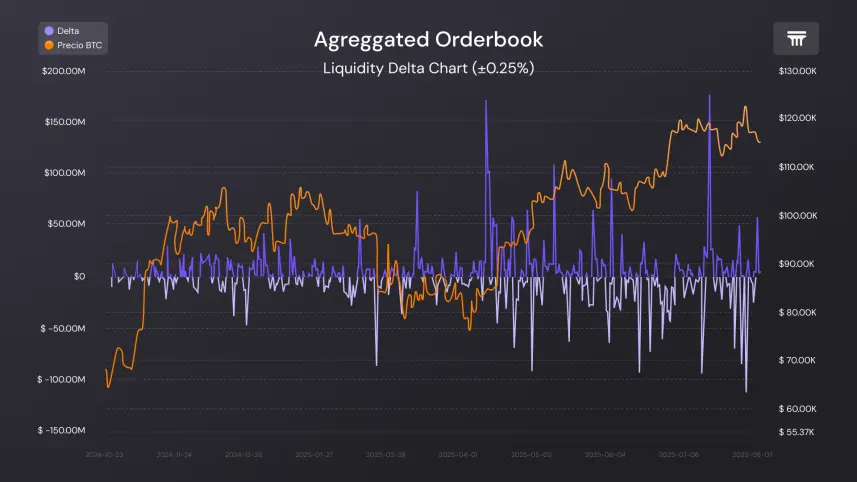
The Aggregated Orderbook Liquidity Delta (±0.25%) chart in BTC futures clearly illustrates the impact that limit orders have on market structure. Even a minimal price fluctuation of just 0.25% can trigger significant execution volumes, both through liquidations and the activation of pending orders.
This effect becomes more pronounced when a limit order is only partially filled. On centralized markets, if there isn’t enough liquidity at a specific price level, the order may be executed in multiple fractions across different prices, a common scenario when trading large amounts or in thinner market conditions.
Such fragmentation results in slippage, the difference between the intended execution price and the actual one. While for a retail trader this might look like just a few cents or dollars off, at the global scale it translates into hundreds of millions being moved with every minor price shift.
Limit Orders: The Hidden Costs of Centralized Trading and Why DeFi Does It Better
In the world of digital trading, limit orders are presented as a basic tool: they allow you to set a specific price at which to buy or sell an asset. However, behind this apparent simplicity, CEXs (Centralized Exchanges) and traditional brokers have found multiple ways to capture value at the expense of their users.
We’ll explore:
- The hidden problems of using limit orders on centralized platforms.
- How intermediaries profit from retail traders.
Why a decentralized DeFi infrastructure brings transparency, control, and direct benefits back to the user.
The Problem with Limit Orders on CEXs and Brokers
Although they are marketed as safe and easy to use, in practice limit orders on centralized platforms face three major issues:
a) Front-running and internal order flow
Many exchanges and brokers redirect order flow to in-house or affiliated market makers. This means that instead of executing your order at the best available price, your trade becomes privileged information for entities that can front-run you and capture part of your potential profit.
b) Hidden slippage
Even if you set an exact price on your limit order, the final execution often includes hidden costs, inflated spreads, or small adjustments that benefit the exchange. In many cases, the user never realizes that the “execution price” wasn’t as favorable as it appeared on the screen.
c) Custody and lack of transparency
On CEXs, orders go through opaque internal systems. The user has no way to verify if their order was routed to the open market, executed against the exchange’s own internal book, or intentionally delayed to capture profit.
How Intermediaries Profit
Brokers and CEXs use limit orders to:
- Monetize order flow (by selling your trading data to market makers).
- Charge hidden spreads, even if they advertise “zero fees.”
- Retain liquidity under their control, leveraging the user’s lack of visibility.
In short, every limit order you place on a CEX is an opportunity for the intermediary to capture value that should have been yours.
The Alternative: Limit Orders in DeFi
A decentralized limit order changes the paradigm:
- Full transparency: orders are executed through auditable smart contracts, visible on-chain.
- No intermediaries: there are no brokers or market makers with hidden advantages. Execution happens directly in the decentralized market.
- User control: your funds never leave your wallet until the condition is met.
- Greater efficiency: smart routers aggregate liquidity across multiple pools to get the best possible price, without hidden spreads.
Direct Benefits for the Trader
- Higher profitability: you don’t lose margins to hidden slippage or inflated spreads.
- Security: your assets never sit in the custody of a vulnerable centralized exchange.
- True free-market experience: execution reflects genuine supply and demand, not intermediary manipulation.
Limit orders on CEXs may look convenient, but they hide mechanisms designed to let intermediaries capture value.
By contrast, limit orders in DeFi represent a real evolution: they eliminate opacity, return control to the user, and ensure every execution is fair, transparent, and secure.
The future of trading isn’t about accepting the rules set by intermediaries, it’s about building and using open infrastructures that truly empower traders.
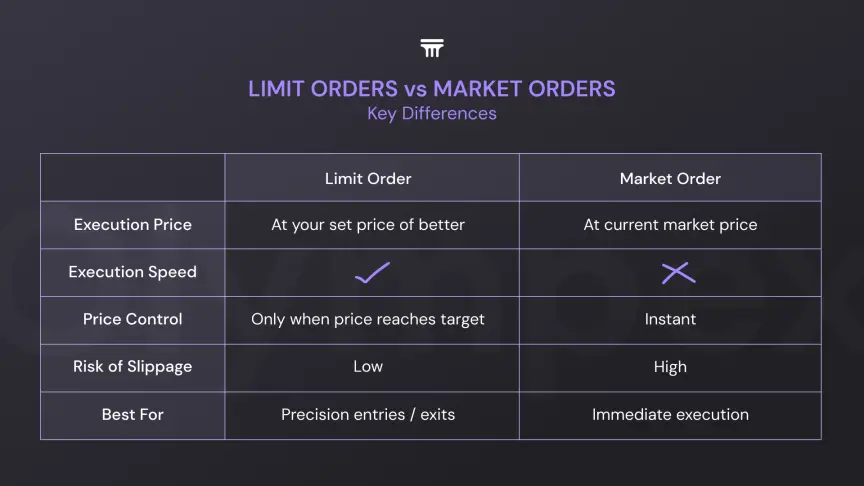
Limit orders vs Market orders
Why Use Limit Orders on Olympex?
Olympex takes the traditional concept of limit orders and brings it into the Web3 trading environment, with smart contract execution and user-focused design.
Key advantages:
- Price Control: Set your exact entry or exit point without chasing the market.
- Trade Without Watching the Screen: Orders execute automatically when your conditions are met.
- Volatility Protection: Avoid emotional decisions in fast-moving markets.
Gas Optimization, Olympex infrastructure ensures efficient execution on-chain.
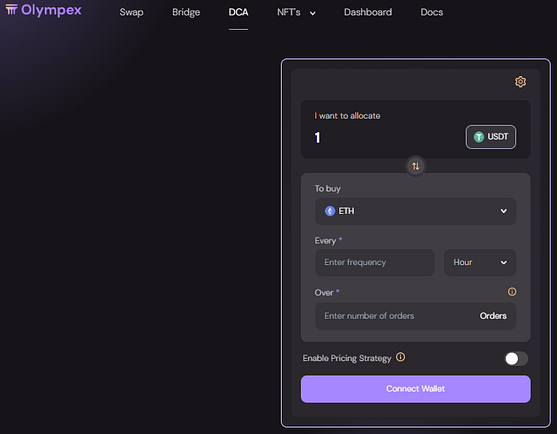
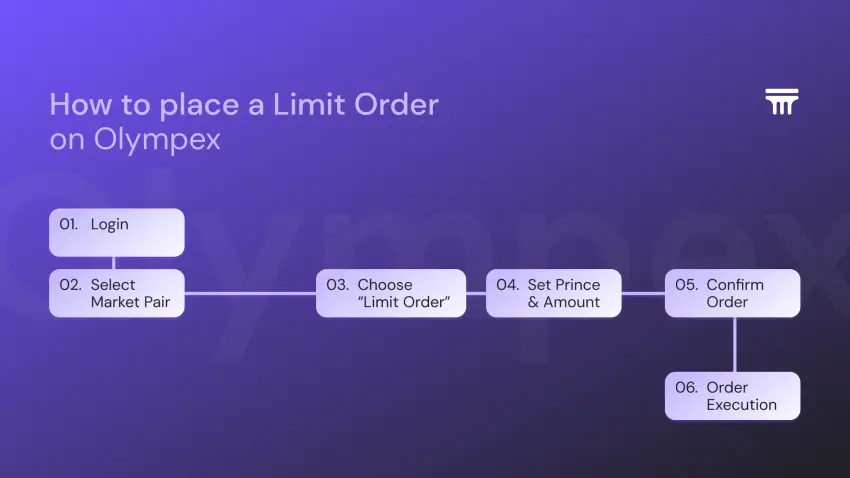
Step-by-Step: How to Place a Limit Order in Olympex
1. Connect Your Wallet
Open the Olympex trading interface and connect your preferred Web3 wallet.
2. Choose Your Trading Pair
Select the crypto pair you want to trade, such as BTC/USDT or ETH/USDC.
3. Set Your Target Price and Amount
Enter the exact price you want to buy or sell, and the quantity.
4. Confirm and Let the Smart Contract Handle the Rest
Once confirmed, your order is stored on-chain and executes automatically if the market reaches your target.
Advanced Strategies with Limit Orders
- Buy the Dip: Place buy orders below the current market price to catch sudden drops.
- Sell into Strength: Lock in profits by setting sell orders above market price.
- Order Splitting: Place multiple limit orders at different price levels to scale in or out of a position.
- Combine with Stop-Loss: Use a protective stop-loss to minimize downside while aiming for optimal entry/exit.
The Olympex Edge
Olympex doesn’t just give you limit orders; it integrates them into a secure, programmable, and user-friendly DeFi ecosystem. Whether you’re executing a short-term scalp or a long-term strategy, Olympex helps you trade smarter by automating precision.
Ready to take control of your trades? Try it now → https://olympex.io/





