
Top Crypto Tools to Trade Smarter in 2025: From Manual Chaos to Smart Automation
Discover how crypto trading evolved from manual, high-stress execution to advanced on-chain automation. Learn how you can integrate DCA, limit orders, and a tactical dashboard for smarter DeFi trading strategies.
From Click Fatigue to Strategic Execution
In the early stages of cryptocurrency markets, traders relied solely on manual execution, placing each order by hand, reacting to price swings in real time. This manual approach often led to missed opportunities, high stress, and emotional decision-making.
Today, DeFi trading automation has replaced this chaos with on-chain trading tools that execute strategies with precision and consistency.
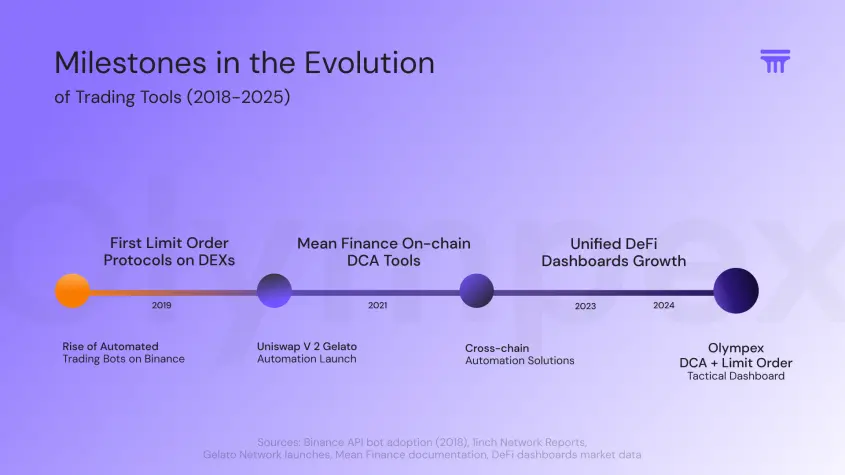
A Brief Timeline of Trading Tool Evolution
2017–2019: Exchange-Centric Automation
- API Bots on Binance & BitMEX: First-generation bots connected via APIs to centralized exchanges, executing strategies like arbitrage, scalping, and grid trading. While effective, they relied on exchange uptime and API limits.
2020–2021: DeFi Brings On-Chain Automation
- Uniswap + Gelato: Automated limit orders and recurring swaps directly on Ethereum, eliminating reliance on centralized infrastructure.
- Mean Finance: Popularized the DCA crypto strategy fully on-chain, allowing traders to reduce volatility risk over time.
2022–2023: Modular Aggregation
- 1inch Limit Orders: Enabled precise execution across aggregated liquidity pools.
- Modular setups emerged, where traders combined DEX aggregator tools, analytics dashboards, and automation protocols to create custom workflows.
2025: Olympex Integration
Unified DCA crypto strategy, limit orders, DEX aggregation, and a multi-chain tactical dashboard into a single Olympex platform.
Total Automation vs Modular Control
Total Automation
- Pros: Hands-off trading, consistent performance, reduced emotional bias.
- Cons: Limited flexibility, slower adaptation to sudden market moves.
Modular Control
- Pros: Ability to tailor setups by combining on-chain tools, analytics, and execution modules.
Cons: Requires strategy planning and monitoring.
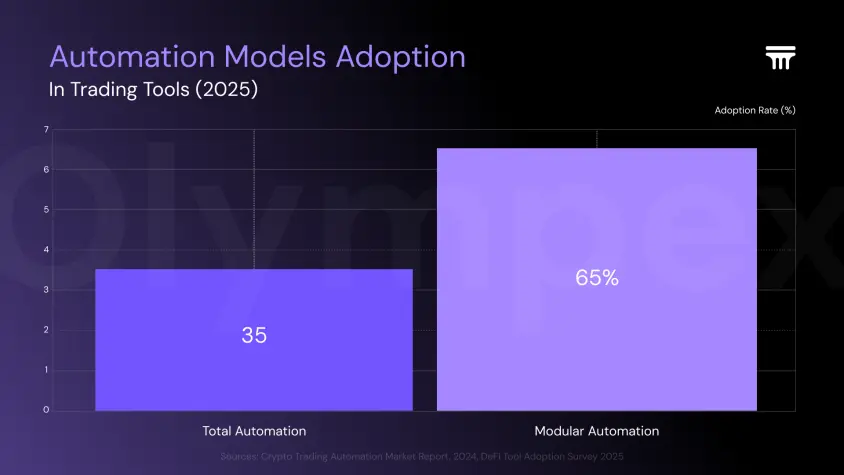
Olympex bridges the gap, enabling both automated crypto strategies and modular flexibility in one interface.
Understanding DeFi Tools and How Olympex Integrates Them
Decentralized Finance (DeFi) offers a wide range of tools and strategies that allow users to trade, invest, and manage crypto assets without relying on centralized intermediaries. Understanding these tools can help traders make informed decisions and manage risk more effectively.
Core DeFi Tools Explained
1. DEX Aggregators
These tools search across multiple decentralized exchanges (DEXs) to find the best price for a trade. By aggregating liquidity from different platforms, they help reduce slippage and improve execution efficiency.
2. Limit Orders in DeFi
Limit orders allow traders to set specific price levels at which to buy or sell assets. This way, users can automate trades and avoid constantly monitoring the market.
3. Dollar-Cost Averaging (DCA) Strategies
DCA is an approach where traders gradually build or reduce a position over time, smoothing out the impact of market volatility. On-chain DCA tools automate this process, making it easier to maintain a consistent strategy.
4. Portfolio Management Dashboards
Decentralized dashboards provide real-time tracking of multi-chain portfolios, performance analytics, and strategy optimization. This helps users make data-driven decisions.
Example Platform: Olympex integrates these core tools, offering a practical way to experiment with DeFi trading strategies while managing multiple assets across blockchains.
Complementary DeFi Strategies
In addition to these tools, DeFi offers several traditional strategies that users can explore:
1. Liquidity Provision (LP)
- Concept: Users supply two tokens to a liquidity pool (e.g., ETH/USDC) and earn LP tokens representing their share. Swap fees are distributed proportionally among LPs.
- Benefits: Earn passive fees and gain exposure to both tokens.
- Risks: Impermanent loss can reduce returns if token prices diverge.
2. Yield Farming
- Concept: Stake LP tokens to earn additional protocol rewards, often in native tokens.
- Benefits: Higher potential returns and incentives for early participation.
- Risks: Token inflation and the combination of impermanent loss and reward volatility.
3. Staking
- Concept: Lock protocol tokens to earn rewards over time. Can be single-sided or combined staking.
- Benefits: Encourages long-term holding and helps support the protocol’s ecosystem.
- Risks: Smart contract vulnerabilities and potential reward dilution.
4. Slippage Control
- Concept: Set a maximum allowed difference between expected and executed trade prices.
- Benefits: Protects against market manipulation and high volatility.
- Risks: Overly strict settings can cause transaction failures.
5. Derivatives (Perpetuals, Options, Futures)
- Concept: Financial instruments that provide leveraged or synthetic exposure to assets without holding them directly.
- Benefits: Advanced trading strategies, hedging, and professional-level speculation.
- Risks: Complex to manage, potential for liquidation, and systemic risk if the platform fails.
Key Takeaways
Understanding the variety of DeFi tools and strategies is essential for anyone looking to participate in decentralized markets. While platforms like Olympex can simplify the process by integrating several tools in one place
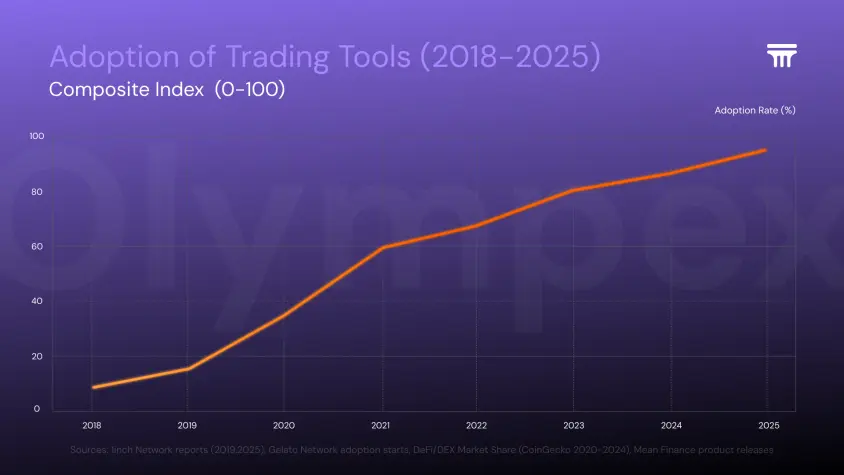
Visualizing the Journey
Conclusion
The crypto trading journey has moved from manual chaos to on-chain smart automation, giving traders better tools for precision and control. The Olympex platform represents the next stage, merging automation, modular strategy, and real-time analytics in a single DeFi hub.
DeFi provides a variety of tools like liquidity provision, staking, DCA strategies, and derivatives that allow users to manage and grow their crypto assets in a decentralized way. Each tool has its own benefits and risks, so understanding how they work is key to making informed decisions.
Take some time to explore these mechanisms, try small experiments on testnets or low-stake positions, and gradually build your knowledge.
Learning by doing is the best way to navigate the DeFi ecosystem safely and effectively.





