
The Secret to Stop Being a Frustrated Trader: Why Limit Orders Matter in DeFi
Introduction
In decentralized finance (DeFi), market volatility can turn trading into an emotional rollercoaster. Many traders have experienced the frustration of seeing a token reach their desired price, only to miss the execution window or enter the market at an unfavorable rate. These situations can lead to emotional decisions, unnecessary losses, and missed opportunities.
Limit orders offer a structured, disciplined approach, enabling traders to regain control over execution without being at the mercy of short-term market swings.
Common Cases of Trading Frustration
Market conditions in DeFi are dynamic and can change within seconds. Common pain points include:
- Unexecuted trades: Prices reach a target momentarily but reverse before the order is placed.
- High slippage: Sudden volatility results in executions at significantly worse prices.
- Emotional entries/exits: Buying into local peaks or selling at local lows due to market pressure.
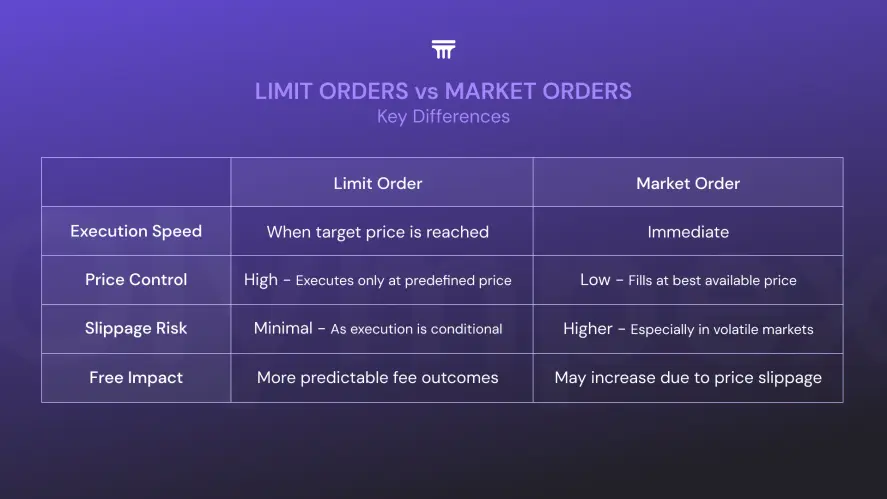
These challenges often stem from relying solely on market orders, which prioritize speed over price control.
Market Orders vs Limit Orders: Key Differences
The Role of Limit Orders in DeFi
Originally a tool more common in centralized exchanges (CEXs), limit orders have gained traction in decentralized environments as protocols improve execution mechanisms.
- In CEXs: Instant matching due to centralized order books.
- In DEXs: Execution depends on liquidity pools and protocol design, but innovation, such as on-chain order matching, has significantly improved reliability.
Recent industry data indicates a rising adoption of limit orders in DEXs, particularly among traders seeking to automate strategies without constant monitoring.
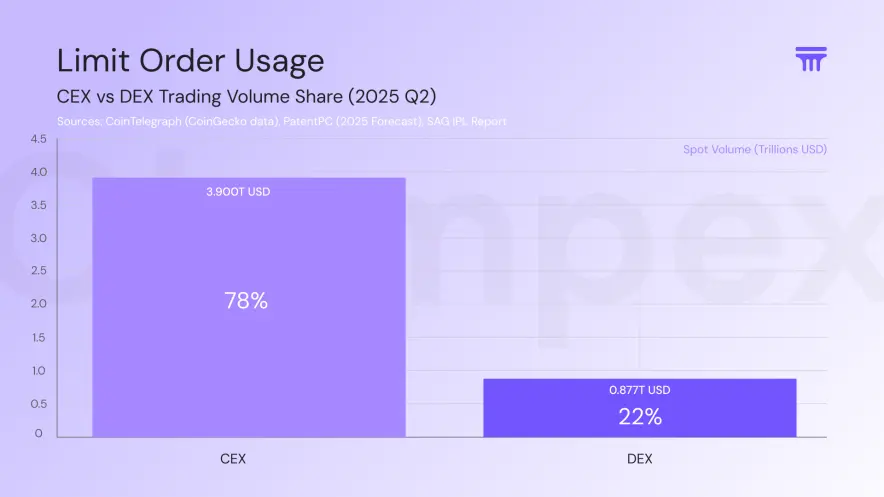
From CEX to DEX: Why Users Are Migrating (and What the Data Says Today)
In the early years of crypto, CEXs dominated thanks to liquidity, wide pair selection, and their “turnkey” user experience. However, in recent cycles, three forces have accelerated migration toward DEXs: self-custody, on-chain transparency, and improved latency/costs enabled by L2s and new routing architectures.
Concrete Benefits of Trading on DEX
Self-custody: eliminates exchange counterparty risk. Orders settle on-chain and funds remain in your wallet until filled.
Verifiable transparency: prices, slippage, fees, and execution are all recorded on-chain; no hidden books or “off-chain fills.”
Permissionless access: heavy regulatory/KYC friction on CEXs vs. global, composable access on DEXs (key for programmatic strategies and arbitrage).
Composability: integrate swaps, bridges, vaults, limit orders, and automations (DCA) in a single flow, essential for quant desks and DAOs.
Execution quality improvements: batch auctions and MEV protection in some DEXs (e.g., CoW-style) reduce price impact on large orders.
Is Migration Actually Happening?
Yes, especially in spot trading and on L2s:
- Q2 2025: several trackers place DEX spot market share at ~25%–30% of the total, historic highs. Binance Square and CryptoRank report spikes in DEX participation alongside quarterly drops in CEX spot volume, pushing the DEX/CEX ratio to record levels.
- Binance
- CryptoRank
- Recent coverage highlights DEXs surpassing 20% of aggregate spot volume, driven by broader token variety and institutional flows on Ethereum and Solana.
- CoinDesk
- Yahoo Finance
- Methodology caveat: if you look at total trading (spot + derivatives), the DEX share is lower; a Grayscale analysis for Jan–May 2025 estimates ~7.6% of total volume. The difference comes from derivatives, still dominated by CEXs.
- Grayscale Research
- On-chain activity: DeFiLlama and other dashboards show DEX monthly volume spikes in 2025 and active address counts at all-time highs, aligning with the narrative of stronger DEX adoption.
- DeFi Llama
- ChainCatcher
Data conclusion: migration is real in spot (rising market share and record highs), while CEXs still dominate derivatives, although DEX perpetuals have been steadily gaining share since 2024.
Why Should Users Consider Migrating (at Least Partially)?
- Risk management: self-custody and on-chain settlement reduce the risk of withdrawal freezes and counterparty failures.
- Costs & execution quality: in long-tail pairs and off-peak liquidity hours, DEXs (with aggregators + MEV protection) often deliver better net effective routes after fees.
- Access to innovation: new listings, composable strategies, and automations (e.g., DCA/limit orders on-chain) appear first in DeFi.
- Multichain portability: bridges and cross-chain routes enable liquidity and strategies across ecosystems without relying on a centralized custodian.
Trade-offs & Best Practices
- Smart contract risk: mitigate by using audited protocols, setting exposure limits, and checking reports/status pages.
- Key management: hardware wallets and signing policies (multisig/social recovery) for operational security.
- Gas costs/latency: favor L2s for frequent trading and use aggregators with accurate cost/time estimators.
- Compliance: factor in tax and reporting requirements in your jurisdiction.
Where Olympex Fits In
Olympex is building a unified hub (aggregator + limit orders + DCA + bridging) with multichain smart routing, MEV protection where available, and a UX designed to minimize cross-chain/product friction. The goal: moving from CEX to DEX shouldn’t mean added complexity; it should mean better control, better transparency, and better execution for both advanced retail traders and institutions.
How Limit Orders Work on Olympex
Olympex integrates limit orders as part of its mission to provide professional-grade trading tools within DeFi. The process is straightforward:
- Select the trading pair.
- Set the exact price at which you wish to buy or sell.
- Define the order size.
- Confirm and allow the protocol to execute automatically when market conditions match your criteria.
Key benefits include:
- Precision in execution.
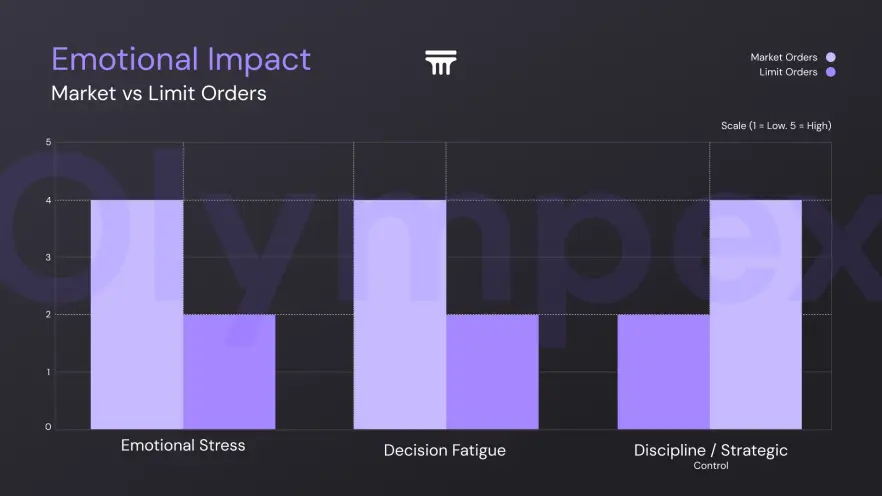
- Reduced emotional decision-making.
- Ability to plan trades without being online 24/7.
From Frustration to Strategy: Mindset Shift
The key to sustainable success in DeFi is discipline. Limit orders transform trading from reactive to proactive, enabling traders to:
- Lock in desired entry and exit prices.
- Avoid emotional decisions driven by market noise.
- Allocate capital efficiently.
This strategic approach ensures that market opportunities are captured on your terms, not dictated by market chaos.
Conclusion
In an environment as fast-paced as DeFi, control and planning are essential. Limit orders provide traders with the tools to navigate volatility while maintaining strategic discipline. Olympex delivers this capability through a secure, intuitive, and efficient trading experience and empowering users to move from frustration to a structured, results-driven approach.
The migration from CEX to DEX is happening.
Start trading sefe Set your limit orders here.





