

The Dark History of Crypto Bridges
In the decentralized finance (DeFi) ecosystem, blockchain bridges have played a crucial role in enabling the transfer of value and data between different networks. They are the arteries of multi-chain liquidity, and like any critical infrastructure, their evolution has been marked by both innovation and vulnerability.
The First Steps: Early Cross-Chain Experiments
The earliest bridge solutions emerged to address a clear limitation: blockchains operate in isolation. Assets and information locked on one network could not move to another without a trusted intermediary.
- Ren Protocol (2018): One of the first systems enabling Bitcoin and other non-Ethereum assets to be wrapped and used in Ethereum’s DeFi ecosystem.
- Cosmos IBC (2021): Introduced native interoperability across chains within the Cosmos network using the Inter-Blockchain Communication protocol.
- Polkadot XCMP: Designed to enable direct message passing between parachains in the Polkadot ecosystem.

Limitations of the early phase: low liquidity, complex user interfaces, and relatively small user bases limited the reach of these solutions.
The Dark Chapter: Major Bridge Hacks
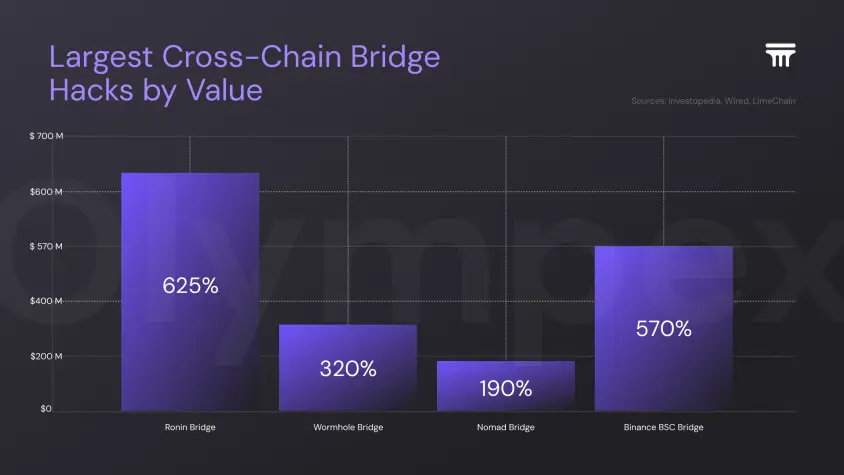
With value flowing through bridges, they became high-value targets for attackers. Several incidents reshaped the industry’s understanding of cross-chain risk:
- Wormhole (Feb 2022): Exploit leading to a loss of $320 million.
- Ronin (Mar 2022): A record-breaking $625 million was stolen from Axie Infinity’s bridge due to compromised validator keys.
- Nomad (Aug 2022): $190 million drained in a chaotic “public free-for-all” exploit.
Common causes: over-reliance on centralized validator sets, inadequate smart contract audits, and poor operational key management.
Maturation of Bridge Technology
After several high-profile bridge hacks and liquidity drains, the DeFi industry was forced to rethink how cross-chain communication should work. Early bridges often relied on centralized validators or weak security assumptions, which made them attractive targets. The new generation of bridges reflects a much more mature and security-focused design philosophy, built on four key pillars:
1. Light Client Validation
Instead of blindly trusting an intermediary, light clients allow a blockchain to verify the state of another chain directly on-chain. This means that when a transaction is executed, it carries a cryptographic proof that can be independently verified.
- Why it matters: users no longer depend on a single custodian or multisig to approve transfers.
- Practical impact: reduces the attack surface, since malicious actors can’t just compromise one validator and move funds.
2. Zero-Knowledge Proofs (zk-proofs)
One of the most important advances in bridge security has been the adoption of zero-knowledge proofs (zk-proofs).
At their core, zk-proofs allow one party (the “prover”) to convince another party (the “verifier”) that a statement is true without revealing the full underlying data. In the context of blockchain bridges, this means that a transaction or state update on one chain can be proven valid to another chain through a compact cryptographic proof, rather than by trusting an intermediary.
- Why it matters:
Traditional bridges often relied on external validators or oracles to “attest” that something happened on another chain. This created trust bottlenecks and points of failure. With zk-proofs, the verification happens mathematically on-chain, reducing reliance on third parties. - Practical impact:
- Security: Attacks become exponentially harder because a hacker can’t just compromise a few validators; they would need to break the underlying math.
- Efficiency: zk-proofs are lightweight. Instead of passing entire block histories, a short proof can summarize complex computations, making cross-chain communication faster.
- Scalability: zk-proofs can batch multiple transactions into a single proof, lowering costs while keeping verification strong.
- Real-world analogy:
Imagine needing to prove you’re over 18 to enter a club. A traditional method is to hand over your ID (revealing your full name, address, and birthday). With a zk-proof, you only show a cryptographic “yes/no” confirmation that you’re over 18 without exposing any other personal details.
Applied to DeFi bridges, this ensures that only the validity of the transaction is revealed, not unnecessary details, which preserves both privacy and security.
3. Modular Security
Older bridges often had “all-in-one” architectures where a single flaw could compromise the entire system. Modern bridge design takes a modular approach, where different layers of the system are separated: consensus, message passing, execution, and settlement.
- Why it matters: even if one component fails, it doesn’t necessarily collapse the entire bridge.
- Practical impact: improves resilience, lowers systemic risk, and makes upgrades easier without breaking everything else.
4. Continuous Auditing and Monitoring
Security isn’t a one-time process. Recognizing this, projects are moving toward continuous audits with recurring third-party reviews, as well as real-time monitoring systems that flag suspicious behavior before it becomes a major exploit.
- Why it matters: instead of discovering vulnerabilities only after an attack, protocols can identify and patch them proactively.
- Practical impact: stronger user trust and more stable liquidity across chains.
The Bigger Picture
This evolution shows how bridge technology is leaving its experimental phase and moving into infrastructure-grade maturity. Just like traditional finance relies on settlement networks and clearinghouses, DeFi now requires secure and reliable cross-chain rails. The adoption of cryptographic proofs, modular architecture, and constant auditing signals that the industry is learning from past mistakes and building for long-term resilience.
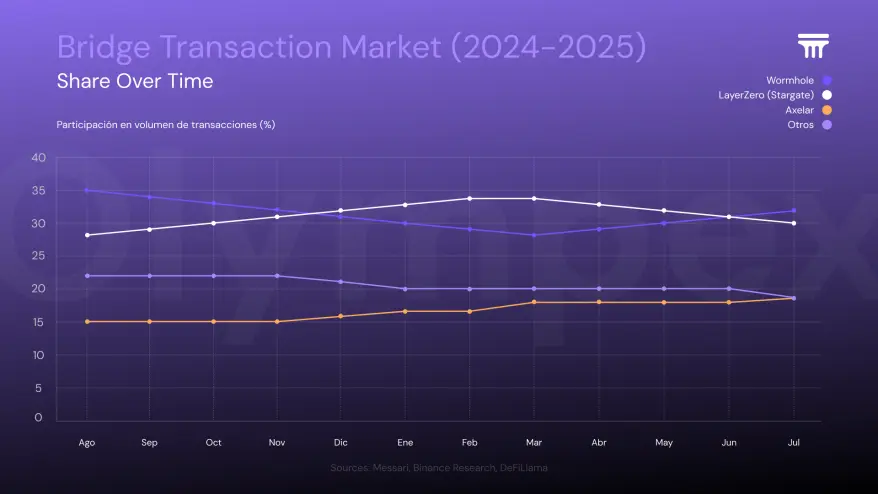
Examples such as LayerZero and Axelar have adopted flexible and multi-path validation approaches, setting a higher security standard.
The Olympex Bridge Advantage

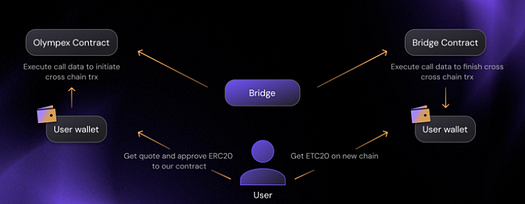
Using an intelligent routing algorithm, the system evaluates the estimated costs and times associated with transferring the asset using different protocols (which are listed in the interface). Once the analysis is complete, the transaction is automatically executed through the option that best optimizes time and cost.
The main benefits of Olympex’s Bridge include:
Ease of use: The platform allows users to transfer assets between blockchains with just a few clicks, eliminating the need for complex technical processes or external services.
Security: All transfers are protected by audited smart contracts, along with advanced security mechanisms that ensure the integrity and protection of funds at all times.
Multichain compatibility: The system supports a wide range of blockchains, including Ethereum, Binance Smart Chain, Polygon, and others, offering users maximum operational flexibility.
Cost efficiency: Optimization of gas fees and minimization of costs associated with blockchain transfers.
Conclusion
The history of crypto bridges is a story of learning from mistakes. Early bridges exposed the ecosystem to enormous risks, millions of dollars lost due to hacks, compromised validators, and weak operational practices. But those painful lessons paved the way for a more mature, secure, and resilient infrastructure.
Modern bridges, built on light client validation, zero-knowledge proofs, modular security, and continuous auditing, demonstrate that innovation and safety can go hand in hand. They remind us that in DeFi, technology alone isn’t enough; understanding how it works and choosing the right tools are equally important.
Bridges are more than technical solutions; they are the highways of multi-chain liquidity, connecting ecosystems while keeping users’ assets safe. As the industry continues to evolve, traders and investors have a responsibility to stay informed, evaluate risks, and adopt solutions that minimize unnecessary exposure.
Explore platforms that combine advanced security with intelligent routing to make cross-chain transactions seamless and safe. Start by experimenting with a trusted DEX aggregator that evaluates cost, time, and security automatically because in the world of DeFi, informed choices are your best protection.
Try it now https://olympex.io/
Sources: DefiLlama, Messari, The Block, Chainalysis, Cointelegraph, Coindesk, Criptonoticias, Binance Research.





