
Curated insights on Bitcoin, DeFi, and macro trends, powered by Olympex Labs
The U.S. Government Reopens, But Markets Don’t Snap Back as Expected
The biggest headline of the week came from Washington, where the U.S. government finally reopened after a 43-day shutdown. In previous cycles, such an event often acted as a spark: liquidity returned, uncertainty faded, and risk-assets responded almost immediately. This time, the reaction was noticeably muted.
The reopening did bring a sense of relief. Regulatory agencies resumed their work, postponed Treasury actions came back online, and markets briefly welcomed the clarity. But Bitcoin, which historically thrives when uncertainty fades, didn’t surge, it simply breathed. The move was cautious, not euphoric, signaling that the market’s concerns lie deeper than political gridlock.
Debt pressures, delayed rate-cut expectations, slowing liquidity injections, and an exhausted cohort of short-term holders all continue to weigh on price. The reopening removed one layer of uncertainty, but it could not erase the structural stress building inside the market.
Bitcoin Slips Into Structural Weakness as Realised Losses Surge
The defining feature of Bitcoin’s behavior this week was not volatility, it was exhaustion.
After defending the $100K level for weeks, BTC finally cracked, tumbling into the mid-$90Ks and revealing the extent to which sellers had been waiting beneath the surface. On-chain data paints a vivid picture of this breakdown, and no chart does it better than the Net Realised Profit/Loss metric.
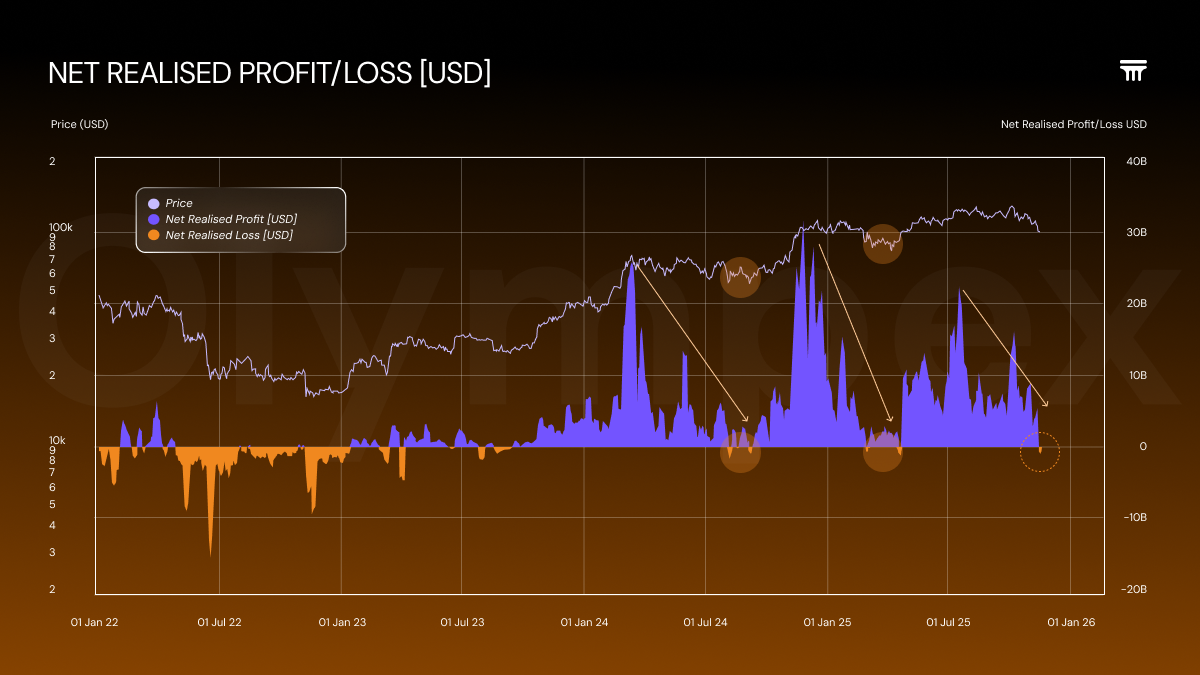
The latest data shows one of the most aggressive spikes in realised losses since early 2024. Holders are selling underwater positions en masse, surrendering coins at a loss that only appears during late-stage corrections. The pattern echoes the capitulation waves seen in the aftermath of the 2021 peak and the mid-2022 deleveraging events.
These loss-heavy periods tend to cluster around market turning points, but that doesn’t mean an immediate reversal. Instead, they highlight an emotional shift: confidence among reactive holders erodes, patience thins, and forced selling takes over. Bitcoin’s price has not collapsed so much as it has deflated, slowly bleeding as sellers crowd the exits.
For now, BTC remains fragile. What happens next depends on whether deeper market participants, long-term holders, continue to anchor the structure.
Short-Term Holders Are Reaching Their Breaking Point
If there is one group feeling the pressure more intensely than anyone, it is short-term holders (STHs), investors who entered the market recently and who are the first to panic when volatility hits.
Their behavior this week tells the entire story. Using the Short-Term Holder Supply in Profit/Loss Ratio, we can see just how deeply underwater this cohort has become.
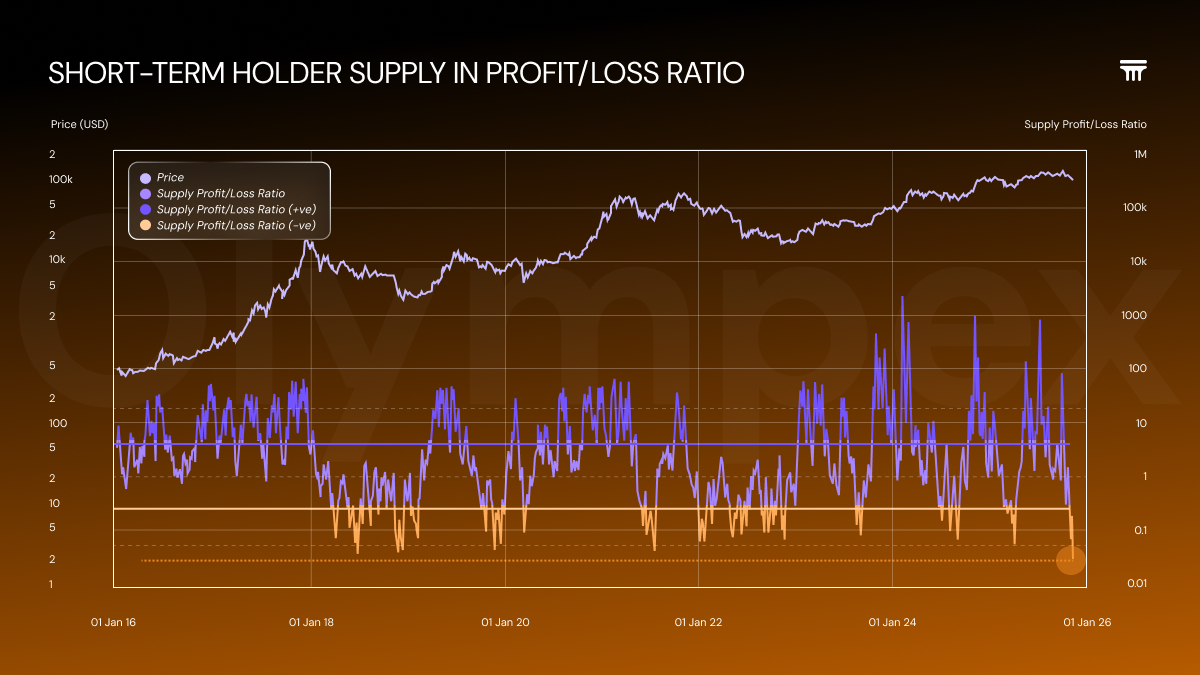
Nearly all recent buyers are now holding coins at a loss, plunging the STH cohort into levels of stress historically associated with capitulation phases. When these traders lose confidence, their actions amplify market downturns: they tighten stops, liquidate into weakness, or simply abandon positions.
But this metric also carries a paradoxical insight. In prior cycles, 2018, 2020, and 2022, these deep-loss zones emerged right before conditions stabilized. Short-term holders panic first, flush out aggressively, and then disappear, leaving the market to stronger, more patient participants.
This doesn’t guarantee the bottom is in, but it does suggest the decline is maturing.
Meanwhile, Permanent Holders Continue Their Quiet Accumulation
Against the backdrop of emotional selling and macro uncertainty, one cohort has not wavered: permanent holders, investors with multi-year horizons and iron conviction. Unlike short-term entrants, permanent holders use corrections as opportunities, not threats.
The BTC 30-Day Demand Change tracks this behavior, and the most recent reading is remarkable.
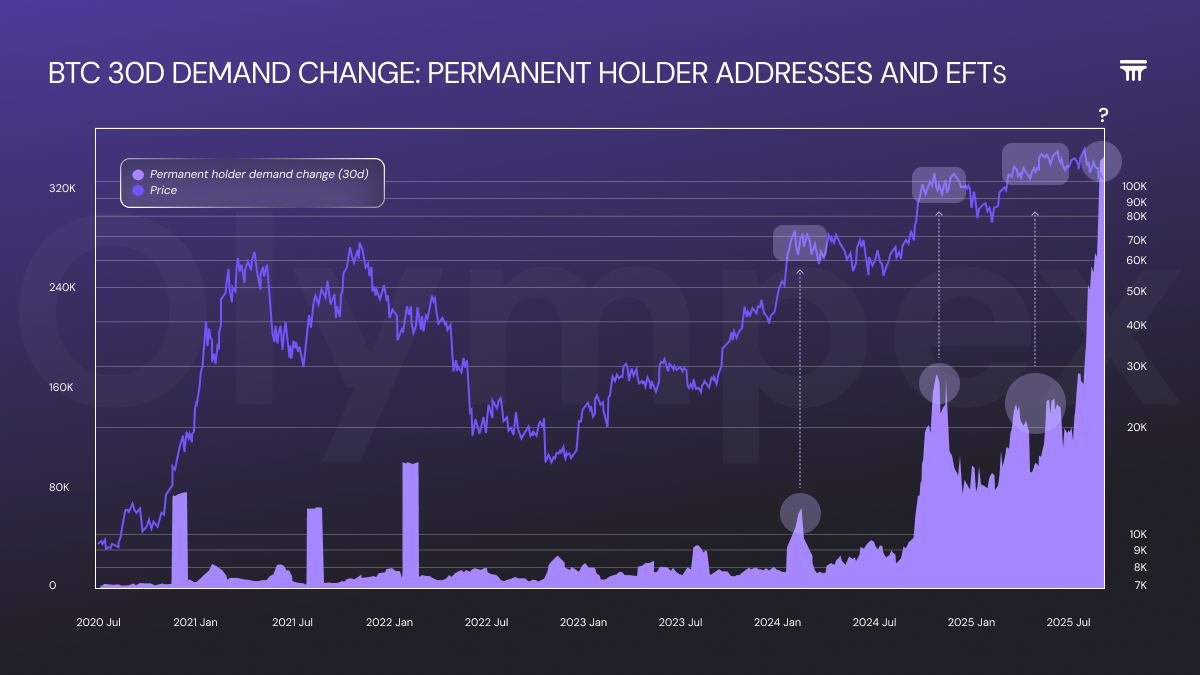
Despite price weakness and surging losses, permanent holders are accumulating at one of the strongest rates of the cycle. Their conviction has not cracked, in fact, it is accelerating. Historically, when long-term investors increase their acquisition during periods of stress, it lays the groundwork for the next expansion phase.
This divergence, short-term panic vs. long-term confidence, is a defining characteristic of transition periods in the market. It signals that although price may fall further in the short term, the underlying network health remains robust.
Bitcoin, at its core, is still being accumulated by those who understand its full arc.
In DeFi, Structural Strength Matters More Than Ever
While Bitcoin wrestles with a period of recalibration, DeFi continues to face its own trials. This week reminded the market that true resilience comes not from hype, but from architecture, security, and transparency.
Protocols that lack verifiable governance, audited smart contracts, or clear risk frameworks continue to struggle in attracting sticky liquidity. Meanwhile, platforms committed to transparency, on-chain dashboards, public treasury movements, documented upgrade processes, are the ones earning long-term trust.
For Olympex, this remains our core principle:
In volatile cycles, the strongest protocols are the ones built on clarity rather than opacity.
Markets may tremble, but trust, once earned, does not.
Outlook: A Market Searching for Its Floor
The week ends with Bitcoin in a reflective state.
Short-term pain is evident, yet long-term belief remains unshaken.
The reopening of the U.S. government removes a cloud, but the winds of macro uncertainty persist. Realised losses suggest a market approaching exhaustion, STH capitulation hints at emotional climax, and permanent holder demand gives the clearest signal of all: the foundation is not breaking, it is strengthening.
In every cycle, markets must breathe out before they can breathe in again.
This week felt like another long exhale.
Coming Soon from Olympex Labs
Cross-Chain Swap + Advanced Limit Orders
Olympex Pass NFT Program
Crypto School by Olympex - our new educational series
Olympex Labs
Building the future of DeFi, one transparent block at a time.
🔗 olymp ex.io | X: @olympexlabs





