
Liquidity pools are one of the most transformative ideas in decentralized finance. They sit quietly beneath every swap, holding markets open day and night, and they allow ordinary users to become liquidity providers rather than passive spectators. In Lessons 1 and 2, you learned how wallets connect you to DeFi and how stablecoins bring order to volatile markets. This chapter takes you inside the machine that powers nearly every on-chain trade.
To appreciate the value of liquidity pools, imagine the difference between traditional finance and DeFi. In old financial systems, only specialized market makers had the privilege of providing liquidity. Their algorithms and large capital reserves shaped how trades were executed. In DeFi, the rules are rewritten. Liquidity comes from users who deposit their tokens into a shared pool, and smart contracts handle all execution. This creates a financial environment that is open, fair, and responsive without requiring a central authority.
Press enter or click to view image in full size
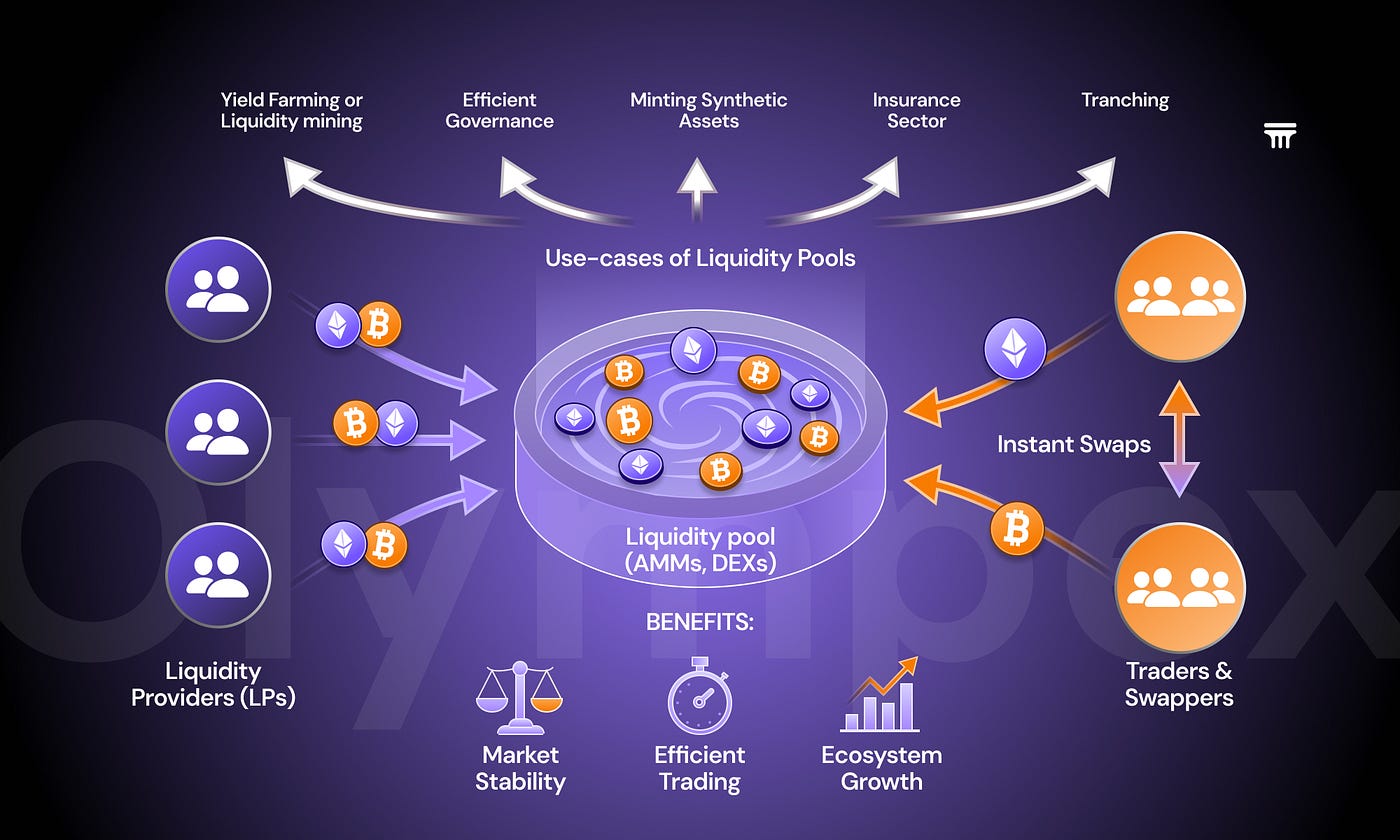
The mechanism behind liquidity pools is an Automated Market Maker. Instead of relying on buy and sell orders, the AMM uses formulas to determine prices as assets move in and out. Imagine a pool that contains equal value of ETH and USDC. Every time someone buys ETH, the amount of ETH in the pool decreases while USDC increases. The formula reacts by raising the price of ETH, reflecting its new scarcity. When someone sells ETH into the pool, the opposite happens. The market updates itself continuously because the pool is mathematically designed to self adjust.
Providing liquidity is simple in structure yet powerful in impact. When you deposit tokens into the pool, the protocol gives you LP tokens that represent your share. As trades occur, the pool collects fees. Those fees accumulate and become part of the rewards you earn for supporting the system. This is why many users describe liquidity provision as making your crypto work for you. The pool handles the trades, while you earn from the activity.
Press enter or click to view image in full size
One important concept appears early in every liquidity provider’s journey. It is the idea known as impermanent loss. When you place two assets inside a pool, the pool automatically adjusts their proportions as traders interact with it. Depending on market conditions, the combined value of your tokens inside the pool may differ from what you would hold if you kept the assets in your wallet. The difference is not always negative and often becomes insignificant when fee income outweighs it, especially in pools that use stable assets. Still, understanding how price movements affect your position equips you to make informed decisions.
The reason liquidity pools matter so much is that they give DeFi its always on nature. Swaps execute instantly because they never wait for another trader on the other side. The pool itself becomes the counterparty to every trade. Without this design, the decentralized economy would feel fragmented and slow. With it, DeFi becomes a continuous global marketplace.
Inside Olympex, liquidity pools take on an even more dynamic role. Every swap you execute is routed through a search process that scans pools across multiple chains. The routing engine identifies which combination of pools delivers the best price, the lowest slippage, and the smoothest execution. Stablecoins are often the hidden connectors in this process. Their predictability makes it easy to move liquidity through several steps without unexpected price jumps. What the user sees feels simple, but the underlying infrastructure is a sophisticated orchestration of liquidity sources.
Press enter or click to view image in full size
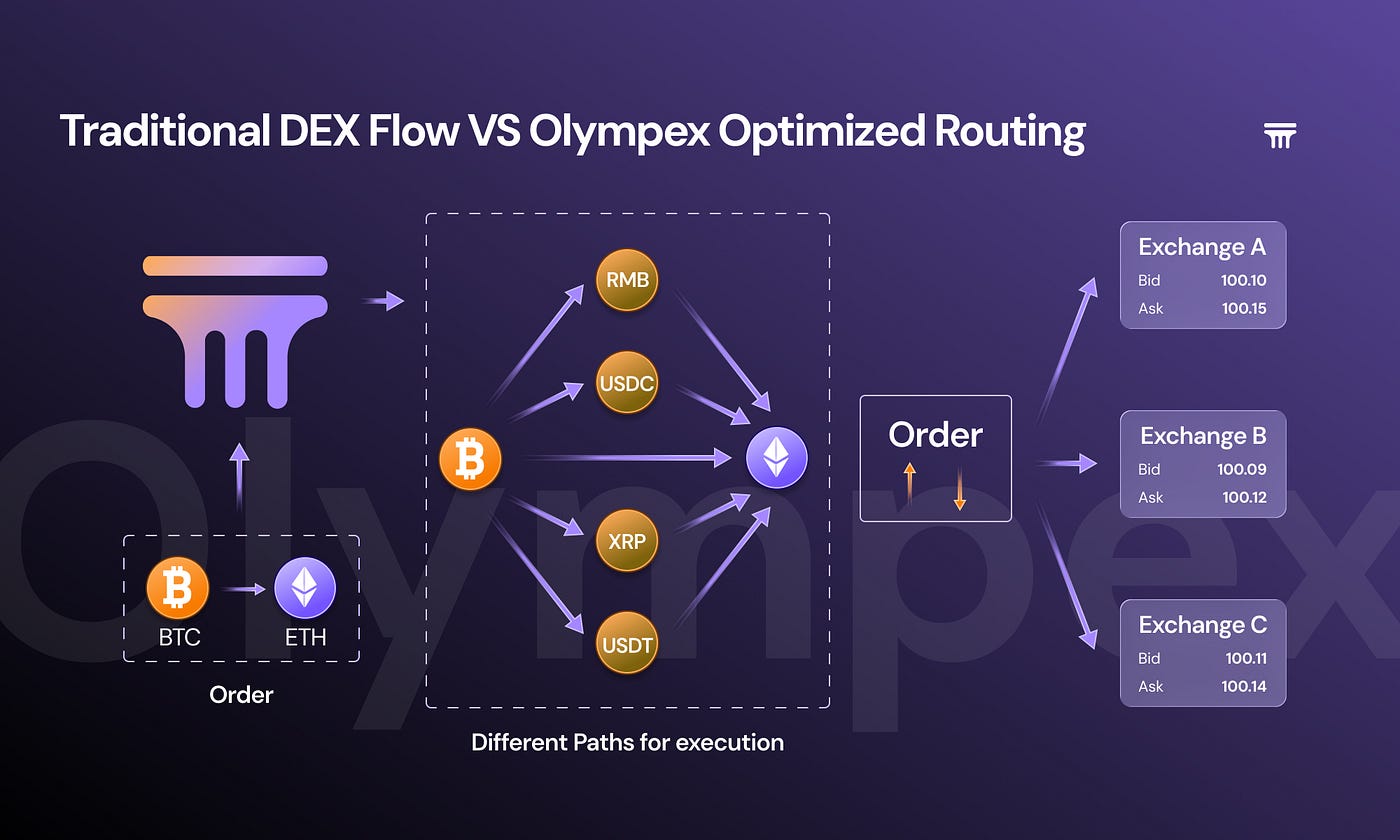
When you continue exploring the flow of a trade inside Olympex, the role of external liquidity becomes much clearer. The platform does not rely on its own pools. Instead, it reads the state of liquidity across many decentralized exchanges at once and evaluates which combination of sources can produce the best outcome for the user. Every pool involved in this process belongs to the wider DeFi ecosystem, whether it sits on Uniswap, Curve, PancakeSwap, Sushi or any other integrated protocol. Olympex becomes the intelligence layer that interprets all this fragmented liquidity and turns it into a single cohesive experience.
This is why a trade on Olympex often takes a route that seems more complex than a simple one pool swap. The aggregator examines prices, liquidity depth, slippage risk, gas implications and even cross chain conditions before deciding how to move the assets. The user only sees a clean confirmation screen, yet behind that simplicity is a sophisticated search across networks and protocols. In many cases, stablecoins serve as a bridge that links one liquidity venue to another, allowing the routing engine to travel smoothly through the DeFi landscape without exposing the user to unnecessary price movement.
Once the route is determined, the transaction unfolds automatically through smart contracts that interact with the chosen external pools. The user never gives custody of funds to Olympex. Everything is executed on chain, and every step remains transparent and verifiable. What feels like a single swap is actually a coordinated sequence of interactions with decentralized liquidity sources that Olympex orchestrates on the user’s behalf.
This approach is what gives the platform its fluidity. Instead of forcing users to visit multiple exchanges, bridge assets manually or make price comparisons across chains, Olympex condenses the entire DeFi infrastructure into one interface. It turns a complex environment of independent pools into a unified trading experience while keeping the underlying mechanics fully visible for those who wish to inspect them.
The user receives the benefits of deep liquidity and optimal routing without ever leaving the comfort of a single platform.
Understanding liquidity pools is not about memorizing formulas, but about learning how decentralized markets actually move and where opportunities come from.
If you want to continue this learning process alongside other users who are exploring DeFi step by step, join the Olympex Telegram community. There, we discuss real examples, break down concepts like liquidity and routing in simple terms, and connect theory with what is happening on-chain in real time. DeFi is easier to understand when you learn it together.
Your journey continues as soon as you are ready.





