
Composability, Incentives, and Identity: The Return of NFTs in DeFi
How NFTs are making a strong comeback in the DeFi ecosystem as composable pieces, incentive tools, and identity layers, and how Olympex integrates these functions into its product offering.
More Than JPEGs: The Second Life of NFTs
NFTs are no longer just images or status symbols. After the wave of speculation and subsequent market correction, non-fungible tokens have reemerged as operational components: access keys, governance instruments, collateral, and revenue-sharing vehicles. This revaluation centers on three pillars: composability, incentives/yield, and identity/reputation. This article reviews each pillar and shows how Olympex leverages this logic to turn NFTs into functional elements within DeFi.
Brief Historical Reminder: NFTs and DeFi Crossed Paths Early
While the PFP and digital art market dominated the public narrative, there were technical implementations where NFTs played a key role in DeFi. A prime example: Uniswap V3 represents liquidity provider positions as ERC-721 (NFTs), enabling these positions to be portable and composable from the start.
docs.uniswap.org
Another milestone: play-to-earn games like Axie Infinity demonstrated that NFTs could sustain entire economies; Axie reached millions in revenue at its peak (2021 reports placed income around $1.3B), showing the economic potential of NFT-centric models.
Sources: Forkast, Yahoo Finance
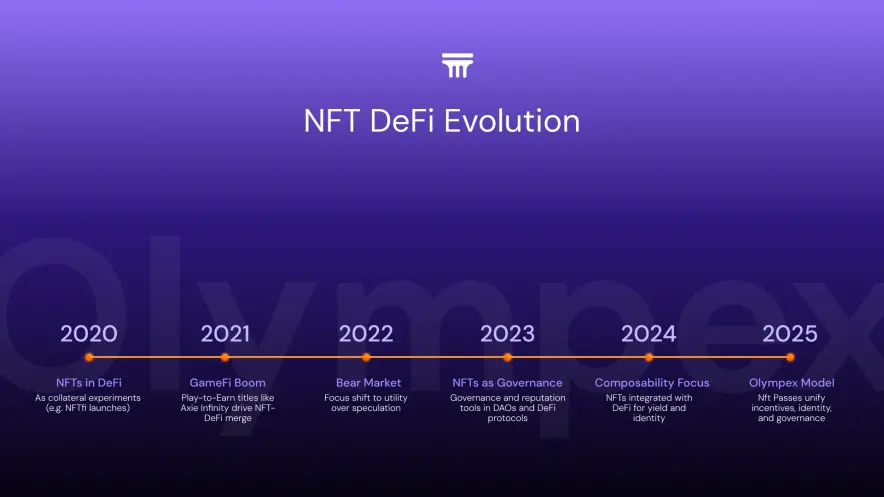
NFT Evolution
Composability: NFTs as Reusable and Linkable Pieces
The true technical advantage of NFTs lies in their non-fungible nature combined with composable standards:
An NFT can represent a position in an AMM (liquidity position), a ticket, or a license. As a token (ERC-721 or ERC-1155), it can be transferred, fractioned, used as collateral, or integrated into contracts that read its metadata. Uniswap V3 exemplifies this by exposing positions as tokens readable by other contracts.
docs.uniswap.org
Protocols like NFTfi allow NFTs to be used as collateral for loans, connecting collector assets to liquidity markets and expanding their financial utility. This turns a “static” token into an asset with concrete financial utilities.
nftfi.com
Composability creates an ecosystem where a single NFT can enable actions across multiple protocols without the user having to “remove” the token from the workflow.
Incentives and Yield: NFTs as Engines of Sustained Economy
NFTs today are designed to generate repeated value flows, not just one-time sales:
- Revenue sharing models tokenize stakes (e.g., NFTs granting a share of platform income).
- In gaming and playful applications (e.g., Aavegotchi), NFTs combine staking, rewards, and on-chain upgrades that create utility and return for holders.
aavegotchi.com
docs.aavegotchi.com
NFT lending markets and yield platforms allow NFT ownership to translate into liquidity or yield access, incentivizing active holding and use.
nftfi.com
Chainlink
This changes the value proposition: NFTs cease to be mere collectibles and become incentive vehicles.
On-chain Identity and Reputation: NFTs as Containers of History
NFTs also serve as non-fungible records of participation and identity:
POAPs (Proof of Attendance Protocol) act as event badges, creating verifiable participation histories that can integrate into loyalty or gating programs. Major brands and events have experimented with POAPs to engage communities.
Welcome to POAP
ENS and its metadata use NFT-like standards to map identity, avatars, and web3-readable records. This demonstrates how tokens can anchor digital identity and reputational properties.
docs.ens.domains
The idea of Soulbound Tokens (SBTs) non-transferable tokens proposed by Vitalik and others aims to use tokens as social or professional credentials accompanying an on-chain identity (e.g., certificates, degrees, contribution history), reinforcing NFTs’ reputational dimension.
Vitalik.eth.limo
Together, these vectors turn NFTs into containers of history and trust signals within decentralized environments.
Risks and Lessons: Why the New Approach Is More Robust
The first wave showed clear risks: utility-less collections, unmet roadmaps, and market manipulation. The current response is pragmatic:
- Prioritize contractual transparency (audits and clarified rights).
- Avoid models relying solely on FOMO; instead, design continuous utilities (access, yield, governance).
- Emphasize interoperability and composability, an NFT should “work” across different contexts without losing utility.
These lessons correct excesses from the speculative phase and move toward sustainable models.
How Olympex Integrates Composability, Incentives, and Identity
Olympex incorporates these principles within an architecture designed for NFTs to be operational instruments rather than mere collectibles:
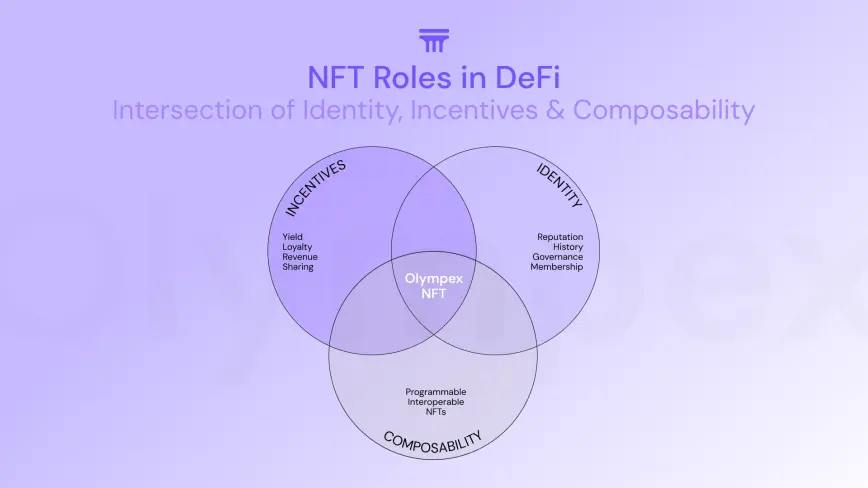
NFT in DeFi
- Olympex Pass: a utility NFT evolving (Bronze → Silver → Gold) based on activity, granting fee discounts and access to benefits; functioning as an incentive and belonging layer. (Official details on Olympex website)
olympex.io
app.olympex.io - Olympians: investment NFTs designed to grant participation in platform revenue (structure and terms defined in smart contracts and T&Cs). This is an example of NFTs integrating direct economic incentives.
app.olympex.io - Technical integration: Olympex combines a DEX aggregator, cross-chain swaps, bridges, and strategy tools (DCA, limit orders) into a unified flow where NFTs act as enablers for benefits, whitelisting, and access levels, avoiding UX fragmentation.
olympex.io
In sum, Olympex transforms the logic of “owning an NFT” into “operating with an NFT” within a unified infrastructure.
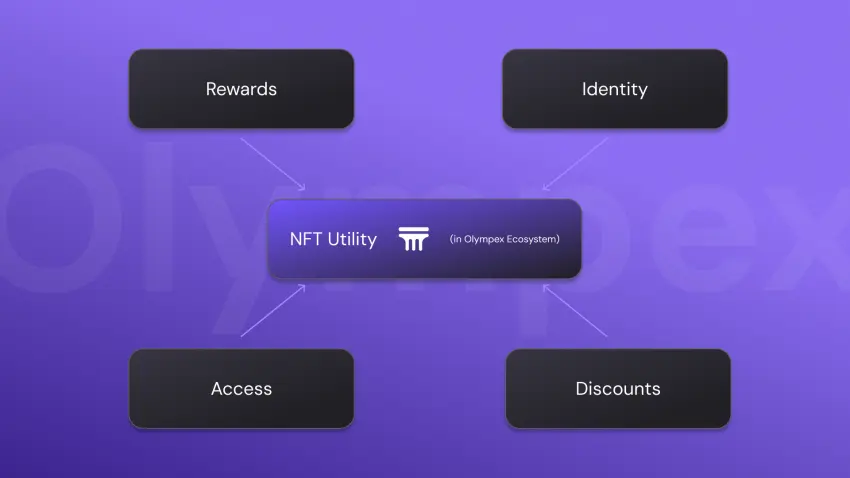
NFT Utility
Concrete Examples and Use Cases
- A Pass granting whitelist access and reducing swap fees is a direct incentive to use the platform (Olympex Pass).
olympex.io - An Olympian NFT receiving periodic distributions tied to platform revenue, a tokenized revenue share model (see T&Cs).
app.olympex.io - A user leveraging an NFT as collateral for a loan on NFT lending platforms (e.g., NFTfi) while retaining platform benefits function composition.
nftfi.com
Conclusion: NFTs as Functional Belonging Structures
The hype cycle taught us two lessons: (1) speculative value without utility erodes quickly; (2) NFTs that survive are those incorporating composability, recurring incentives, and identity signals.
Olympex embodies this shift: treating NFTs as functional belonging structures instruments granting benefits, enabling participation, and bridging multichain interoperability rather than mere collectibles.
In practice, the new generation of NFTs is infrastructure with a face: combining product, economy, and reputation. This is exactly what
Explore Olympex → https://olympex.io/





