
Trading is not about predicting the future. It is about building a process: knowing when to enter, how much to risk, when to exit, and how to react when the market does not behave as expected.
For Olympex, this is the real edge: helping traders move beyond impulse and into structured execution. The following four strategies combine lessons from market psychology, classic speculation, risk management, value investing, and modern portfolio infrastructure. They are inspired by ideas found in Trading in the Zone, Reminiscences of a Stock Operator, The Intelligent Investor, and Day Trading and Swing Trading for Dummies.
1. Probability-Based Trading: Trade a System, Not a Feeling
The first strategy starts before the chart. A consistent trader does not need to be right on every trade. A consistent trader needs to think in probabilities, accept risk, and execute a plan without emotional interference.
This idea is central to trading psychology: the market does not owe us certainty. Every trade has an uncertain outcome, but a well-defined system can produce an edge over a large enough sample of trades.
Before entering a position, a trader should know three things:
What is the setup?
Where is the invalidation level?
How much capital is at risk?
If there is no clear invalidation, there is no trade. There is only a bet.
A practical example would be a trader who only buys after price breaks a key level, pulls back, and confirms support. The entry is not based on “it feels like it will go up.” It is based on a repeatable structure.
This is where tools like technical analysis charts on TradingView can help traders visualize support, resistance, and market structure before making decisions. TradingView describes support and resistance as one of the most widely used concepts in technical analysis.
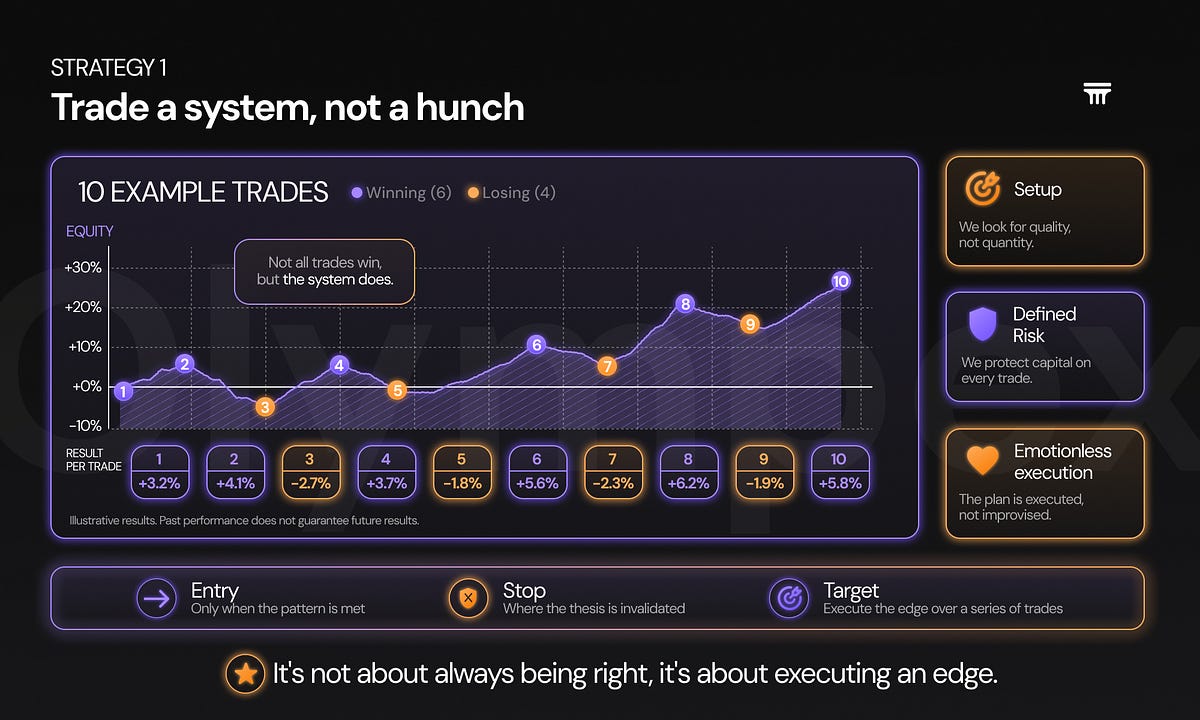
Execution rule:
Risk per trade: 0.5% to 1% of capital.
Entry: only when the setup is confirmed.
Stop: where the thesis becomes invalid.
Target: partial exit at the first objective, then trail the rest if momentum continues.
The key lesson is simple: one losing trade does not mean the system is broken. Poor execution does.
2. The Livermore Principle: Cut Losses Fast and Let Winners Run
One of the most important lessons from Reminiscences of a Stock Operator is that traders should never become emotionally attached to a position. A small loss is part of the business. A large loss often comes from refusing to accept reality.
The story of Jesse Livermore shows how timing, market psychology, leverage, and discipline can define the difference between survival and destruction in the market. The book was originally published in 1923 and is widely recognized as a classic fictionalized account inspired by Livermore’s trading career.
This strategy is built around trend-following. Instead of fighting the market, the trader waits for confirmation, enters when price proves strength, and exits quickly if the market invalidates the thesis.
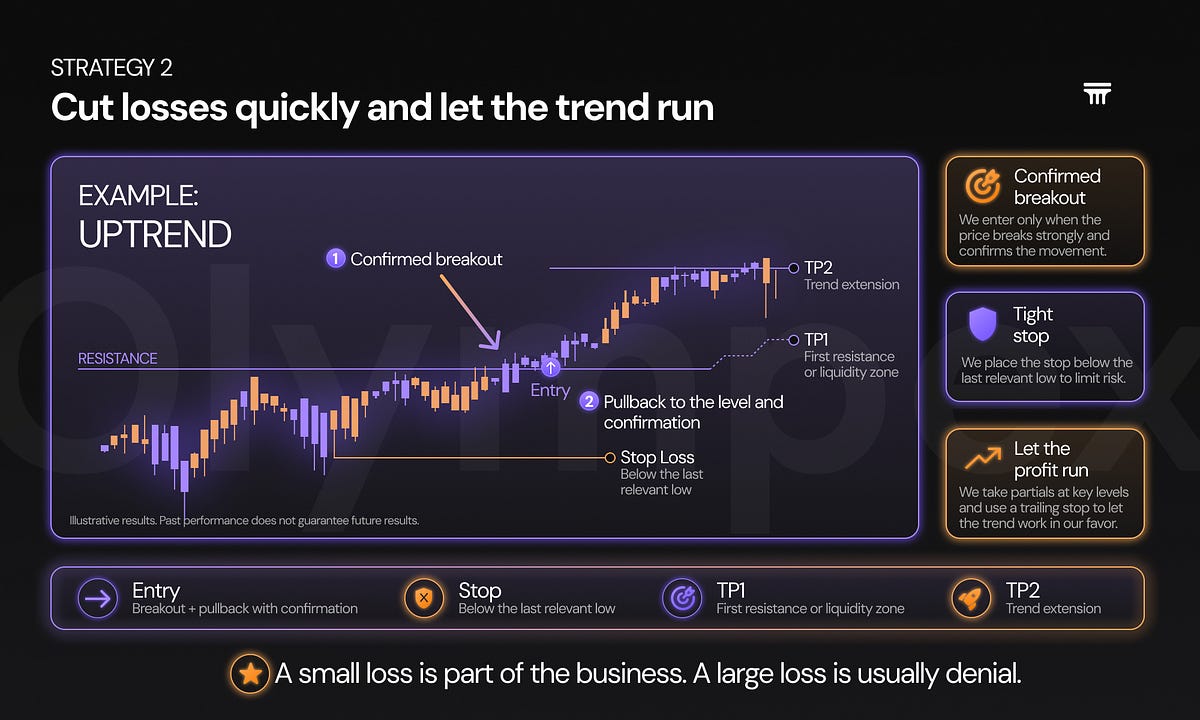
A simple bullish version looks like this:
Price is trending upward.
Resistance is broken with strength.
Price pulls back to the breakout area.
The level holds as support.
The trader enters with a stop below the last relevant low.
The stop is not random. It is placed where the original idea is no longer valid.
For traders, understanding stop-loss orders is essential because they are designed to help limit losses or protect gains once a predefined price level is reached.
Execution rule:
Long entry: breakout plus pullback confirmation.
Stop: below the last relevant swing low.
TP1: next resistance or liquidity area.
TP2: trend extension.
Management: move stop to breakeven after TP1.
The most dangerous version of this strategy is using leverage without discipline. Leverage does not improve a bad trade. It only makes the consequences bigger.
3. Margin of Safety: Do Not Pay Any Price
A good asset can still be a bad trade if the entry is poor.
This principle comes from value investing but applies directly to trading. The Intelligent Investor emphasizes the difference between speculation and disciplined investing, especially through analysis, realistic expectations, and protection of capital.
For a trader, margin of safety means refusing to chase price. It means waiting for a level where the potential reward justifies the risk.
A trader may have a strong thesis, but if the entry is too late, the stop is too wide, or the target is too close, the trade does not deserve capital.
That is why the risk/reward ratio matters. It compares the distance between entry and stop against the distance between entry and target, helping traders decide whether the potential reward justifies the risk.
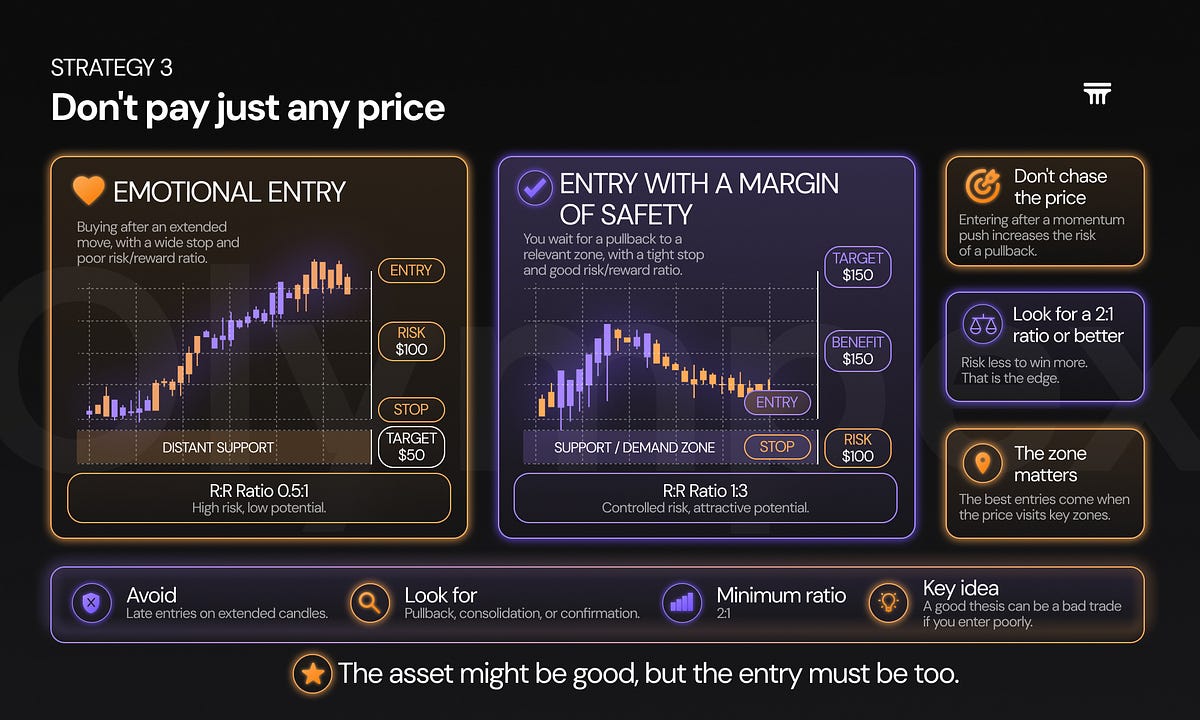
Execution rule:
Do not enter if price is too far from the logical stop.
Do not chase extended candles.
Wait for a pullback, consolidation, or confirmation.
Only take trades with at least a 2:1 reward-to-risk profile.
Example:
If the trader risks $100, the potential reward should be at least $200. If the setup only offers $80 of potential reward for $100 of risk, it is not a high-quality trade.
The key lesson: being right about direction is not enough. The entry must also make sense.
4. Olympex Strategy: DCA, Liquidity, and Smart Rotation
Not every market opportunity requires perfect timing. Some strategies are designed to build exposure gradually, preserve flexibility, and rotate capital as conditions change.
This is where Olympex’s infrastructure vision becomes especially relevant. The modern trader does not only need access to assets. The modern trader needs the ability to allocate, protect, rebalance, and react.
This strategy divides capital into three main buckets:
Growth assets: assets with upside potential.
Protection assets: defensive assets such as gold or lower-volatility instruments.
Liquidity: stablecoins or cash-like positions reserved for opportunity and risk control.
The first tool is Dollar-Cost Averaging, or DCA. Coinbase explains DCA as investing a fixed amount at regular intervals to reduce the impact of volatility on large asset purchases.
The second tool is liquidity. Holding liquidity does not mean doing nothing. It means having the ability to react when the market creates opportunity.
In crypto and DeFi markets, stablecoins are often used as a liquidity layer because they are designed to maintain a stable market value, usually by being pegged to fiat currency, commodities, or other assets.
The third tool is rotation. When volatility increases, a trader may reduce growth exposure and move toward protection or liquidity. When trend conditions improve, capital can rotate back toward higher-beta opportunities.
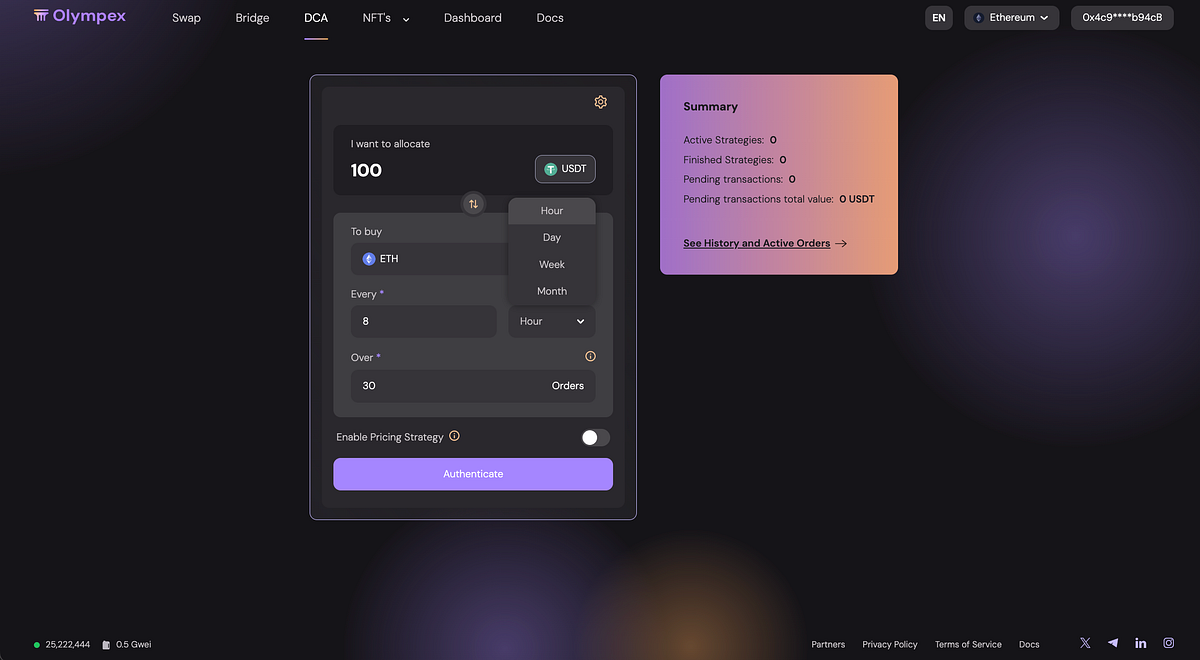
Execution rule:
Use DCA to build positions in high-conviction assets.
Keep part of the portfolio in liquidity.
Rotate toward defensive assets when volatility rises.
Rotate toward growth assets when trend confirmation returns.
This approach is not about predicting every move. It is about staying in the game long enough to capture the next opportunity.
Final Takeaway: Professional Traders Do Not Chase Excitement. They Follow Process.
The four strategies connect into one operating framework:
Think in probabilities.
Cut losses quickly.
Demand margin of safety.
Keep liquidity available for rotation.
For Olympex, the message is clear: the next generation of traders does not only need more assets. It needs better infrastructure to execute, automate, rotate, and manage risk from one place.
The goal is not to trade more.
The goal is to trade better.





