
What's goin on Investors?
I've been seeing some internet chatter about the price being pushed to the 30K/40K ranges...I can't definitely say it won't, but I will attempt to explain why I believe it may not.
The Core Theory: A Manufactured Capitulation?
The speculation that Bitcoin could deliberately be driven down to the $35,000–$45,000 range so Wall Street can "restock" ETF inventory makes intuitive sense to some market observers. It plays into deep-seated narratives about institutional manipulation—echoing hedge fund manager Mark Yusko's warnings that sophisticated players "push the price down so you can buy more at a lower price."

However, when we examine the actual mechanics of today's Bitcoin market, this specific price target range ($35K–$45K) appears inconsistent with current institutional cost structures and market realities, even if the broader concept of institutional accumulation at lower prices contains elements of truth.
Why $35K–$45K Doesn't Align With Current ETF Economics
The most significant problem with the $35K–$45K target thesis is the average cost basis of existing institutional holdings. According to recent data, the average cost basis for ETF holders sits around $80,000–$84,000
. At current prices (~$78,000 as of early February 2026), many institutional ETF positions are already underwater.
A drop to $35K–$45K would mean:
- 45%–55% drawdowns from current levels
- Catastrophic losses for institutional mandates that entered in 2024–2025
- Massive redemptions as panicked investors flee, forcing ETFs to dump Bitcoin onto the market—exactly the opposite of "restocking."
Analysts at Amberdata note that there's a psychological and practical "ETF cost basis floor" around $60,000–$80,000, where institutional holders are unlikely to panic sell without a fundamental thesis change, but where structural support exists.
What the Data Actually Shows: Institutional Behavior in 2025–2026
Rather than a coordinated suppression campaign targeting $35K–$45K, the evidence suggests volatile, tactical accumulation at much higher levels:
Recent Institutional Activity (February 2026)
- After weeks of heavy outflows ($1.33B and $1.49B in consecutive weeks), Bitcoin ETFs snapped back with $561.9M in single-day inflows (Feb 3, 2026), led by BlackRock and Fidelity
- This pattern shows buying the dip (which I keep telling you to do!) in the $70K–$78K range—not waiting for generational lows
- Even as Bitcoin briefly touched $71,640 (its lowest since November 2024), institutional buying accelerated
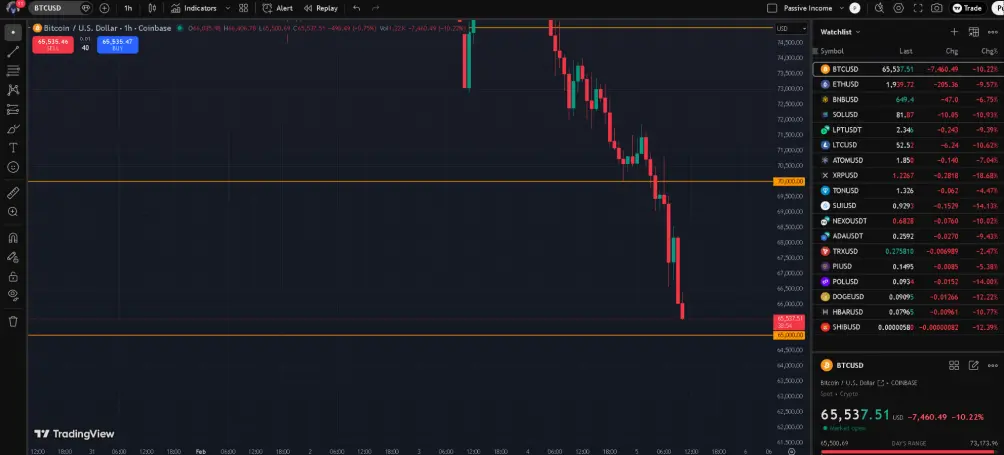
- That said, the current price suggests a much lower price action is ahead as Bitcoin sits around 65K at the time of writing (above photo)
The Structural Demand Gap
CryptoQuant's analysis reveals a stark reality: ETFs that purchased 46,000 BTC during the same period last year have become net sellers of roughly 10,600 BTC in 2026—a 56,000 BTC demand gap. This isn't strategic restocking; it's capital flight driven by macroeconomic headwinds, tariff fears, and risk-off sentiment.
The Manipulation Question: Partial Truth, Wrong Magnitude
The $35K–$45K "restocking" theory likely conflates two real phenomena with an exaggerated price target:
- Creation/Redemption Arbitrage Mechanics
Authorized Participants (APs) like major broker-dealers do indeed arbitrage price discrepancies between ETFs and spot Bitcoin. Through in-kind creation/redemption (now fully operational since mid-2025), APs can:
- Deliver BTC to create shares when ETFs trade at premiums
- Redeem shares for BTC when ETFs trade at discounts
- This creates "synthetic supply" pressure that can suppress prices temporarily
- Tactical Accumulation During Weakness
Mid-tier institutional whales (1,000–10,000 BTC) have indeed been aggressively buying recent dips while mega-whales (10,000–100,000 BTC) take profits—a "changing of the guard" that suggests smart money accumulation
. However, this accumulation is happening right now at $65K–$78K, and not waiting or looking for $35K–$45K not yet.

Realistic Downside Scenarios: Where Institutions Might Actually Step In
If you're looking for institutional "buy zones," the data points to these levels:
Level: $60,000–$68,000
Significance: 200-week EMA, July 2024 highs, maximum technical support
Probability: High (Bear case)
Level: $53,000–$56,000
Significance: Network realized price, ultimate support zone
Probability: Moderate (Severe stress)
Level: $65,000–$75,000
Significance: Current institutional accumulation zone, "strong hand" buying
Probability: Current activity
I know I'm Mostly Right on This Point, but I Could Still be VERY WRONG!
The $35K–$45K range would likely require:
- A 2008-style systemic crisis or major exchange failure
- Regulatory reversal invalidating the institutional thesis
- Complete collapse of the "halving cycle is dead" paradigm
My Final Thoughts
The Verdict: Intriguing Theory, I Believe Wrong Numbers
The narrative that Wall Street wants cheaper Bitcoin to refill ETF coffers contains structural truth—institutions do benefit from lower entry points, and ETF mechanics can create synthetic selling pressure. However, the specific $35K–$45K target appears to be retail fantasy rather than institutional reality.
Today's Bitcoin market is dominated by:
- ETF flows that move 12x daily mining supply
- Cost basis floors around $80K that institutions are already defending
- Regulatory clarity (U.S. Strategic Bitcoin Reserve, GENIUS Act) that makes $35K catastrophic rather than opportunistic
If institutions are "restocking," they're doing it now, in the $65K–$70K range, not waiting for a generational crash that would destroy the institutional adoption narrative they've spent years building. The "Wall Street restocking" thesis makes sense—but at prices roughly 50% higher than the conspiracy theories suggest.
The real accumulation zone isn't $35K–$45K. It's the $65K–$78K band we're trading in right now.
Until next time, The Dark Sage singing out ✌️
Faucets That Work:
POLYGON ECOSYSTEM TOKEN FAUCET
Banks & Exchanges:
CAPITAL ONE SHOPPING GET 40.00 for YOU & 40.00 for ME






