
Ask not what your state can do for you but what you can do for the state.
In my post on Monday, the 17th of April, I explored the relationship between knowledge and Power as identified by Foucault; specifically, learned knowledge or categorical knowledge and its relation to state authority. Today, I will explore how these relate to the state’s interests and what they mean for state subjects.
Foucault’s work continues to intrigue me. While I will adamantly say I do not see eye-to-eye with Foucault, I do think that what he’s communicating is of utmost value. When we get to the core of what Foucault has to say, look past his interest in sexual identity, psychiatry, or even the prison system, we start to see a pattern that I find troubling to deny. Foucault astutely identifies the state’s relationship to the subject or individual and how the latter either annihilates the former for its interests or gives it a new identity. These two possibilities are not mutually exclusive, but the latter does not necessitate self-annihilation outright, while the former does. I find it hard to fault this pattern because it seems to have been identified by both Burnham and de Jouvenel.
For Foucault, Biopolitics begins with the birth of post-Medieval politics and the emergence of nation-states. These nation-states, Foucault argues, are a product of the conflicts between different European groups vying for Power or control. Founded in conflict, this political paradigm conceived of truth not so much as a thing to intelligently grasp the world with, bereft of bias, but as a thing to dominate an adversary and to assert one’s self as the rightful inheritor of Power (c.f., Foucault’s allusion to the French king on pp. 63-64). Founding its identity in a struggle for Power, the post-Medieval European identity forced itself to confront class distinctions and the biological substrates on which they were founded (p. 64).
As a concept, the nation-state required the European to question his understanding of self-governance. This questioning produced new conceptions of how people relate to each other, between and within the classes, and how the state’s institutions relate to the people and each other (p. 68). Out of this investigation, “A new historical perception takes form; it is no longer polarized around the end of time and the consolidation of all the particular sovereignties into the empire of the last days; it is open to an indefinite time in which the states have to struggle against one another to ensure their own survival” (p. 69). This new framework or perception produces two goals for the state: The state must prepare for conflict with neighboring states and it must tend to the population so that they are willing to fight or defend the state. Effectively, the state’s population becomes a resource which was identified by both de Jouvenel and Burnham, as well. Foucault calls this system Polizeiwissenschaft, which is defined as “the theory and analysis of everything ‘that tends to affirm and increase the power of the state to make good use of its forces, to obtain the welfare of its subjects,’ and above all, ‘the maintenance of order and discipline, the regulations that tend to make their lives comfortable, and to provide them with the things they need for their livelihood’” (p. 70). I.e., a state that takes care of its population prepares them for war.
In part, Liberalism (as Foucault analyzes it) stands against this system. I say "in part" because, as Foucault suggests, Liberalism’s goal is to question when the state has overstepped its limits; when there is too much government. Still, this analysis of Liberalism is not extensive. This analytical conception of Liberalism is distinct from Burnham’s Liberalism (which is far more exhaustive) but the conflict can be resolved. Foucault is analyzing Liberalism as it was classically; i.e., Classical Liberalism of the laissez-faire variety. What Burnham means by Liberalism is the Progressive or Managerial variety (c.f., Suicide of the West). Regardless, what Foucault makes clear is that for Liberalism to engage in its analytical processes properly, it must consider the conditions the state is dealing with, i.e., the problems facing the state and its people (e.g., Germany and the United States post WWII, pp. 77-79). If it disregards a state’s problems or conditions, then it cannot see when the state has overstepped its bounds. This analytical conception of Liberalism seems to be the basis for Foucault’s understanding of the problematic as elucidated in later interviews with Foucault (which can be found in the cited work).
What Foucault notices is that the state simultaneously asks individuals to acknowledge the truth and submit themselves to an authority that has a limited understanding of the truth (c.f. my post from Monday). To resolve this, the state engages in two practices: exomologesis (p. 81) and exagoreusis (p. 83). Exomologesis is intended to reveal a truth and a subject’s adherence to that truth; i.e., to affirm what one believes and the fact of that belief. Foucault suggests this act was traditionally performative rather than explicitly verbal; i.e., something like genuflection but more diverse. Exagoreusis requires or necessitates a teacher or master, is a way to examine one’s conscience, and is an exhaustive exploration of one’s mental impulses. This was achieved through self-examination at the day’s end and perpetual self-reflection or accounting throughout the day (p. 83). The end goal of exagoreusis was not Liberty, i.e., to make one a sovereign or give one the tools to become sovereign (as defined by Burnham and de Jouvenel). Rather, it was self-annihilation (p. 84). Through this process, the state could manufacture subjects and dissolve the distinctions between members of the nation, the nation and state, and – for that reason – members of the state. I.e., the individual was to become nothing more than a cell of the state’s organs.
What could the state do or what can individuals do to avoid this fatal outcome? Foucault argues that we should be less concerned about asking “what we are” but rather “how we should care for ourselves?”.
One’s circumstances pose problems for an individual, requiring him to care for himself, to know himself, and to subjectify himself to care for himself. Out of these conditions, the individual receives, (irrespective of its source) an injunction to care for themselves. To care for one’s self, one needs to know who one is. Thus, the individual needs to subjectify and conceptualize themselves qua themselves, producing a theory of knowledge or conceptual knowledge based on experiential knowledge of the self. The government can enter this process to tend to the individual as a subject for its own aims. The state or government can use this theory of the subject for its personal interests, especially if the subject poses a problem for the state and its members. However, the state as Power only cares for its interests. Thus, when the state provides its injunctions to individuals based on the theoretical knowledge it acquires from the conceptual subject, it intends to increase its authority and ability to defend itself against other states or to conquer those states by resolving its, its members, or the individual’s problems.
What Foucault provides us is a system of care. The initial injunction, as has been stated, requires us to know who we are. To achieve this, we need to find, within ourselves or for ourselves, a space or mia khôra. Within this space, by making true statements [verdica dicta], cleansing one’s self of false beliefs or opinions, physically disciplining one’s self, and cultivating a self through therapeutic practices, one can produce a self-concept (the subject). This subject must then become automatic, habituated, or embodied. An embodiment of the automatic self is achieved by paying attention to one’s self and their surroundings (i.e., listening); taking notes about one’s day, what one’s thinking and learning, or by writing down questions and engaging in a dialogical process; and lastly, through self-retreat (i.e., anakhorēsis eis heauton) wherein one may account for the treasures acquired through self-development and reflect on how one has grown.
What I claimed last time was that the state or sovereign fails when it isn’t capable of thinking counterfactually. Foucault also seems to recognize that self-development requires something like counterfactual thinking. I.e., “One can distinguish between those exercises carried out in a real situation, which basically constitute training in endurance and abstinence, and those which constitute training in thought by means of thought” (p. 102). This distinction is the difference between vérité and savoir. Where the latter can produce delusions, i.e., cause magical thinking, the former forces the individual to face reality. How does Foucault suggest we do this?
Foucault provides individuals with four methods: praemeditatio malorum, exercitatio, reflection on representations that cause emotional responses, and meletē thanatou (pp. 102-105). Foucault’s description of the latter of these is profoundly moving, in my opinion, and helps the reader see what – I think – Foucault is ultimately trying to communicate. Through these checks and through the processes of self-development, Foucault provides us with a model for developing an ethical mode of being. What’s fascinating is that, because problems or contradictions constantly present themselves to us, the need to reconstitute what it means to care for one’s self, i.e., update and develop the automatic self, is constant. As the automatic-self expands, it encounters new problems and contradictions, forcing itself to reflect on itself again and reconsider how it's interacting with its environment. In theory, can constantly develop and grow through this process.
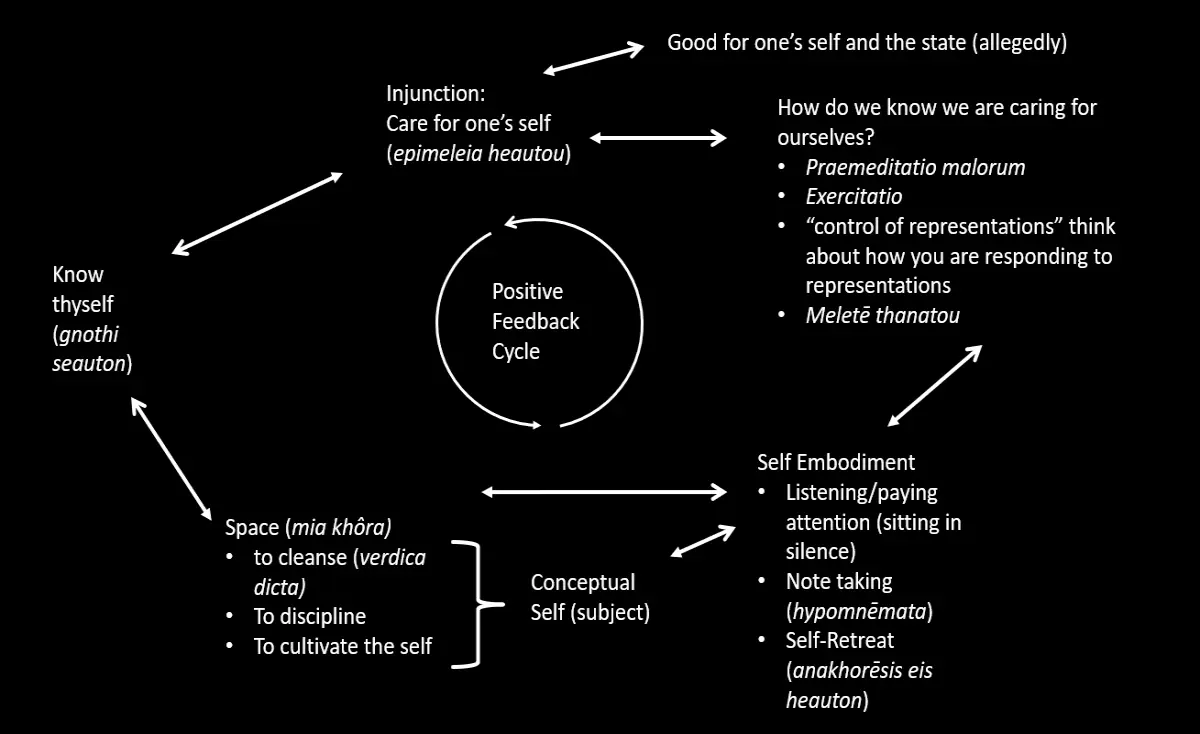
Foucault argues the state has a significant interest in this process. If the reader can recall the meaning of Polizeiwissenschaft, they should be able to recognize that the state has an interest in letting the individual develop himself as a subject of the state through the state without the state treating him as a mere category. Unfortunately, I do not think the state can do this. The state, as a structure for and of Power, is self-interested. If it faces a problem posed by any of its members that conflicts with its interest for self-preservation and conquest, those problems will be ignored. The state is a product of Power struggling against other Powers; and out of this struggle, the state and Power realized it is useful to treat their members as cells of their body rather than individuals (c.f., de Jouvenel’s discussion on conscription during the Napoleonic era).
There are also limits to the ethical process, even if Foucault doesn’t acknowledge this and says the opposite. In Foucault’s later interviews, especially on homosexuality (pp. 141-156), the reader might feel as if Foucault is confusing his behavior with his desires or interests. In particular, he confuses pleasure, death, pain, and power. Still, I do think it is necessary to consider his statements from his life’s context. With this context in mind, we should consider what Foucault says in his interviews, but we should not pretend as if he has full access to the developmental mode he has provided us or that he’s engaging in verdica dicta (as a cleansing or purifying practice). As he develops himself, he is working out his life’s contradictions; he is as much a problem for himself as the forces he’s wrestling with. Readers should note here that self-development is limited by an individual's nature, conditions, and ability to perceive them.
Foucault also seems to recognize essential differences between categorical subjects (although not explicitly consenting to them), if not in substance then at least logically. He clearly states Homosexuals are not Heterosexuals, he even – in his silence and laughter on the subject – implies there’s a difference between Gays and Lesbians and, by extension, Men and Women. Still, as categories, these concepts have no essence, and I think this is what Foucault is implying when he refrains from assenting to Essentialism (p. 164). Foucault acknowledges essential differences tacitly but places a significant emphasis on becoming – existence – through his ethical model. His emphasis on becoming implies a thing that can become, i.e., a thing with the essence of becoming; a thing with the nature to become. For contemporary critics to place the problematics of transgenderism, transvestites, or intersex persons on his shoulders suggests an ignorance of his work, at least his ethical work. As paradoxical and contradictory categories, these problematics have an essence quite distinct from the Homosexual, Gay, Lesbian, Heterosexual, Man, or Woman, especially vis-à-vis their circumstances. The “We” uniting them would, I think from Foucault’s perspective, be a thing to critique, especially that “We’s” relationship to the state as a category for the state's self-interested goals.
For the sensible right to disregard the ethical process Foucault has provided us (which has its roots in Stoic and Epicurean philosophy), or what he has to say about the way a subjective identity’s problems force the state to synthesize solutions to their identity for its own survival is to do themselves, and Foucault, an injustice. The sensible right, in its current condition, doesn’t appear to accord with the progressive state’s machinery. Still, that progressive machinery probably won’t be able to perpetuate itself without members from the sensible right. Foucault’s identity-less-ness posed a problem for his contemporaries, but the way he performed his identity, confronted his paradoxes or contradictions (within himself and from the state), and forced the state to acknowledge and resolve those paradoxes through dialogue, here there are significant lessons for the sensible right to learn from.
Bibliography:
Burnham, J. (1964). Suicide of the West: An Essay on the Meaning and Destiny of Liberalism. Encounter Books.
De Jouvenel, B. (1945). On Power: The Natural History of its Growth. Liberty Fund.
Foucault, M. and Rabinow, P (translator) (1997). Michele Foucault: Ethics, Subjectivity, and Truth. Editions Gallimard.





