
"Dig Deeper"
A woman is an adult human female. I do not need to be an accredited biologist to answer this question. Dylan Mulvaney, full stop, is not an adult human female. He is a man, an adult human male, who pretends to be a woman. However, I think there’s much to learn from Dylan.
Dylan, I think, reflects the United States’ or the West’s struggle with its identity. Specifically, I think that he represents the identity crisis Men and Women are facing. His identity juxtaposes the Masculine and Feminine and forces us to confront our inability to acknowledge that there are differences between the sexes, patterns of behavior that occur more frequently in one sex than the other, and roles that lead to the best outcomes for both sexes.
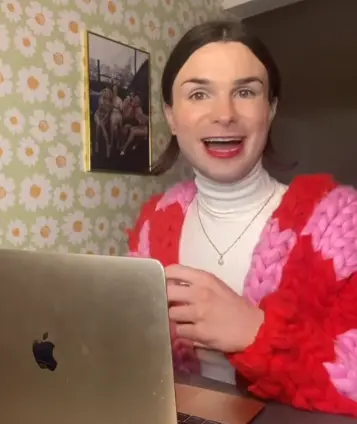
This is one of the first images of Dylan Mulvaney. I think this image is striking. First, in the foreground, we see the Apple laptop. The image of the Apple echoes Biblical themes in Genesis, specifically Adam and Eve taking from the Tree of Knowledge. Just as the fruit of that tree falsely convinces Adam and Eve that they can define what’s good or evil for themselves, so too is Dylan, here, defining what is good and bad for himself. He is asserting himself as the final definer of who he is. Neither God, nature, culture nor traditional gender roles will define Dylan henceforth in his mind.
Fascinatingly, in the background, we see an image from HBO’s Sex in the City. In Sex in the City, from what I recall, Sarah Jessica Parker’s character is working as a writer and riding the rooster carrousel. Sarah’s character idolizes Mr. Big, the man she loves and, in some sense, also wants to be. Sex in the City reflects a woman’s desire to overcome the culture she finds herself within, her nature, and the will of God. Just as Carrie Bradshaw seeks to overcome the gender roles she’s defined by, so too does Dylan seek to overcome his. From an American viewpoint, we really can’t say Dylan is diminishing what it is to be a woman. From this perspective, he is simply living by the same standards established by women through cultural artifacts like Sex in the City. In both, they are defining good and evil for themselves. In both, they are defining their natures and themselves. In both, they are defining culture through their actions by throwing off the yoke of their traditional culture’s demands of them. In the case of Carrie Bradshaw’s character, or at least her author, it didn’t work out so well. One can only predict that for the likes of Dylan, the same will be the case.
However, unlike Carrie Bradshaw, Dylan is filling the void that contemporary women have left. In many of his pieces, he seeks to capture the traditional roles that women once filled; specifically, the artistic roles they once filled, many of which reflect icons of the ’50s, ’60s, and ’70s.
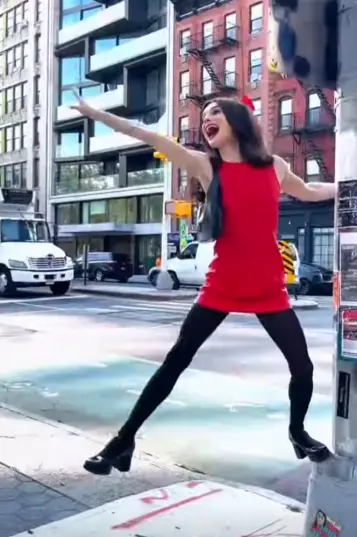
In this image, we get a glimpse of his obvious musical theatre background (which there’s nothing inherently wrong with), echoing the musical Thoroughly Modern Millie. Here, also, we can see the trope, found in Sex in the City as well, of the woman’s desire to overcome and conquer the grit of the city. Dancing down the street, he reflects Carrie Bradshaw’s unwillingness to let the city be a man’s place. He’s not going to let the city keep him down. He can bring the bubbly, playful, and flexibly feminine to the city. Like Carrie, Dylan seeks to bring joy and pleasure to the grey, earthy, stinky, and hard cityscape. Where Carrie uses fashion and writing to make her mark, Dylan uses his subversive role-playing.
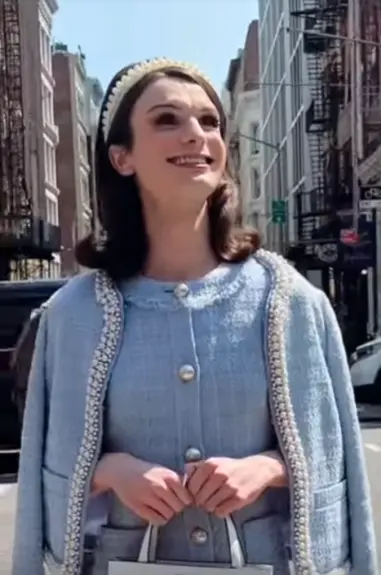
In this image, once again, we get a glimpse of the themes that Dylan is seeking to evoke. One can imagine that behind him is a 20th Century Fox skene of a cityscape. Dylan’s eyes, in this image, and his posture, are looking upward, to the future. This forward-looking posture is juxtaposed by his entire outfit, which reflects his embodiment of the traditional woman of the 60s and 70s. Here, he is revitalizing the traditional femininity of Audrey Hepburn, Grace Kelly, Jackie O., Elizabeth Taylor, Ingrid Bergman, Donna Reed, and Judy Garland. This is a trope in the culture that Dylan comes from, for sure, but its consume-ability and popularity also reflect an unconscious desire of his audience to return to the traditional feminine.
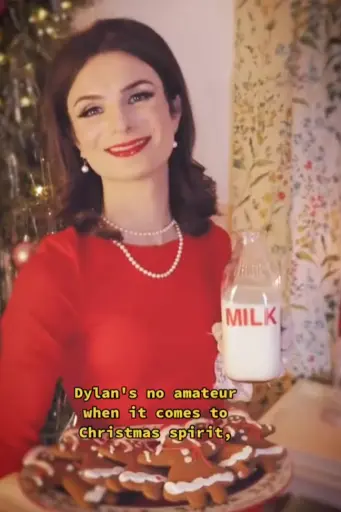
Dylan captures the ‘50s’ Retro aesthetic, as well. On occasion, he manifests an existential mode that is often criticized for being unlivable. Yet, ironically, Dylan is showing us through his actions that it is livable. After taking his estrogen pills, he grabs the cookies and milk, sits down by the fire with the kids near the Christmas tree, and gives the hardworking father a massage. It’s a disgusting and perverted image, but it also echoes the Norman Rockwell dream we’ve left behind. In this mode, Dylan delivers upon his audience’s yearning for a simpler time where, funnily enough, Women were Women and Men were Men. Having abandoned this mode as Americans, we seek it only in the likes of Dylan; for women, generally speaking, have abandoned it.
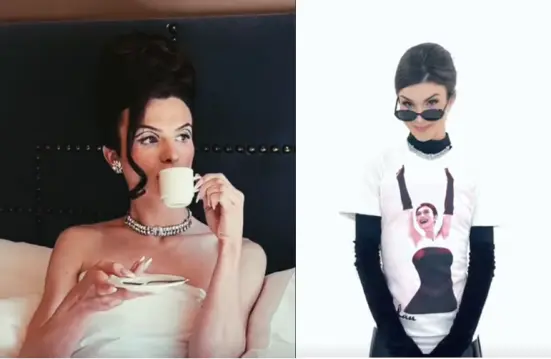
Dylan also seems to be aware of this. It’s not like he’s oblivious to the topes he’s capturing. However, I don’t think he’s conscious of the role that he’s fulfilling for his consumers that contemporary women have abandoned for a sex-filled twenties, business or humanities degree, an office job, and a lonely, post-thirty life with cats or dogs.

Dylan’s behavior also seems to be a mockery of contemporary feminine behavior. When he prances through the meadows, stating that he loves “’em,” when he tells us that he loves nature but runs away from dragonflies when he sees them, he captures the contemporary woman’s ability to garner attention by wearing revealing clothing and pretending like she lives a natural life by spending time in a national park. It’s not like this doesn’t happen, either. Instagram is not bereft of many such examples of female “models” wearing revealing clothing, high heels even, in the middle of a park, drinking coconut water (they sponsor her), and talking about how much they love the outdoors. Dylan is mimicking the behavior of women on Instagram when he does this. Of course, if they spent time in nature, they would understand how brutal it is. They would end up looking, acting, and talking like this awesome dude:

In part, this kind of self-awareness, this literal self-aware self-obsession seems to be Dylan’s modus operandi.

(Here is an image of Dylan presenting a picture that he liked because it looked like him.)
Dylan acknowledges that he’s self-obsessed, he acknowledges that he likes how he looks, and he does not deny – as far as I can tell – his narcissistic tendencies. He manages to perfectly capture the contemporary, American woman’s mindless self-obsession (more on that later) while calling attention to the reality of an aesthetic wherein that obsession was put to better use; specifically, America of the1950s and ‘60s.
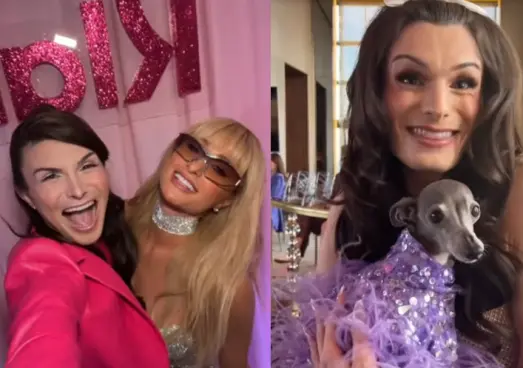
At once, Dylan is both a mockery of the contemporary, post-Carrie Bradshaw woman and a callback; an echo of the traditional feminine aesthetic that the women of Sex and the City have left behind. And what have they left it behind for? Women have abandoned their traditional roles so they can act like men. Carrie Bradshaw’s followers may not have found their Mr. Big but they, more than likely, have become their Mr. Big. Just as Dylan Mulvaney seeks to fill the role that women have left behind, which he adores, so too do contemporary women seek to fill the role that they desire, which they have pushed men out of. The Girl Goss is, in many ways, the female version of Dylan Mulvaney.
I came across a video before writing this piece, which I wasn’t able to find, that highlights the state of contemporary women. She was a younger, zoomer girl – a TikTok star that was living and traveling out of her van. She had a dog that she found on her journey, a boyfriend as well, and a relatively decent life. However, she abandoned her boyfriend, and the van they made together, to “find herself” with her dog. The titular question of the video: “What is she searching for?”
She, of course, comes from Carrie Bradshaw’s America; she can be whatever she wants to be if she sets her mind to it. However, instead of being the Girl Boss, maybe because she instinctively knows that such a role won’t make her happy, or has recognized that it won’t through cultural osmosis, she’s decided to live out the gypsy-life aesthetic: the van life. In doing so, she tacitly admits that she’s searching for herself; she’s trying to define herself. Why? Because the America she was born into, Carrie Bradshaw’s America, gave her no essential identity. It told her that the likes of Audrey Hepburn, Grace Kelly, or Donna Reed were anachronistic stereotypes of a patriarchal culture that needed to be, and were, dismantled and replaced by more “realistic” models of female behavior: the aforementioned Carrie Bradshaw, Charlotte York, Samantha Jones, and Miranda Hobbes. Unwilling to embrace these roles, she set out to define herself – because she can do that.
However, it doesn’t seem as if she’s able to. Her life could be defined by what she does for the man she apparently loved, the dog they cared for together, the life they could have if they settled down and built it together, and the children they could have. But instead, she goes to Europe to get in touch with herself, which more likely than not means having sex with random men from Europe. She simultaneously wants to be defined by the man, is defined by the man, but refuses to embrace that identity. The indefiniteness of her identity is exciting to her. Carrie Bradshaw is boring. Audrey Hepburn is boring. Living on the edge, meeting Stelios for coffee and afternoon “brunch” while on her trip to Greece – that’s much more exhilarating. Of course, it is also short-lived. Eventually, unlike Chelsea Handler, who tries to vehemently convince us (and herself) that her spinster (SINK) life is great, she will have to settle down; not everyone can live Chelsea Handler’s life. She will, one day, hit the wall. And the traveling gypsy knows this. She won’t admit it, but she knows it. She knows she can expect to die alone, in a nursing home if she’s lucky, and if not, in her small apartment with her cats, probably due to starvation.
Dylan Mulvaney, on the other hand, defines himself as his idols, understands who he is, what he wants to be, and what he’s doing. He genuinely doesn’t seem uncertain of himself. His identity isn’t ambiguous. He’s a self-centered man that enjoys acting like his female idols and seeing images of himself as a woman while he mocks the unconscious vapidity of contemporary American women. Unlike van girl, Dylan has found himself. Is it genuinely any surprise, then, that Dylan has become the idol of Old-Hollywood stars like Drew Barrymore?
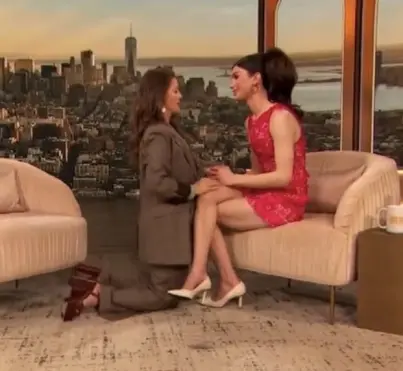
What Dylan forces us to confront is our inability to grasp the identity of Women. It is not the likes of Dylan Mulvaney who have an identity disorder. Dylan seems to know who he is. Instead, it is contemporary American women, who pretend to be men by acting like Girl Bosses, who seem to have the identity disorder. They have higher rates of mental health issues, are on more anti-depressants than men, and self-harm more often than young boys their age. Girls and Women are facing an identity crisis because they’ve been told they can be whatever they want to be and, as a result, are as aimless as the van-life girl. Dylan doesn’t force us to face the crisis of the Masculine identity; instead, he forces us to face the roots of his identity: the destruction and desecration of the American woman by corporate America and the American woman, herself.
As we assign blame to Dylan, as we – in some sense – righteously chastise him, as we mock him for failing to live up to our masculine standards or living as a Man, we also fail to enforce a similar standard on American women generally. On the Whatever podcast, we may see the likes of Michael Knowles mocking genuinely dumb, unconsciously self-obsessed, and sometimes evil and sociopathic women, but we never really see the same vehement hatred for such women as we do for Dylan Mulvaney by the likes of Matt Walsh. It’s just not kind or fashionable to do. We treat American women, who are more aimless and lost, who suffer from a greater lack of identity-lessness and identity confusion than Dylan, as victims; or, even worse, we champion them as the pinnacle of Girl Boss-ness. We simultaneously give them a leg-up throughout the whole of their lives and then are dumbfounded when they can’t find a man at the peak of success because we’ve pushed all the men down for the women to succeed. Instead of acknowledging this, Corporate America, hoping to squeeze a few more pennies out of the feminist movement before its adherents wither away, childless, and die, trot out the few examples of genuinely happy Girl Bosses to claim they represent the whole. Of course, anyone with a basic understanding of logic and whose brain isn’t mush could tell you that such an action is nonsensical. But they keep doing it, and it keeps working because Americans will not and seem unable to confront the identity-confused, American woman.
While we demand Dylan take responsibility for his actions, we fail to hold the American woman accountable for her own. It is genuinely as if we do not see women as agents of their own lives, which is why we fail to acknowledge that they have a responsibility to the society that produced them. Women have a duty, but no one holds them to it or acknowledges it; that would be patriarchal and sexist. Van girl can do what she wants, the crazy cat lady can die childless and alone, and single mothers, who exist primarily due to State and Governmental support, are hardly ever held responsible for the actions of their children. Instead, we blame the fathers of those children without ever acknowledging the roles of the State and Government and how women take advantage of all three; we fail to recognize the incentives that dissuaded the childless cat-woman from settling down and having a family; and we ignore the listless and hedonistic narcissism of the young, van girl as nothing but youthful and playful fun. Americans simply will not hold women responsible for their actions like they do men because they confuse a woman pretending to be a man with a successful woman.
In the end, Americans confuse Dylan’s confusion with their own.






