Bitcoin ETFs have outperformed Gold ETFs by leaps and bounds, as the former becomes the new investor favorite.
Bitcoin has often been dubbed “digital gold,” primarily due to its potential as an inflation hedge and a store of value - a repute originally held by the precious yellow metal. However, new data comparing cumulative net flows into U.S. Gold ETFs and U.S. Spot Bitcoin ETFs since their respective launches underscores how Bitcoin is not only fulfilling this role but also outperforming gold by a significant margin. The analysis highlights Bitcoin's rise as a superior financial instrument for investment returns and a modern hedge against inflation.
A Tale of Two ETFs
The top chart below (Figure 1) shows the cumulative net flows for U.S. Gold ETFs and U.S. Spot Bitcoin ETFs. Gold ETFs, which have been around for decades, took 1,535 trading days to achieve net inflows of $36.85 billion. In contrast, Bitcoin ETFs have garnered $36.67 billion in just 239 trading days. This rapid accumulation of funds demonstrates the growing institutional and retail appetite for Bitcoin as an asset class.
When adjusted for inflation, the gap between the two asset classes becomes even starker, as illustrated in the second chart. Inflation-adjusted cumulative gold ETF flows stagnate compared to the meteoric rise of Bitcoin ETF flows. Gold ETFs’ trajectory appears sluggish and cyclical, whereas Bitcoin ETFs exhibit exponential growth, signaling that investors increasingly view Bitcoin as a more dynamic alternative.
Bitcoin’s performance on an inflation-adjusted basis further underscores its value proposition as a modern hedge against inflation. While gold has long been considered a safe haven during periods of economic instability, Bitcoin’s unparalleled growth suggests it is rapidly overtaking gold as the preferred choice for investors seeking to preserve and grow their wealth in the face of rising inflation and macroeconomic uncertainty.
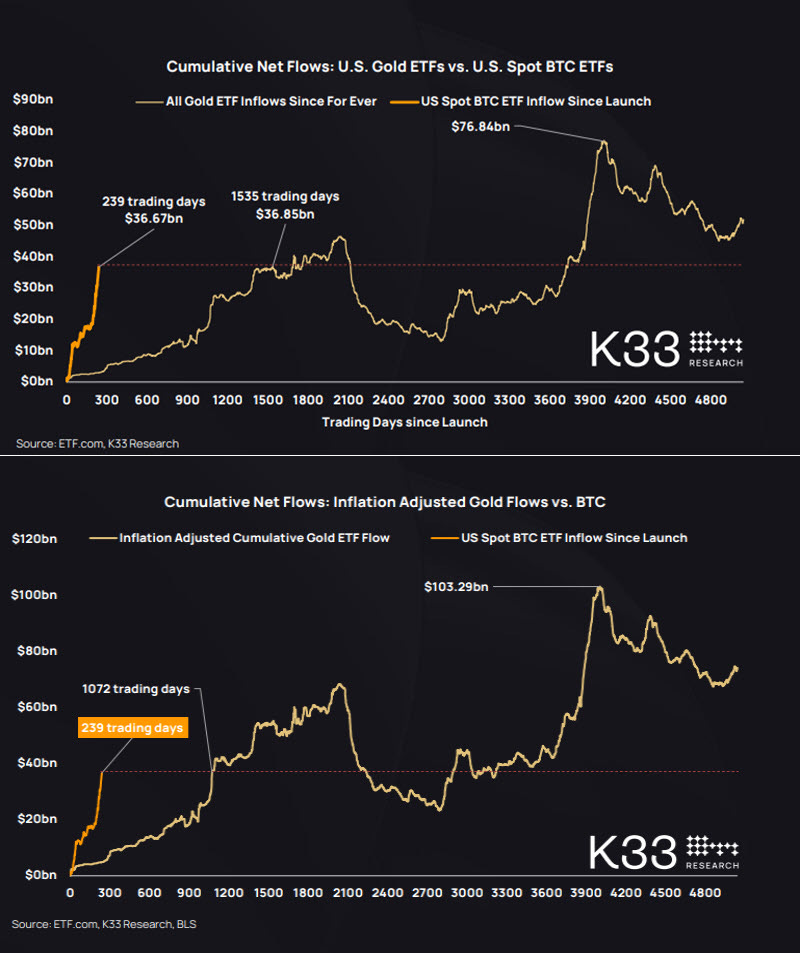 Figure 1
Why is Bitcoin Winning?
🟦 Scarcity and Store of Value: Bitcoin’s fixed supply of 21 million coins contrasts sharply with gold, which continues to be mined. This inherent scarcity drives demand for Bitcoin, enhancing its appeal as a store of value.
🟦 Digital Accessibility: Unlike gold, Bitcoin is a purely digital asset, making it more accessible and easier to transact globally. This accessibility has attracted a broader range of investors, including younger demographics and tech-savvy individuals.
🟦 Outsized Returns: Beyond being an inflation hedge, Bitcoin offers investors the potential for substantial returns, as evidenced by the data. Its historical performance far exceeds that of gold, appealing to those seeking growth alongside security.
🟦 Institutional Adoption: The rapid rise of Bitcoin ETFs reflects growing institutional confidence in Bitcoin as an asset class. Major financial players are increasingly integrating Bitcoin into their portfolios, fueling its adoption.
🟦 Macroeconomic Tailwinds: In an era of unprecedented monetary expansion and inflationary pressures, Bitcoin’s decentralized and deflationary nature aligns well with the needs of investors seeking refuge from traditional financial systems.
Rapid Rise
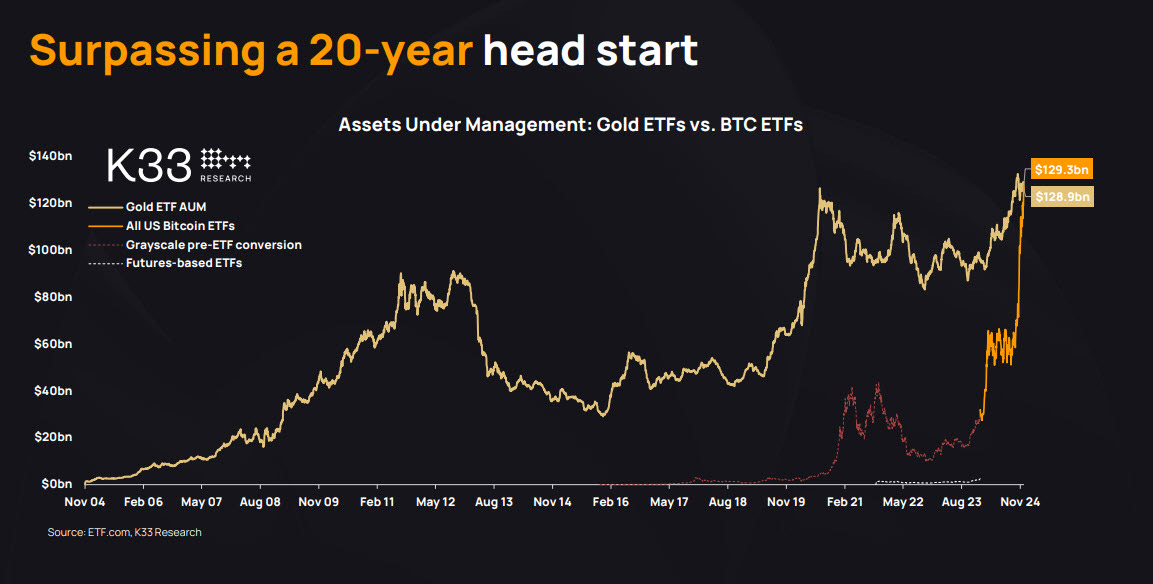 Figure 2
The chart above (Figure 2) highlights the rapid rise of Bitcoin ETFs, which have nearly matched the AUM (Assets under management) of Gold ETFs despite gold's 20-year head start. Gold ETFs, with steady but cyclical growth, reached $129.3 billion in AUM by 2024. In contrast, Bitcoin ETFs, driven by the approval of spot-based ETFs and Grayscale’s pre-ETF transition, surged to $128.9 billion within a significantly shorter period.
This meteoric growth underscores Bitcoin's increasing appeal as a store of value and inflation hedge, challenging gold's traditional safe-haven status. Institutional interest and demand for digital assets have fueled Bitcoin's rapid adoption, signaling a paradigm shift in investor preferences. The convergence in AUM between Bitcoin and Gold ETFs also reflects a broader transformation in financial markets, as investors embrace digital assets for diversification and superior growth potential.
Room to Grow
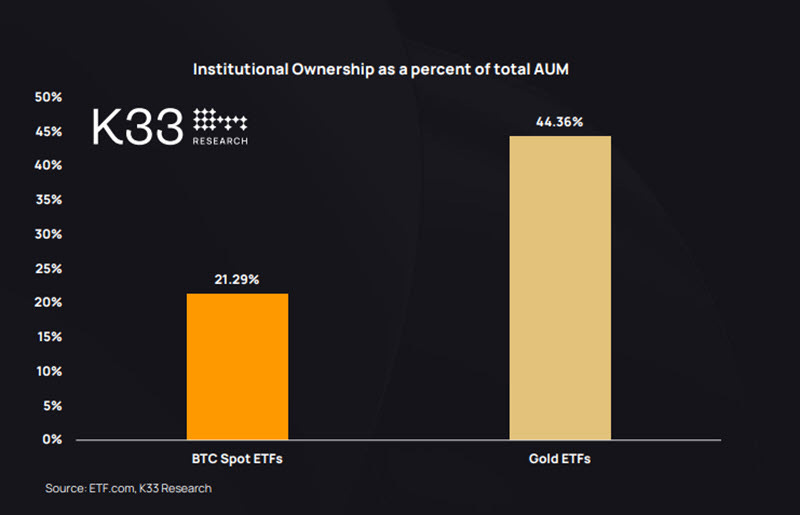 Figure 3
Analyzing the final chart, it illustrates the level of institutional ownership as a percentage of total assets under management (AUM) for Bitcoin Spot ETFs and Gold ETFs. Institutional ownership of Gold ETFs stands at 44.36%, significantly higher than the 21.29% for Bitcoin Spot ETFs. This suggests that gold retains stronger institutional trust and adoption as a traditional investment vehicle.
The relatively lower institutional involvement in Bitcoin Spot ETFs highlights its status as an emerging asset class. While Bitcoin ETFs are gaining traction, the data indicates that institutional investors are still cautious, possibly due to regulatory uncertainties or the asset's higher volatility. More importantly, this gap also represents potential future growth for Bitcoin ETFs as institutional confidence grows.
A Paradigm Shift
The data unequivocally shows that Bitcoin ETFs have outperformed gold ETFs not only in terms of speed of adoption but also in total inflows and inflation-adjusted metrics. This remarkable trajectory highlights Bitcoin’s evolution from a niche digital asset to a mainstream financial instrument rivaling and surpassing gold as a store of value and inflation hedge.
While gold retains its place in history as a stalwart store of value, Bitcoin’s exponential growth and digital nature position it as the asset of the future. As more investors and institutions embrace Bitcoin, it is clear that the narrative of “digital gold” is more than a metaphor—it’s becoming a financial reality. Bitcoin is not just matching gold; it’s leaving it in the dust.
Originally published at Substack.