Despite Middle East tensions and NATO–Russia tensions looming, Bitcoin's institutional backing shows no signs of slowing.
Bitcoin surged to $108,000 earlier today in a classic liquidity grab, liquidating short positions and rekindling aspirations for a retest of its all-time high. This move, widely anticipated by traders who had pinpointed the $103-$108K range for a sweep, now sets sights on $111K if BTC can overcome a key Fair Value Gap. The rally occurred amidst easing Middle East tensions, although renewed warnings of NATO-Russia flashpoints keep broader macro risks elevated.
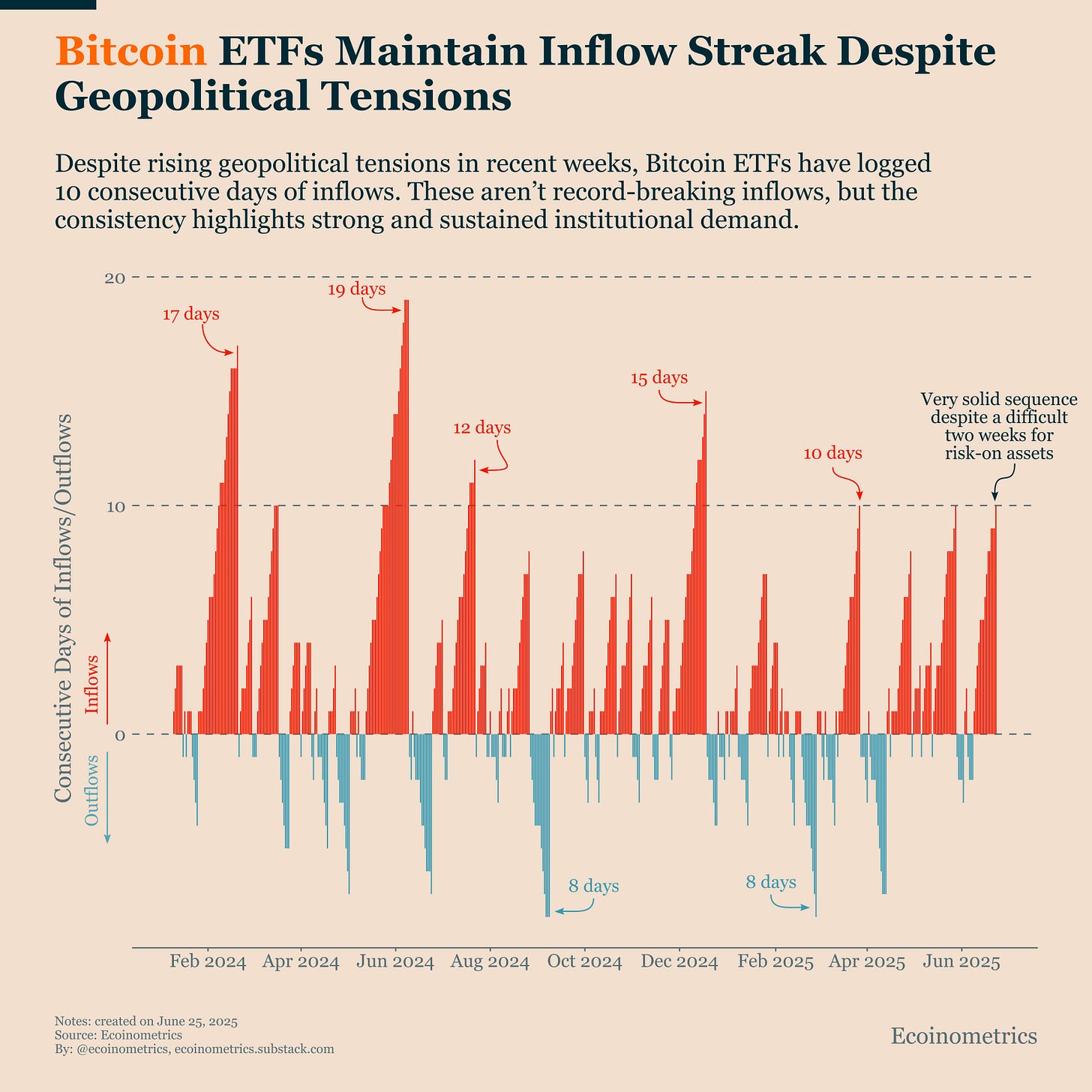
When the geopolitical world shakes, most risk-on assets tend to retreat. But not Bitcoin—not anymore. Despite recent flashpoints involving Iran, Israel, and the United States, Bitcoin ETFs have just recorded an impressive 10 consecutive days of inflows, according to data from Ecoinometrics. This is no longer a fluke.
It’s a statement: institutional demand for Bitcoin doesn’t flinch easily. Bitcoin, once criticized by traditional finance as volatile, speculative, and unfit for macro portfolios, is now finding deep and consistent support from institutional capital. And in times of global uncertainty, that support isn't weakening—it’s intensifying.
A Data-Backed Testament to Conviction
The Ecoinometrics chart (below), visually captures this conviction. From February 2024 through June 2025, Bitcoin ETFs have seen multiple significant inflow streaks:
-
17-day streak in early 2024
-
19-day streak in late spring 2024
-
12-day rally in summer 2024
-
15-day streak in December 2024
-
And now, 10 consecutive days in June 2025, despite intense geopolitical pressure
Each spike in red (representing inflows) marks sustained buyer interest. Conversely, the blue troughs (outflows) rarely last beyond 8 days—another bullish sign. The chart’s narrative is unambiguous: Bitcoin ETFs are not just receiving sporadic interest; they are increasingly becoming foundational tools for capital allocation.
This kind of resilience doesn’t emerge from hype or speculation. It reflects calculated decisions made by asset managers, family offices, hedge funds, and even sovereign entities, all seeking digital exposure without venturing into the complexities of direct coin custody.
Why Institutions Aren’t Spooked?
There’s a reason institutional appetite isn’t deterred by macro turbulence:
-
Hedge Against Fiat Fragility
Bitcoin is increasingly viewed as a hedge, not just against inflation, but against monetary instability and geopolitical currency weaponization. As central banks face pressure to resume easing or devalue currencies for competitive advantage, BTC offers a permissionless, apolitical store of value. -
ETF Vehicle Maturity
Since the launch of spot Bitcoin ETFs in the U.S. and abroad, a new class of allocators—those restricted by mandates or custody limitations—has entered the market. These ETFs offer compliance-friendly, tax-efficient, and familiar exposure to BTC, making inflows sticky and consistent. -
Portfolio Rebalancing in Favor of BTC
According to Bybit, Bitcoin’s share in crypto portfolios has surged to 30.95%, up from 25.4% just seven months ago (chart below). This trend suggests Bitcoin is not just surviving altcoin rotations—it’s thriving on them. Broader Bitcoin dominance is now above 62%, underscoring its gravitational pull during market uncertainty. -
Narrative and Psychological Support
With every inflow streak and ETF milestone, Bitcoin becomes more "normal" to traditional allocators. That normalization brings psychological safety: in uncertain times, institutions prefer betting on what they perceive as “least risky” among risk assets, and Bitcoin is increasingly winning that vote.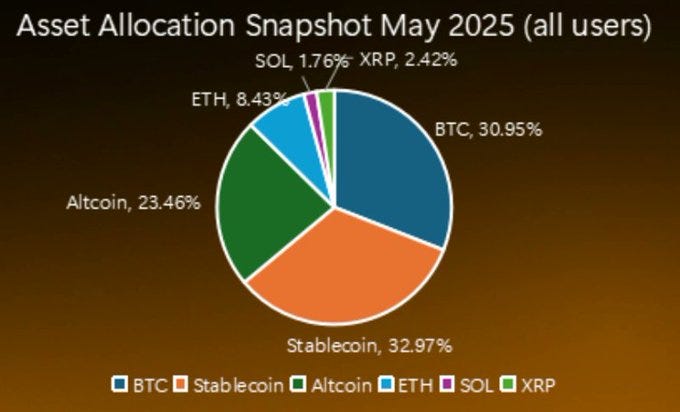
What Does This Mean for the Price Trajectory?
The recent rally to $108,000 isn’t just a price movement—it is a statement. Traders had been eyeing that range as a likely liquidity zone, and the fact that BTC tapped it precisely as tensions eased in the Middle East is not coincidental. Technical analysts now see a pathway to $111,000 if Bitcoin can decisively reclaim the Fair Value Gap (FVG) above $108K.
Perhaps more interesting is what underlies this breakout: the quiet, powerful hum of ETF inflows and institutional accumulation. It’s worth noting that previous inflow streaks of 12 to 19 days often preceded local tops or periods of consolidation. However, this time, the context is different. With ETF demand growing and macroeconomic uncertainty persisting, Bitcoin may be entering a phase of sustained strategic buying, rather than merely speculative froth.
Bitcoin as Macro Collateral
Beyond just price action and inflow data, the evolving thesis around Bitcoin is that it may become a form of macro collateral—something akin to digital gold, but with broader utility in DeFi, cross-border settlements, and collateralized lending. In a world where NATO-Russia tensions could escalate and dollar-based trade faces new challengers, Bitcoin's neutrality and borderless nature may become more than just a feature—it could be a necessity.
A New Chapter
Bitcoin’s ability to maintain a 10-day ETF inflow streak amid Middle East conflict is not just a quirky data point—it’s an indicator of deep structural transformation. Institutions aren’t here to speculate. They’re here to hedge, diversify, and build long-term positions.
As short sellers lick their wounds from the latest liquidity sweep and traders set their sights on $111K, the real story may be unfolding under the surface: Bitcoin is graduating from a misunderstood digital experiment to an indispensable pillar of the global financial system. And if the past few weeks are any guide, the road to Bitcoin’s next all-time high might not just be paved with volatility, but with conviction.
Originally Published on Substack.