Crypto Market Alert: Although Bitcoin price looks resilient, smart money moves out of the premier digital asset screams caution.
Bitcoin (BTC) has shown resilience in its price performance despite recent market turbulence, but the latest data on exchange-traded fund (ETF) flows paints a more concerning picture for the premier cryptocurrency and the broader crypto ecosystem. Last week, Bitcoin ETFs recorded a staggering $713 million in net outflows—one of the worst weeks for the asset this year.
A particularly painful $326.27 million exited the crypto space on Tuesday, April 8th, contributing to a full week of zero net inflows. Blackrock’s IBIT led the outflows with $342.61 million, followed by Grayscale’s GBTC ($160.93 million) and Fidelity’s FBTC ($74.63 million).
Ethereum ETFs are faring even worse, marking their seventh consecutive week of net outflows at $82.47 million. Fidelity’s FETH led the bleed with $45.04 million, followed by Grayscale’s ETHE ($28.32 million). These trends underscore a cautious sentiment among institutional investors and raise questions about the sustainability of Bitcoin's price stability in the face of a turbulent macroeconomic landscape.
A Warning Sign?
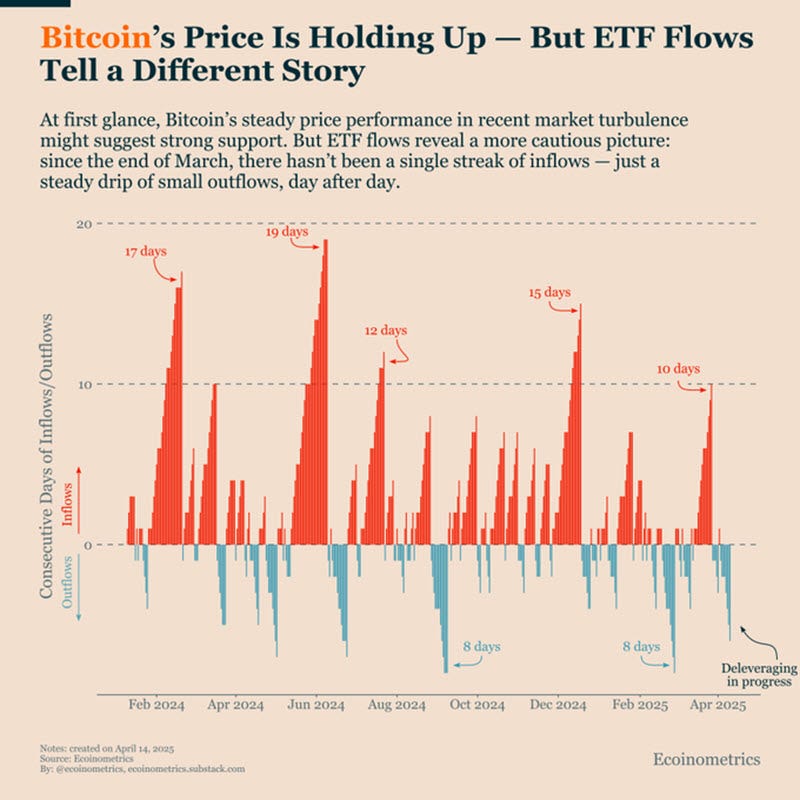
The Ecoinometrics chart (below) reveals a troubling trend: since late March 2024, Bitcoin ETFs have experienced a persistent drip of outflows, with no significant streak of inflows to counterbalance the exodus. It highlights several periods of consecutive outflows, ranging from 8 to 19 days, with the most recent data showing a "deleveraging in progress" as of April 2025.
This $713 million outflow in a single week is a stark reminder of the fragility of investor confidence, even as Bitcoin's price holds steady. ETFs are often seen as a barometer of institutional sentiment, and the consistent outflows suggest that large investors are either reducing exposure or reallocating capital amid heightened uncertainty.
The deleveraging could indicate a broader risk-off sentiment, where institutions are prioritizing liquidity and safer assets over speculative ones like Bitcoin. While Bitcoin's price has not yet reflected this pressure, the ETF flows signal underlying vulnerabilities that could materialize if macroeconomic conditions worsen.
Divergence Between Price & Fund Flows
Bitcoin's price stability amid substantial ETF outflows presents an intriguing market dynamic. While spot prices have demonstrated resilience in recent turbulent weeks, the consistent ETF outflows since late March tell a different story—one of cautious institutional positioning rather than robust market confidence. This divergence between price performance and fund flows could indicate that while short-term trading and perhaps retail sentiment remain relatively strong, longer-term institutional positioning has become decidedly more conservative.
Macroeconomic Pressures Mounting
The current ETF outflows must be viewed within the broader macroeconomic context. Recent market turbulence caused by U.S tariffs has affected multiple asset classes as investors recalibrate expectations around inflation, interest rates, and economic growth. Bitcoin, despite its "digital gold" narrative, hasn't been immune to these pressures.
The "deleveraging in progress" notation on the chart suggests a broader reduction in market exposure, with investors potentially reducing risk across portfolios. This deleveraging process often affects speculative assets first and most severely, which helps explain the sustained ETF outflows despite relatively stable prices.
Implications for the Broader Crypto Ecosystem
This divergence between price action and fund flows creates several potential scenarios for the cryptocurrency market:
-
Hidden Vulnerability: The steady price may mask underlying weakness that could manifest if retail support wavers or if institutional outflows accelerate beyond their current pace.
-
Rotation Within Crypto: Funds may be moving from regulated ETF products to direct crypto holdings or alternative investment vehicles within the ecosystem.
-
Temporary Positioning: These outflows might represent tactical rather than strategic moves, with institutions temporarily reducing exposure during uncertain market conditions.
For the broader crypto ecosystem, sustained ETF outflows could eventually create downward pressure on prices if the trend continues. The fact that Ethereum ETFs are experiencing even more persistent outflows suggests this concern isn't limited to Bitcoin alone.
A Path Forward: Resilience or Reckoning?
Despite these challenges, there are reasons for cautious optimism. Bitcoin's ability to maintain its price amid significant ETF outflows suggests that there is still strong underlying demand, possibly from retail investors or long-term holders (HODLers). Additionally, the crypto market has weathered similar periods of uncertainty in the past, often emerging stronger as regulatory clarity and adoption grow over time.
However, the current macroeconomic landscape demands vigilance. For Bitcoin to sustain its price stability, it will need to regain institutional confidence, which may require clearer regulatory frameworks, improved market infrastructure, or a shift in global economic conditions. For the broader crypto ecosystem, Ethereum's struggles highlight the need for diversification and innovation to maintain investor interest.
Originally published on Substack.