Crypto Trading volume’s third straight decline just hit—get the full breakdown on what happened in March.
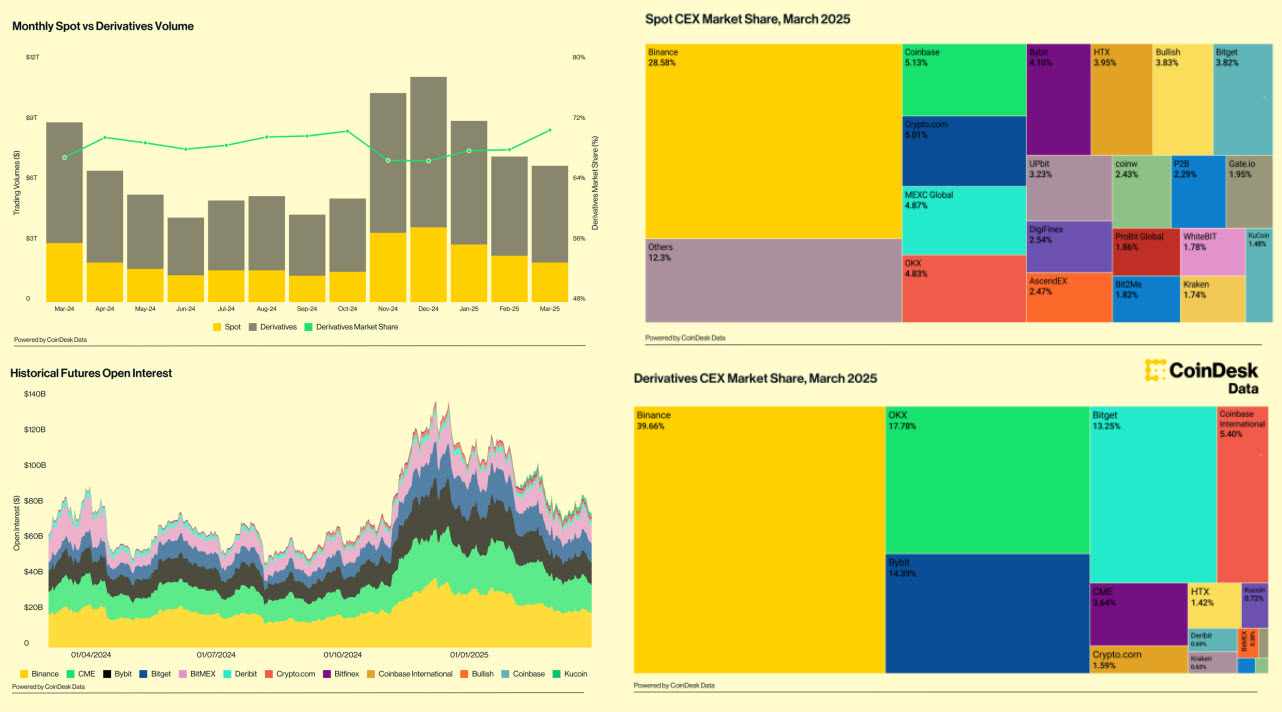
March marked the third consecutive month of declining cryptocurrency trading activity, as both spot and derivatives markets faced headwinds amid global economic uncertainty and falling digital asset prices. According to CoinDesk Data's Exchange Review for March 2025, combined spot and derivatives trading volume on centralized exchanges fell by 6.24% to $6.79 trillion, hitting the lowest level since October of last year.
Spot Market Slump
The spot trading sector experienced a more significant contraction, with volumes falling 14.1% to $1.98 trillion in March. This decline coincided with Bitcoin and Ethereum reaching fresh lows of $76,700 and $1,750, respectively, as ongoing uncertainty regarding U.S. tariff policies with global trading partners continued to pressure the markets.
Top-Tier exchanges, those rated AA-A in CoinDesk's Exchange Benchmark, saw their volumes decline by a substantial 18.5% to $1.25 trillion. Meanwhile, Lower-Tier exchanges experienced a less severe drop of 5.53%, bringing their monthly total to $730 billion. This shift resulted in Top-Tier exchanges representing 63.1% of total spot volume in March, down from 66.5% in February.
Among the AA-A graded exchanges, total spot volume decreased by 14.2% to $1.05 trillion. Binance, Coinbase, and OKX remained the dominant players, collectively accounting for approximately 61.1% of Top-Tier exchange volume, up from 55.5% in February.
Exchange Performance Varies Widely
The market share landscape shifted considerably in March, with some exchanges gaining ground while others faced significant setbacks:
-
Binance strengthened its dominant position, increasing its market share by 1.63% to reach 28.6% - its highest level since June 2024.
-
Bybit suffered a dramatic 52.1% drop in spot trading volume, falling to $81.1 billion following a February hack of its cold wallets.
-
Crypto.com experienced a 46.7% decrease in trading volumes to $99.1 billion, dropping its market share from 8.07% to 5.01%.
-
Coinbase now ranks as the second-largest exchange with a 5.13% market share.
Derivatives More Resilient
The derivatives sector demonstrated more stability than spot trading, declining by only 2.56% to $4.81 trillion in March. This relative strength increased derivatives' share of the overall crypto trading market to 70.8%, up from 68.2% in February and marking the highest proportion since December 2023.
Binance maintained its position as the largest derivatives exchange with $1.91 trillion in volume (down 1.26% month-over-month), followed by OKX with $855 billion (up 5.71%) and Bybit with $692 billion (down 6.61%). HTX and Kraken were standout performers in the derivatives space, with volumes increasing by 39.0% and 22.6%, respectively.
In terms of market share within derivatives:
-
Binance led with 39.7% (up 0.52%).
-
OKX followed with 17.8% (up 1.39%).
-
Bybit captured 14.4% (down slightly).
-
Bitget held 13.3%.
-
Coinbase International and CME rounded out the top six with 5.40% and 3.64%, respectively.
Open Interest & Institutional Interest
Total open interest across centralized derivatives exchanges fell 6.00% to $81.9 billion. Binance led the field with a 24.0% share of open interest, followed by CME (18.7%) and Bybit (15.4%). Notably, institutional demand appears to have softened, as evidenced by CME’s declining options volume and falling market share (down to 3.64%).
Institutional participation, as measured by CME Group's crypto derivatives trading, showed signs of cooling. Total derivatives volume on CME fell 23.5% to $175 billion, its lowest level since October 2024. The exchange's market share among derivatives platforms dropped from 4.63% to 3.64%. Even the highly anticipated Solana (SOL) futures on CME managed to generate only $151 million in trading volume for March, indicating cautious institutional engagement with newer crypto assets during this period of uncertainty.
Industry Developments
Despite the trading slowdown, March saw significant strategic moves from major exchanges:
-
Coinbase acquired a team to accelerate privacy efforts on its Base blockchain and announced plans for 24/7 perpetual-style futures in the U.S.
-
Kraken secured UK EMI authorization, launched ultra-low-latency trading through its colocation service, and announced the acquisition of NinjaTrader.
-
Binance introduced Private Portfolios for exclusive spot copy trading.
-
Gemini enhanced its ActiveTrader platform and partnered with Evolve for leveraged crypto ETFs.
Future Outlook
As the cryptocurrency market navigates this period of reduced trading activity, the shift toward derivatives suggests traders are increasingly favoring hedging strategies amid market uncertainty. The disproportionate impact on Top-Tier exchanges compared to Lower-Tier platforms also indicates changing trader behavior, possibly reflecting a more cautious approach from sophisticated market participants.
If global economic tensions persist, particularly regarding U.S. tariff policies, crypto trading volumes may continue to face pressure in the coming months. However, the ongoing development of exchange infrastructure and new product offerings could position the industry for renewed growth when market conditions eventually improve.
Originally published on Substack.