
Despite strong profits in corporate America, job creation outside healthcare is nearly stagnant, with the BLS revising nearly a million jobs out of prior totals.
The latest U.S. jobs report landed with a thud last Friday, underscoring the extent to which America’s employment growth now hinges on a narrow set of sectors — healthcare and support services. Beyond hospitals, nursing homes, and daycare centers, the broader economy is generating little to no job growth. According to Labor Department data, healthcare alone has averaged roughly 64,000 new jobs per month in 2025, while the rest of the economy has added only about 9,400.
This lopsided trend paints a troubling picture: the so-called “engine” of job creation is running, but with just one piston firing. Adding to the sense of unease today, the U.S Bureau of Labor Statistics (BLS) issued annual revisions that slashed previously reported payroll numbers by 911,000 jobs for the year prior to March 2025.
While revisions are standard practice, this one landed at the higher end of Wall Street expectations, which ranged between 600,000 and 1 million. Such a large downward correction not only raises questions about the underlying strength of the economy but also casts doubt on the reliability of government data itself.
Job Growth: Running on Healthcare Alone
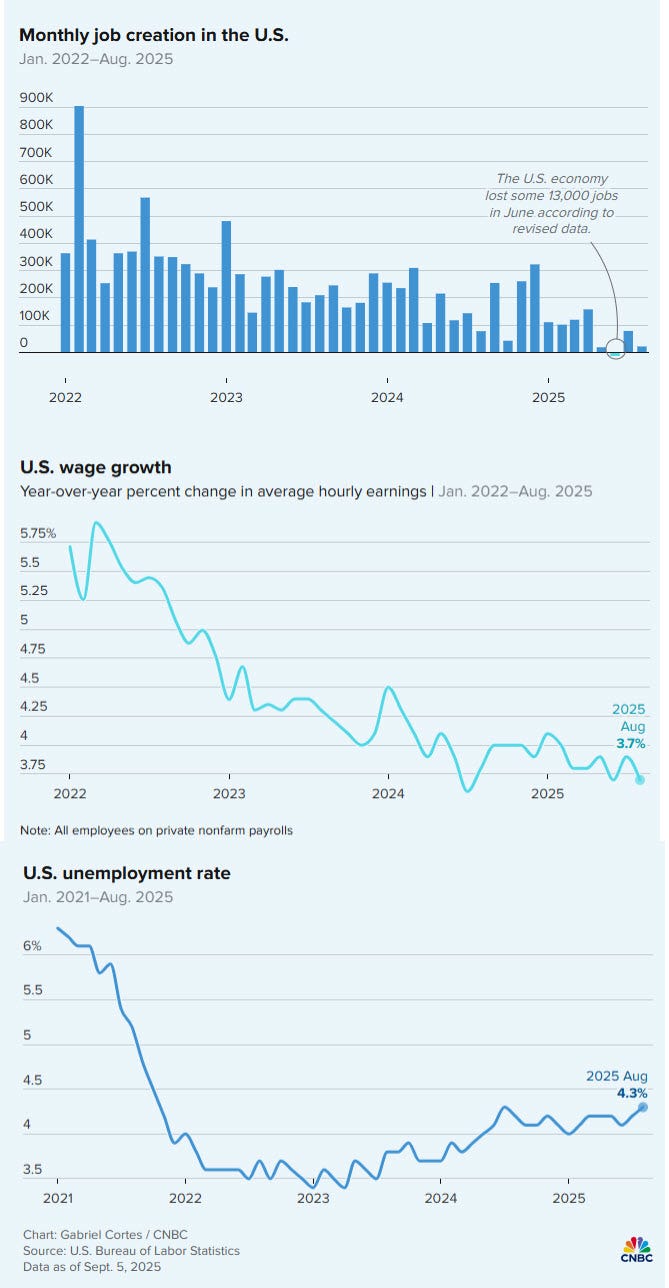
The U.S. job creation figures tell a stark story. From January 2022 through August 2025, monthly job gains have gradually weakened, with the summer months of 2025 proving especially soft. Between June and August, the economy added just 29,000 jobs per month on average — far below the estimated 75,000 to 100,000 “breakeven” level needed to stabilize the unemployment rate as the population grows.
Healthcare, social assistance, and allied services remain the outliers. With an aging population and growing demand for caregiving, this sector continues to churn out steady employment. In contrast, industries ranging from manufacturing to retail to professional services are either stagnant or shrinking. Notably, the tech sector — despite record-breaking profits at giants like Microsoft, Google, and Meta — has embraced cost-cutting by slashing payrolls.
Salesforce, Microsoft, and others are among the firms reducing headcount, reflecting a shift toward leaner operations even as revenues swell. This divergence highlights a structural challenge: the U.S. is creating jobs, but not necessarily in the areas that fuel broad-based prosperity or align with long-term growth sectors like clean energy, advanced manufacturing, or infrastructure. Instead, the labor market is being propped up by the basics — care work, hospitals, and day-to-day support.
Wage Growth: Cooling Fast
Wages, once a bright spot for American workers, are also losing steam. The data shows (second chart below) that average hourly earnings grew just 3.7% year-over-year in August 2025, down from nearly 6% in early 2022. While this deceleration may ease inflationary pressures, it also signals weakening worker bargaining power.
When wage growth slows while inflation remains above the Federal Reserve’s 2% target, real incomes stagnate. This risks eroding consumer spending, which accounts for about two-thirds of U.S. economic activity. As inflation data due later this week is expected to show an uptick, the spread between wage growth and rising prices may widen further, squeezing household budgets.
Unemployment: Edging Higher
The unemployment rate, which hovered near historic lows through much of 2022 and 2023, has begun to creep upward (bottom chart below). As of August 2025, it stands at 4.3%, up nearly a full percentage point from its low point in early 2023.
A 4.3% unemployment rate is not catastrophic by historical standards, but the trend matters. Rising joblessness paired with downward revisions to past payroll gains suggests that the labor market is weaker than many had believed. For policymakers, this complicates the economic outlook: the Federal Reserve may find itself caught between fighting inflation on one hand and preventing a slowdown in hiring on the other.
Data Reliability Under Scrutiny
The BLS revisions have brought another layer of tension to the debate. Job numbers form the backbone of economic policymaking, influencing decisions from the Fed's interest rates to White House policy priorities. When revisions approach one million jobs, it fuels skepticism about data reliability at a time when clarity is desperately needed.
Criticism of the BLS has intensified from political quarters, with President Trump recently firing the BLS chief. To be sure, revisions are not errors but rather adjustments based on fuller datasets collected over time. Still, in a climate of economic anxiety, such revisions can be politically toxic, amplifying mistrust in institutions.
The Corporate Paradox: Profits Up, Jobs Down
One of the most striking dynamics in today’s labor market is the disconnect between corporate profitability and employment. Big Tech and other large firms are reporting banner quarters, flush with profits from cloud computing, artificial intelligence, and digital services. Yet many of these same firms are trimming payrolls.
The logic is simple: investors demand efficiency. Companies are shedding staff not because they are in distress, but because they believe they can maintain, or even improve, performance with fewer workers. This creates a paradox: while balance sheets strengthen, payrolls shrink, leaving workers exposed and the labor market hollowed out.
Looking Ahead: Inflation and Policy Risks
The immediate focus now turns to inflation. Economists expect Thursday’s Consumer Price Index (CPI) report to show a modest uptick, widening the gap between actual inflation and the Fed’s 2% target. For the central bank, the timing could not be more delicate. Higher inflation limits the Fed’s ability to cut interest rates, even as the job market softens.
This tension raises the risk of a policy misstep. If the Fed holds rates too high for too long, it could deepen the labor market slowdown. On the other hand, easing prematurely could allow inflation to reaccelerate, raising fears of stagflation.
A Labor Market at a Crossroads
The latest jobs report underscores a labor market under strain. Job creation is narrow, wages are cooling, unemployment is rising, and data reliability is in question. Healthcare continues to be the workhorse of U.S. employment, but the rest of the economy appears to be idling. For workers, this means fewer opportunities outside caregiving and support services. For policymakers, it means navigating a narrowing path between inflation control and employment stability.
And for businesses, it highlights the growing disconnect between profit maximization and job creation. The question now is whether America’s labor market is experiencing a temporary soft patch or entering a new phase of slower, uneven job growth. With inflation data looming and political scrutiny mounting, the months ahead will be pivotal in determining whether the U.S. economy can regain balance or whether the cracks visible today widen into something more systemic.
Originally Published on Substack.






