
The AWS outage wasn’t just a technical failure; it was a warning about how deeply our modern world depends on a few corporate servers.
When Amazon Web Services (AWS) suffered a 15-hour disruption this week, the ripple effect wasn’t just technical; it was existential. Apps went dark, websites froze, and global connectivity wavered, revealing how precariously dependent our digital lives are on a handful of corporate giants. According to Downdetector, more than 8.1 million problem reports were logged during the outage, affecting everything from small business websites to enterprise systems across continents.
Amazon swiftly resolved the issue, restoring most services within hours. Traders shrugged it off, too. In fact, Amazon’s stock has already rebounded even as its cloud infrastructure briefly faltered. For many, this was just another day in a hyperconnected world where digital breakdowns are inconvenient but expected. Yet beneath that nonchalance lies a growing structural vulnerability: our internet, the supposed decentralized network of networks, is increasingly centralized in practice.
A Single Point of Failure in a Multi-Cloud World
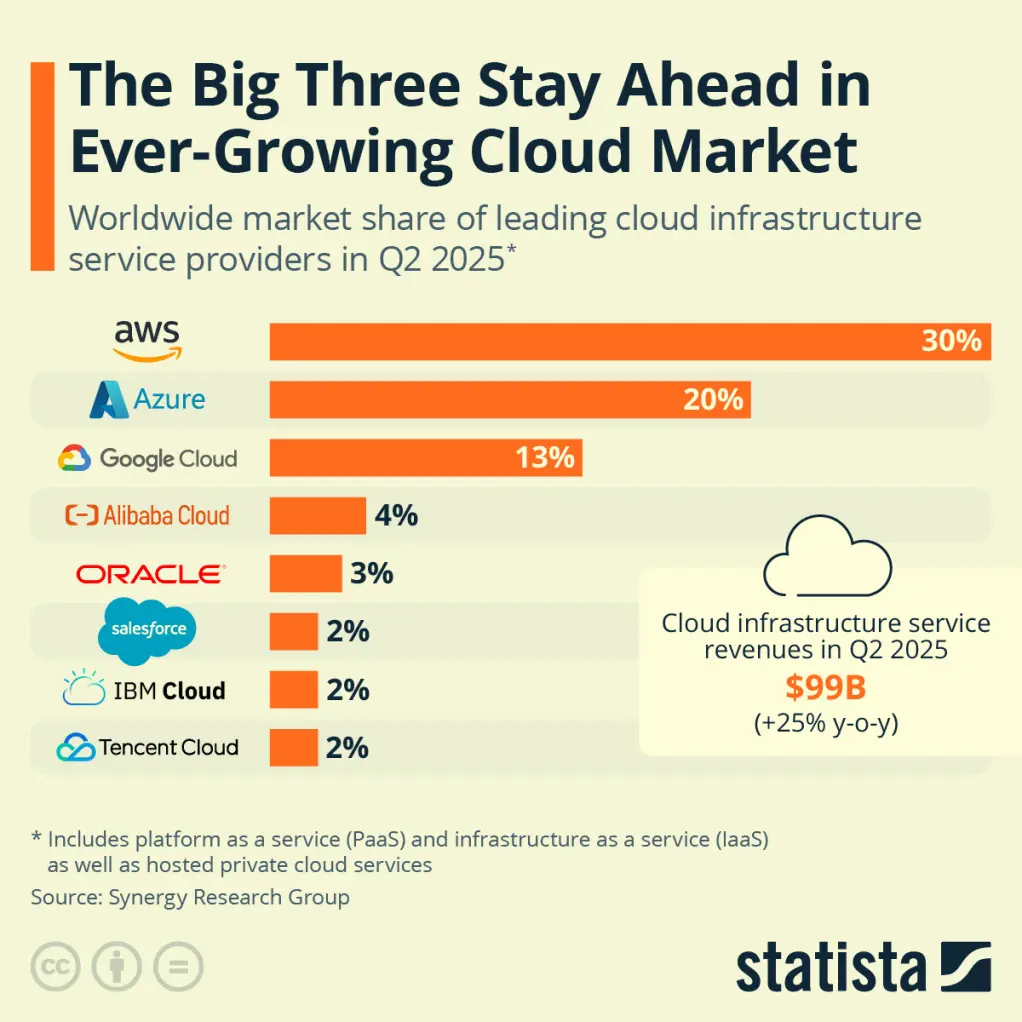
Cloud computing was meant to democratize the web—making storage, computing power, and scalability accessible to anyone with a startup dream. But over the years, market consolidation has produced an oligopoly. Amazon Web Services, Microsoft Azure, and Google Cloud together command nearly two-thirds of the global cloud infrastructure market (chart below). AWS alone accounts for roughly 31%of the market, according to Synergy Research Group.
It powers not only consumer apps and e-commerce websites but also logistics systems, streaming platforms, smart devices, and even portions of critical infrastructure. This means that a single technical misconfiguration or regional outage can paralyze the internet’s nervous system. We saw this vividly in December 2021, when AWS’s outage disrupted everything from Disney’s theme parks to Netflix streaming and even Adele concert ticket sales. That episode served as a wake-up call, but evidently, not much changed. The recent outage shows that resilience has not yet caught up with our reliance.
Comparing Crises: AWS vs. CrowdStrike
Interestingly, markets treat cloud disruptions differently depending on who’s responsible and how quickly the problem is fixed. When CrowdStrike suffered a global IT outage in July 2024, caused by a faulty security update, it was an investor bloodbath. The cybersecurity firm’s shares plunged over 20% in a single day, and its market reputation took months to rebuild. Amazon, by contrast, emerged relatively unscathed this week. The difference highlights two intertwined dynamics: investor psychology and brand scale.
CrowdStrike’s blunder directly impacted enterprise endpoints, halting computers worldwide. AWS’s disruption, however, affected systems indirectly—painful but not catastrophic for most users. And, crucially, AWS’s “too big to fail” aura gives it a protective moat. Investors assume Amazon will recover because, quite simply, it must. The global economy depends on it. That’s the paradox of digital centralization: the more integral a company becomes to our infrastructure, the more immune it is to consequences.
The Hidden Cost of Convenience
In the digital age, convenience and consolidation go hand in hand. AWS’s success is built on providing frictionless scalability; no one wants to build their own data centers when the cloud offers reliability, flexibility, and near-infinite capacity. But this convenience masks fragility. A recent study by the Uptime Institute found that 80% of major IT outages in 2023 were linked to cloud or hosting provider failures, with costs averaging $100,000 or more per incident for affected companies.
The problem isn’t that cloud systems fail; it’s that so many organizations fail together when one provider goes down. From fintech apps to hospital systems, the “cloud monoculture” problem means that a single disruption can cascade across industries. Experts have long warned that over-reliance on any one provider, no matter how sophisticated, creates systemic risk comparable to over-leveraged banks before the 2008 financial crisis.
Normalization of Outages: A Dangerous Complacency
Perhaps what’s most troubling about the latest AWS outage isn’t the event itself—it’s the collective shrug that followed. Users complained, memes circulated, services rebooted, and the world moved on. Outages, it seems, have become part of the digital landscape. This normalization of failure risks dulling our awareness of dependency. We’ve come to expect the internet to “mostly work,” and when it doesn’t, we assume it’ll be fixed soon.
That complacency is dangerous. As technology weaves deeper into supply chains, healthcare systems, and even government operations, each outage carries greater stakes. It’s not hyperbole to suggest that a prolonged cloud failure could disrupt critical national infrastructure. From airline scheduling systems to smart grids and emergency communications, the cloud is no longer just a convenience; it’s a lifeline.
The Road to Resilience
So, what can be done? The answer lies in diversification and accountability.
First, businesses must move beyond single-provider dependencies. Multi-cloud strategies, where organizations distribute workloads across multiple providers, can reduce exposure to outages. Hybrid models that combine private servers with public cloud platforms can also help mitigate systemic risks.
Second, policymakers and regulators should treat major cloud providers as critical infrastructure entities, subjecting them to similar resilience standards as financial institutions or energy grids. The European Union has already taken steps in this direction with the Digital Operational Resilience Act (DORA), which imposes tougher oversight on cloud service providers supporting financial entities.
Finally, transparency matters. Outages should not be swept under the rug as rare anomalies. Providers like AWS must disclose not only the nature of the failures but also the safeguards implemented afterward to prevent recurrence. Trust, once broken, can only be rebuilt through openness.
A Future Built on Fragile Clouds
We have built a civilization on the promise of uninterrupted digital access. Yet, as this latest incident reminds us, even the most advanced systems rest on fragile foundations. The cloud may seem infinite, but its architecture is still human—subject to error, overload, and unforeseen breakdowns. It’s time to rethink resilience not as a technical upgrade, but as a philosophical one. The internet was conceived as a decentralized network designed to survive nuclear war. Ironically, in our pursuit of efficiency, we’ve rebuilt it atop a handful of companies. AWS’s 15-hour glitch may not have brought the world to its knees, but it showed us, once again, how easily it could.
Originally Published on LinkedIn.






