
A seven-decade journey through inflation, crises, and recovery and the Fed’s delicate balancing act.
Few indicators tell the story of America’s economic evolution as clearly as interest rates. Set by the Federal Reserve, the federal funds rate—the rate at which banks lend to each other overnight—serves as the benchmark for borrowing costs across the economy. From mortgages and auto loans to corporate credit and government borrowing, changes in this single figure ripple outward to shape financial stability, consumer confidence, and long-term economic growth.
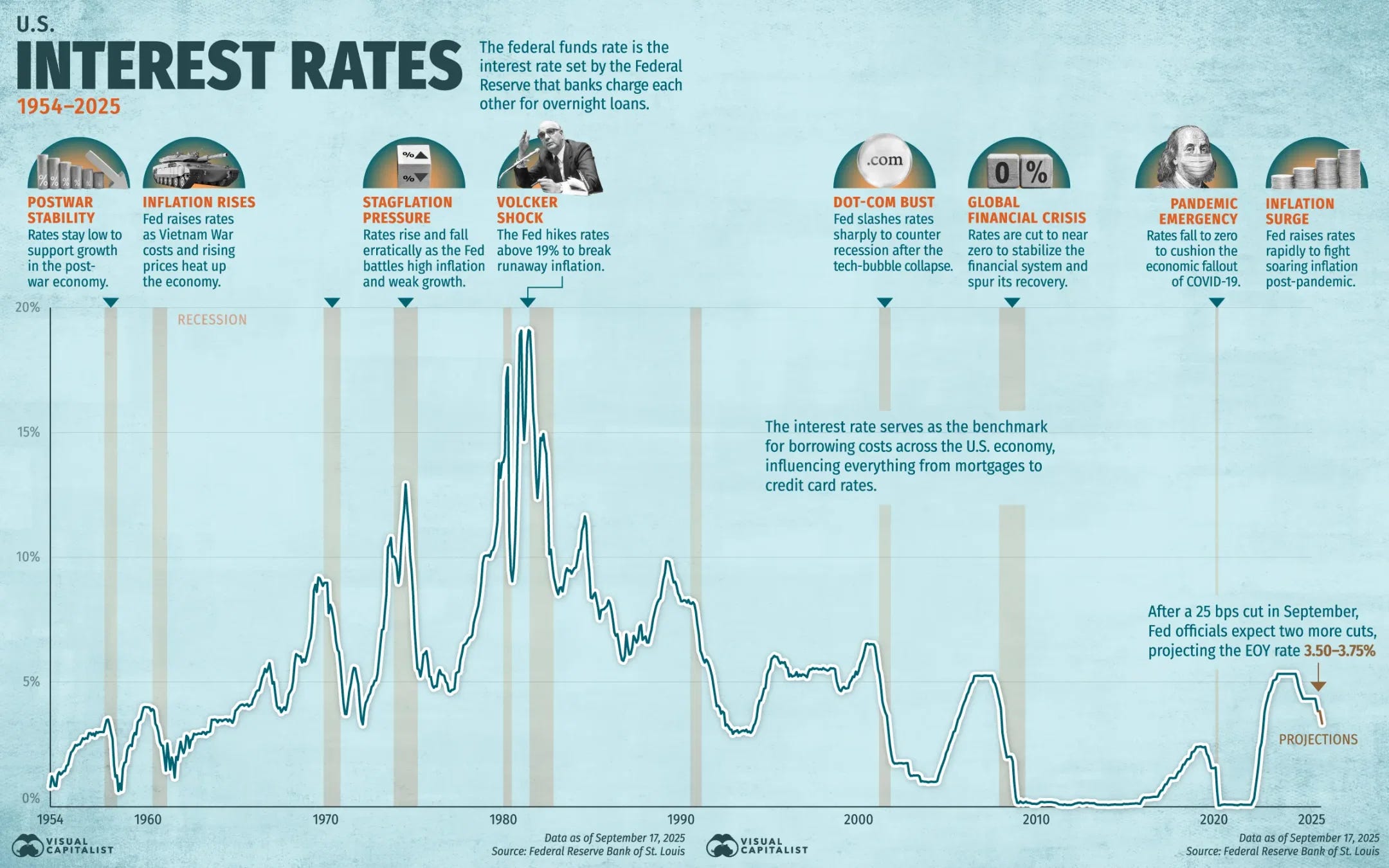
Looking back over seven decades of U.S. interest rate history reveals more than just shifts in monetary policy. It tells a story of wars and recessions, of inflationary shocks and financial crises, of optimism, fear, and recovery. A recent visualization by Visual Capitalist using data from the Federal Reserve Bank of St. Louis charts the trajectory of rates from 1954 through projected values in 2025. The story it tells is not only historical, it holds lessons for the future.
Postwar Stability (1950s–1960s)
In the wake of World War II, the U.S. entered a period of robust economic expansion. Industrial production surged, consumer spending grew, and suburbanization reshaped the American landscape. During this era of postwar prosperity, the Federal Reserve kept interest rates relatively low to support growth and ensure access to credit.
Through the 1950s, rates generally hovered between 1% and 4%, with temporary upticks to counter mild inflationary pressures. But by the 1960s, the picture began to shift. The escalating costs of the Vietnam War and Lyndon B. Johnson’s “Great Society” programs began to fuel inflationary pressures. By the late 1960s, rates climbed toward 6%, marking the beginning of a new era where inflation became a persistent challenge.
Stagflation and the Volcker Shock (1970s–1980s)
The 1970s were defined by a rare and painful combination of stagnant economic growth and soaring inflation—stagflation. Triggered in part by oil price shocks (notably the 1973 OPEC embargo), inflation spiraled while growth faltered. The Fed raised and lowered rates erratically, trying to tame prices without choking off the economy.
By the late 1970s, inflation had reached double digits, eroding purchasing power and shaking confidence in the U.S. economy. In response, Federal Reserve Chair Paul Volcker took bold, controversial steps. In what became known as the Volcker Shock, the Fed hiked interest rates aggressively—pushing the federal funds rate above an astonishing 19% in the early 1980s.
This decision was deeply painful in the short run. The U.S. endured back-to-back recessions in 1980 and 1981–82. Unemployment spiked, housing markets froze, and businesses struggled under high borrowing costs. But Volcker’s strategy succeeded: inflation was finally broken, setting the stage for a period of relative price stability in the decades ahead.
The Great Moderation (1990s–2000s)
After the turbulence of the 1970s and early 1980s, the U.S. entered what economists later called the Great Moderation—a period of relatively stable inflation and steady growth from the mid-1980s through the early 2000s. Interest rates gradually declined, generally ranging between 3% and 7%, as the Fed managed inflation with more credibility and precision.
But stability was not immune to shocks. In the late 1990s, the dot-com bubble fueled speculative growth in technology stocks. When the bubble burst in 2000, the Fed slashed rates sharply, cutting them to around 1% by 2003 to stimulate recovery. These ultra-low rates helped stabilize markets but also contributed to new risks, fueling a housing bubble that would have devastating consequences later in the decade.
The Global Financial Crisis (2007–2009)
When the housing market collapsed and Lehman Brothers failed in 2008, the world faced the worst financial crisis since the Great Depression. Credit markets froze, unemployment soared, and global trade collapsed. To stabilize the financial system, the Fed cut rates to near zero, effectively between 0% and 0.25%, a level previously considered unthinkable.
These policies were paired with unconventional measures, including quantitative easing (QE), in which the Fed purchased trillions in government bonds and mortgage-backed securities to inject liquidity into the economy. This marked the beginning of a new era in monetary policy, where central banks wielded unprecedented tools to prop up financial systems.
The Pandemic and Post-Pandemic Era (2020–2025)
Fast-forward to 2020, when the COVID-19 pandemic brought the global economy to a sudden halt. Businesses closed, millions lost jobs, and uncertainty spread faster than the virus itself. The Fed responded by cutting rates back to near zero, aiming to cushion the economic fallout. Once again, borrowing costs plummeted, fueling a rapid surge in credit availability.
But the rebound created new problems. Supply chain disruptions, massive fiscal stimulus, and surging consumer demand contributed to the highest inflation in four decades. By 2022, inflation had climbed above 8%, forcing the Fed into its most aggressive tightening cycle since Volcker’s era. Interest rates were lifted rapidly, reaching above 5% by 2023.
As of September 2025, the Fed has begun easing again, cutting rates by 25 basis points. Officials project the federal funds rate will end the year between 3.50% and 3.75%, signaling a cautious pivot as inflation cools but growth remains uncertain.
Lessons from Seven Decades of Interest Rate History
The chart of interest rates from 1954 to 2025 offers more than numbers. It provides key lessons about the delicate balance central banks must strike:
-
Inflation control is paramount. The Volcker era demonstrated that allowing inflation to spiral can erode trust in an economy, but also that taming it comes with painful trade-offs.
-
Low rates can fuel excesses. The early 2000s and post-pandemic years show how ultra-low borrowing costs can encourage bubbles—in housing, stocks, or other asset classes.
-
Crisis response shapes the future. Whether in 2008 or 2020, the Fed’s willingness to act aggressively prevented systemic collapse. But emergency measures often sow seeds of future instability.
-
The Fed’s credibility matters. Markets, businesses, and households take their cues not just from the current rate but from expectations of Fed policy. Clear communication is as important as policy itself.
Looking Ahead: What Will Define the Next Chapter?
The Fed’s projected rate cuts for 2025 suggest policymakers believe inflation is cooling and the economy can sustain modest growth. But uncertainty looms. Geopolitical tensions, supply chain shifts, and the unpredictable impacts of climate change all pose risks. At the same time, artificial intelligence and new technologies could reshape productivity and wage growth in ways difficult to anticipate.
If history offers one lesson, it is that interest rate policy cannot solve every problem. Monetary policy is a powerful tool, but it works in tandem with fiscal policy, global trade, and technological change. The challenge for the Fed is not just reacting to crises but steering expectations, fostering stability, and avoiding overcorrection.
The Continuing Evolution of Monetary Policy
From the postwar boom to the Volcker shock, from the dot-com bust to the COVID-19 pandemic, interest rates have been both a reflection of America’s economic challenges and a lever for navigating them. As we approach the midpoint of the 2020s, the Federal Reserve once again stands at a crossroads—balancing the need to support growth against the imperative of keeping inflation in check.
History suggests the road ahead will be anything but linear. But by studying the past, we gain a clearer lens through which to view the future of U.S. monetary policy.
Originally Published on Substack.






