
Platforms like Shein and Temu thrived on the $800 loophole—now, every package faces duties and tighter customs checks.
Starting today, a long-standing feature of U.S. trade policy—the “de minimis” exemption—comes to an end. For decades, Americans could order packages from abroad valued under $800 without paying customs duties. That era is now over. The Trump administration has formally scrapped the rule, placing millions of low-value imports under the same tariff regime that governs higher-priced shipments.
This change is more than a bureaucratic tweak. It marks a turning point for global e-commerce, U.S. consumers, and the companies that thrive on direct-to-consumer supply chains. With nearly 4 million such shipments entering the U.S. each day, the policy shift will ripple through everything from holiday shopping patterns to international trade balances.
A Brief History of the ‘De Minimis’ Rule
The idea of exempting small packages from import duties is not new. It first appeared in the Tariff Act of 1930, a law designed to streamline customs enforcement while supporting U.S. industries during the Great Depression. At the time, the threshold was set at a mere $1 per parcel—equivalent to about $20 today.
Over the decades, Congress gradually raised the exemption:
-
1978: The threshold increased to $5.
-
1993: Raised again to $200, reflecting the growth of global commerce.
-
2015: In the most dramatic leap, the bar was lifted to $800, in part to foster the explosion of small business imports and e-commerce marketplaces.
That last change coincided with the rise of global direct-to-consumer platforms. Companies like Shein and Temu (Pinduoduo) leveraged the $800 loophole to ship clothing, electronics, and home goods directly from overseas factories to U.S. households, bypassing import duties entirely.
Ironically, Trump’s first-term tariffs on Chinese goods may have accelerated the growth of this model. While bulk imports from China faced steep duties, platforms routed products in smaller packages under the $800 limit, sidestepping the tariff wall altogether.
Why the Crackdown Now?
The administration frames the rollback of de minimis as a national security and public health issue. Officials argue that the exemption has been exploited for:
-
Illicit narcotics trade (notably fentanyl shipments).
-
Counterfeit goods - undermining both consumer safety and intellectual property rights.
-
Revenue leakage - The U.S. forfeited billions annually in foregone duties.
The numbers back up the concern. According to U.S. Customs and Border Protection, 92% of all cargo entering the U.S. qualifies as de minimis shipments. In recent years, that share has been “growing in epic proportions,” raising alarm in Washington. The government’s new approach requires transportation carriers (FedEx, UPS, DHL, USPS, etc.) to collect and remit duties. They can either:
-
Apply the tariff rate based on the product’s country of origin, or
-
Temporarily pay a fixed per-item amount ranging from $80 to $200.
This dual system is meant to prevent customs bottlenecks, but it also shifts compliance responsibility squarely onto logistics providers.
A Revenue Windfall for Washington
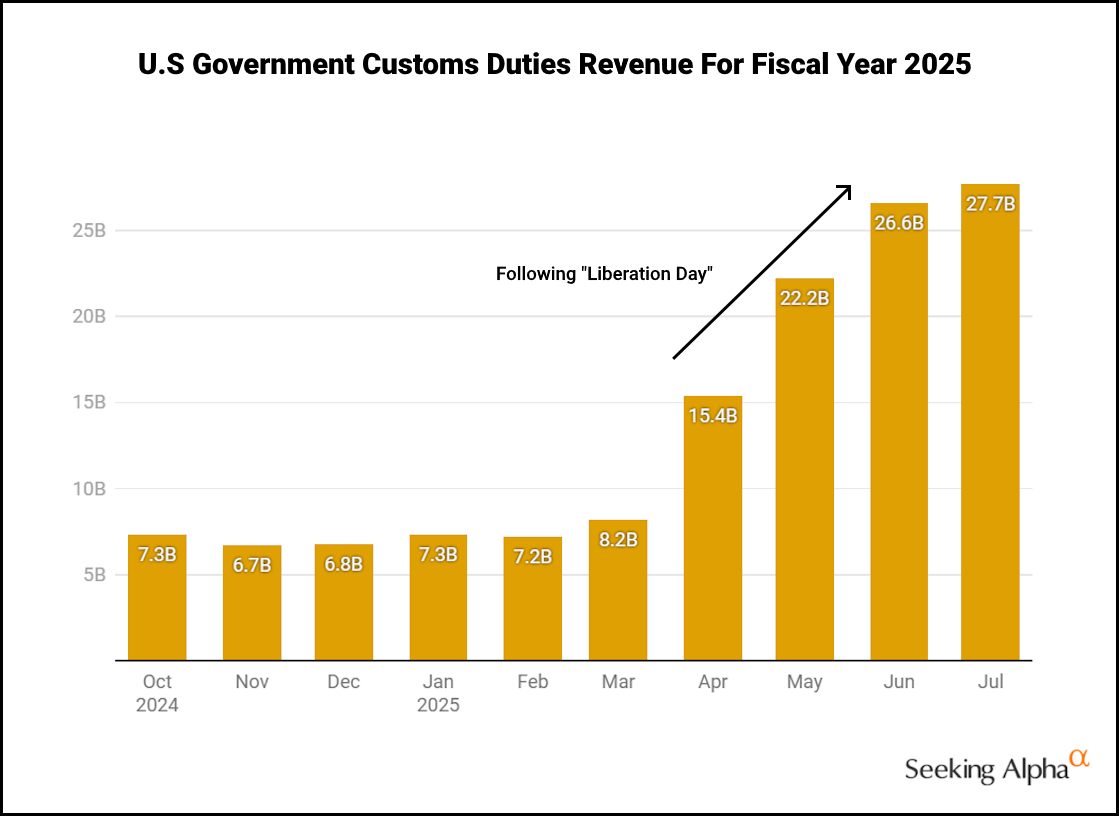
The end of de minimis is not just about stopping contraband. It also comes at a time when the federal government is eager to expand revenue streams. The latest data illustrates the stakes vividly. According to figures compiled by Seeking Alpha (below), U.S. Customs Duties Revenue surged dramatically in 2025:
-
From October 2024 through March 2025, revenue averaged $7–8 billion per month.
-
In April 2025—shortly after the new rules took effect—collections jumped to $15.4 billion.
-
By May, revenue had soared to $22.2 billion, climbing further to $26.6 billion in June and $27.7 billion in July.
This near quadrupling of customs revenue in a matter of months underscores how central the de minimis rule had become to U.S. import flows. Ending it not only tightens border enforcement but also furnishes Washington with tens of billions in fresh income at a time of rising deficits.
Winners and Losers in the New Trade Order
The demise of de minimis will reshape incentives across the supply chain.
Consumers: Americans who grew accustomed to cheap cross-border shopping will face higher prices. That $15 blouse from Shein or $30 gadget from Temu may now come with an additional $10–$40 duty. Buyers will be forced to scrutinize final checkout totals or shift spending to domestic retailers.
E-Commerce Platforms: Companies whose business model relies on micro-shipments, especially fast-fashion and discount platforms, are the hardest hit. Their competitive edge came from bypassing tariffs. Without it, U.S.-based retailers like Amazon or Walmart may reclaim some ground.
Transportation Carriers: FedEx, UPS, DHL, and USPS find themselves in a regulatory squeeze. They must either adapt their systems to calculate duties on millions of packages daily or accept fixed per-item costs that may erode margins. Expect lobbying pressure for streamlined processes or further exemptions.
The U.S. Government: Washington emerges as the biggest winner. Beyond revenue collection, the policy strengthens customs oversight, curbs illicit trade, and aligns with Trump’s long-standing “America First” trade philosophy.
The Bigger Picture: Global Trade and Geopolitics
This policy shift is not occurring in isolation. Around the world, governments are reassessing how cross-border e-commerce interacts with national sovereignty. The European Union has already abolished its own low-value exemption (€22) as of 2021, requiring VAT on nearly all imports. For the U.S., the end of de minimis also doubles as a geopolitical lever. Many of the platforms exploiting the $800 loophole are Chinese, and the crackdown further aligns with Washington’s broader strategy of rebalancing trade and reducing dependence on China.
What Comes Next?
The near-term future will likely bring friction: longer shipping delays, higher prices, and potential confusion at checkout screens. But longer term, the policy could:
-
Incentivize domestic production and sourcing closer to U.S. shores.
-
Push platforms like Shein and Temu to establish U.S. warehouses to handle duties in bulk.
-
Encourage new entrants in logistics and customs software to help carriers adapt.
The question is whether consumers, after years of bargain-hunting, are willing to absorb the higher costs or will seek substitutes elsewhere.
Looking Forward
The end of duty-free imports under $800 closes a chapter in U.S. trade history that began nearly a century ago with the Tariff Act of 1930. What was once designed to “avoid the expense and inconvenience” of collecting minor duties has, in the e-commerce era, become a loophole exploited on a massive scale.
Now that the Trump administration has ended it, Americans may need to rethink their online shopping habits, businesses will adjust their supply chains, and Washington will enjoy a new stream of customs revenue. Whether the policy fulfills its goals of reducing contraband and counterfeits, or simply raises prices for consumers, remains to be seen. One thing is certain: the days of frictionless, duty-free shopping from overseas are over.
Originally Published on Substack.






