
The AI revolution generated millions of new millionaires, yet poverty and economic insecurity continue to affect billions worldwide.
The global economy is witnessing one of the most extraordinary wealth creation events in modern history. Fueled by artificial intelligence, surging stock markets, and resilient corporate earnings, millions of individuals joined the ranks of the wealthy last year. Yet beneath the headlines celebrating new millionaires and soaring asset values lies a far more complicated reality: global poverty remains stubbornly persistent, and mounting macroeconomic risks threaten to deepen existing inequalities.
The contrast raises a fundamental question: How can the world generate unprecedented wealth while millions continue to struggle to meet basic needs?
AI Becomes a Wealth Creation Engine
Artificial intelligence has evolved from a promising technology into one of the most powerful wealth generators of the decade. Investors who positioned themselves in AI-related companies benefited from remarkable gains as markets rewarded firms involved in semiconductor manufacturing, cloud computing, data infrastructure, and generative AI applications.
According to Capgemini’s World Wealth Report 2026, the number of high-net-worth individuals (those with at least $1 million in investable assets) increased by nearly 2 million in 2025, reaching 25.3 million people worldwide. Their combined wealth surged by 8.7% to a record $98.3 trillion, marking the strongest annual expansion in five years.
Robust equity markets and significant capital deployment into AI-focused enterprises were among the primary drivers behind this growth. The United States led the surge, adding approximately 736,000 new millionaires in a single year. Meanwhile, Asia-Pacific recorded some of the fastest wealth growth rates, benefiting from strong demand for AI chips, electronics, and advanced technology infrastructure.
A Look at the Numbers
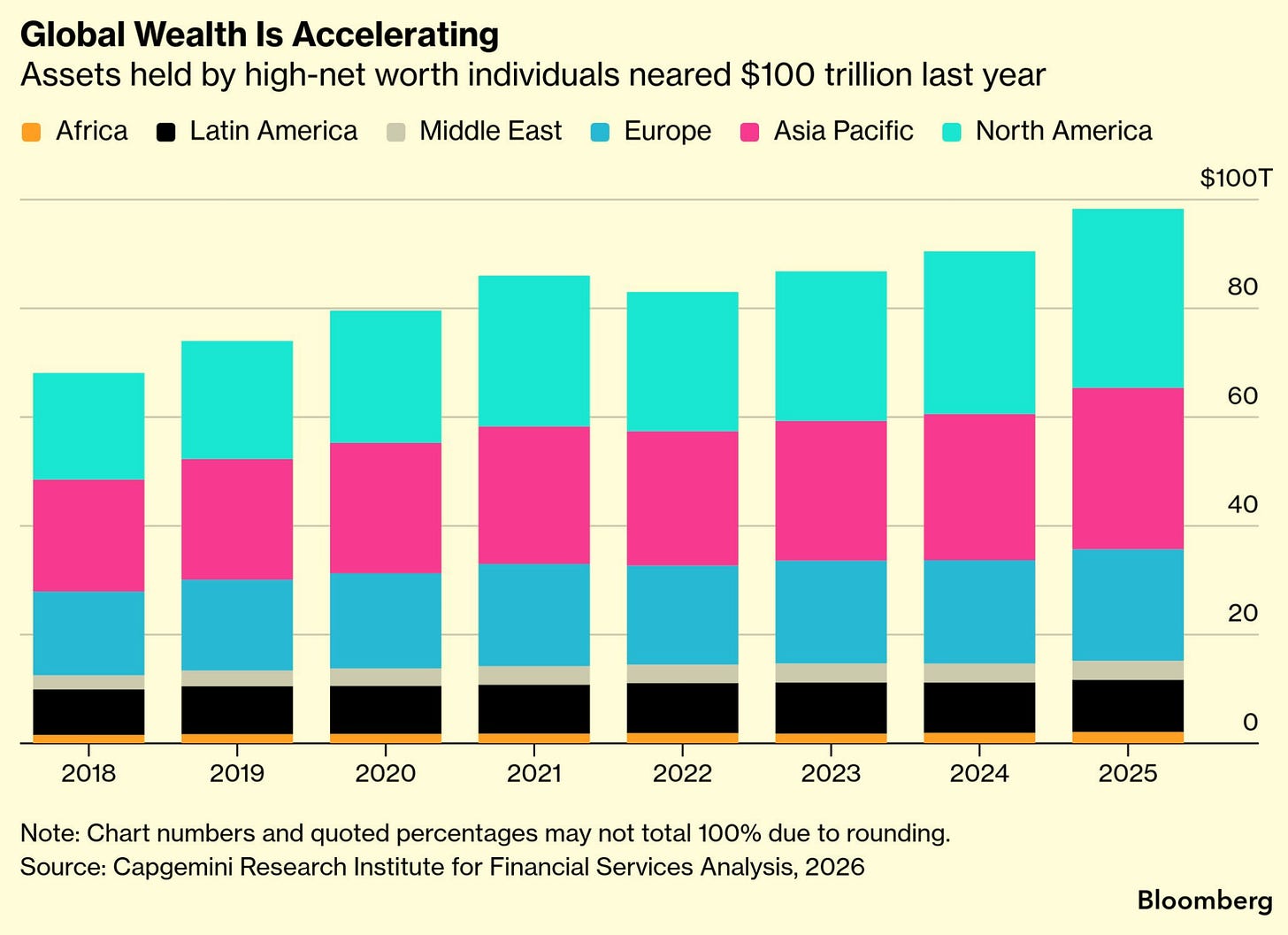
The data presented in the accompanying chart (below) illustrates the remarkable acceleration in global high-net-worth wealth since 2018.
According to Capgemini Research Institute data, global wealth held by high-net-worth individuals rose from roughly $68 trillion in 2018 to nearly $100 trillion in 2025. North America and Asia-Pacific accounted for the largest shares of this increase, reflecting their dominance in technology innovation, capital markets, and AI investment activity.
Several notable trends emerge:
-
Global millionaire wealth grew by more than $30 trillion over seven years.
-
North America remains the largest contributor to global wealth assets.
-
Asia-Pacific continues to close the gap as countries such as China, South Korea, Taiwan, and India expand their technology sectors.
-
Europe maintained steady growth despite geopolitical and economic challenges.
-
Latin America, the Middle East, and Africa contributed smaller but steadily increasing shares.
At nearly $100 trillion, the wealth controlled by the world’s affluent population now approaches the size of global annual economic output, highlighting the extraordinary concentration of financial resources within a relatively small segment of humanity.
Why the Rich Got Richer
The wealth surge was not evenly distributed, even among millionaires. Capgemini’s research found that ultra-high-net-worth individuals, those possessing more than $30 million in investable assets, experienced the strongest gains. Access to private equity, venture capital opportunities, hedge funds, and early-stage AI investments allowed this group to outperform other wealthy investors.
In fact, the ultra-rich accounted for a disproportionately large share of wealth growth despite representing only a small fraction of the wealthy population. The pattern reflects a broader reality of modern capitalism: access to high-growth investment opportunities often increases with wealth itself.
Those already possessing substantial assets can participate in private markets and emerging technologies long before they become available to the general public. AI has therefore become both a creator of wealth and an accelerator of wealth concentration.
The Poverty Paradox
Despite these impressive gains, global poverty remains a serious concern. Many regions continue to face rising living costs, food insecurity, housing shortages, and limited access to healthcare and education. Inflation may have eased in several advanced economies, but its effects continue to burden lower-income households worldwide.
Meanwhile, economic growth remains uneven across regions, leaving vulnerable populations exposed to financial shocks. The benefits of AI-driven prosperity have largely accrued to asset owners rather than wage earners. Individuals holding technology stocks, venture capital positions, or ownership stakes in AI companies have seen substantial gains.
Workers without financial assets, however, often experience little direct benefit from stock market rallies. This growing divergence helps explain why record wealth creation can coexist with persistent poverty. The challenge is not merely how much wealth is being generated but how broadly the gains are distributed throughout society.
Macroeconomic Risks Remain
The wealth boom also faces significant threats. Global debt levels remain elevated, geopolitical tensions continue to disrupt trade and investment flows, and many economies face demographic pressures that could constrain future growth. Interest-rate uncertainty, cybersecurity risks, and potential AI-driven labor market disruptions add further complexity.
Moreover, financial markets have become increasingly dependent on a relatively narrow group of technology companies. If AI-related valuations fail to meet investor expectations, wealth tied to those assets could experience significant volatility. The same technological forces that created millions of new millionaires could also amplify economic instability if growth slows or market sentiment changes.
The Defining Economic Question of the AI Era
The emergence of AI is undoubtedly creating immense economic value. The technology has already transformed industries, boosted corporate profitability, and generated unprecedented returns for investors. Yet the broader challenge for policymakers, businesses, and societies is ensuring that the benefits extend beyond shareholders and asset owners.
The world has demonstrated that it can create wealth on an extraordinary scale. The more difficult task will be determining whether that wealth can contribute to broader prosperity, social mobility, and economic resilience. As global millionaire wealth approaches $100 trillion, the defining question of the AI age may no longer be how much value technology can create, but who ultimately gets to share in it.
Originally Published on Substack.





