
Although the damage has been contained for now, it shows how liquidity conditions can rapidly deteriorate across the board
On Friday, March 10th, regulators shut down Silicon Valley Bank (SVB), marking the largest bank failure since the global financial crisis (GFC). Unlike the GFC bank failures, which were caused by poor management of collateral risks, the SVB collapse was caused by poor management of duration risk exacerbated by rapidly rising interest rates from a caught-in-headlights Federal Reserve facing high inflation.
Deposit holders rushed to get their funds out of the bank, leading to a run on the bank and ultimately its takeover by the FDIC. Circle, the firm behind DeFi’s most used stablecoin, USDC, held approximately $3.3 billion of its cash reserves with SVB, and USDC holders rapidly fled the stablecoin, resulting in an all-time-high deposit level on centralized exchanges (CEXs) and a liquidity crunch within DeFi (bottom chart below).
Coinbase paused USDC to USD conversions as the price of USDC deviated from the $1.00 peg. The rapid decline in USDC demand caused the price to fall over 13% by Saturday morning to a low of $0.87 (top chart below) before ultimately recovering back to $0.95–0.97 once Circle assured redemptions would flow normally come Monday. The stablecoin since then has returned to $1.00.
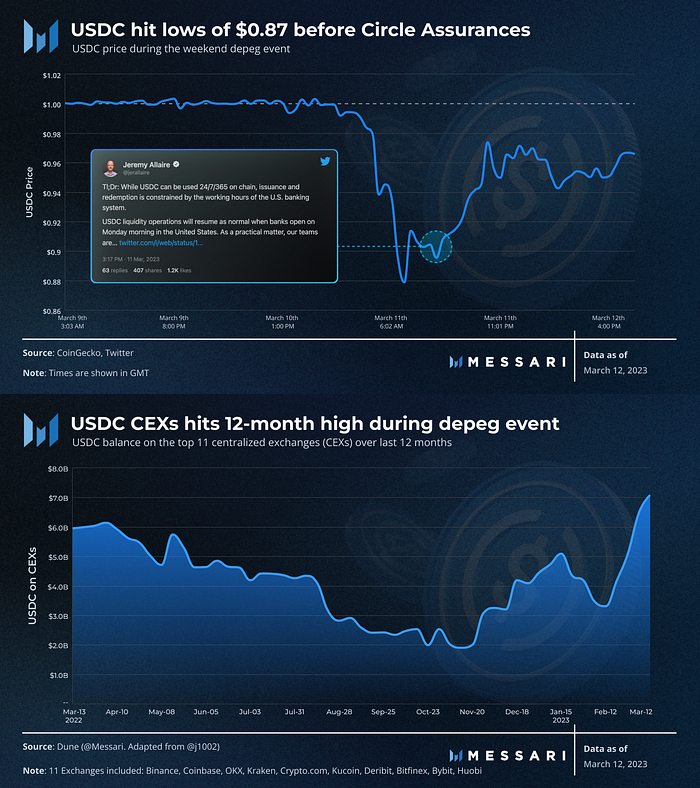
While fear of USDC’s backing caused the depeg event, DeFi, and its implicit assumptions, exacerbated the volatility. The Curve 3pool, one of the largest USDC DEX pools, assumed that the three stablecoins within it should all be $1.00. When one deviated from the peg, the concentrated liquidity mechanism and incentives rapidly resulted in further price declines.
Elsewhere in DeFi, USDC was so trusted that protocols hardcoded $1.00 assumptions, with Maker’s peg stability module (PSM) being the most notable one. With a hardcoded USDC price, Maker and DAI absorbed a ton of risk and volatility as arbitrageurs were able to take advantage of the price discrepancies offloading over $2 billion of USDC to the PSM more than doubling the USDC held by Maker.
While Circle’s $3.3 billion SVB deposits will likely be restored this week, the implications for DeFi will reverberate for months to come. The incident highlights the need for DeFi protocols to incorporate robust risk management practices that account for both internal and external events. In particular, the DeFi industry must address the issue of reliance on centralized stablecoin issuers, and develop more decentralized and trustless stablecoin alternatives.
Originally Published on Medium
Email | Twitter | LinkedIn | StockTwits | Telegram | Newsletter






