
Two leaders, two philosophies, one trillion-dollar legacy: How Apple’s DNA of innovation continues to define the future of tech.
Apple shares hit their first record of 2025 on Monday (Oct. 20), closing at $262.24 after a 4% surge, following Loop Capital’s upgrade of the stock from hold to buy. The investment firm cited robust iPhone demand as a key catalyst, a familiar refrain in Apple’s decades-long narrative of reinvention. This new milestone is not merely a reflection of short-term investor sentiment but a culmination of two distinct eras of leadership, innovation, and philosophy that have defined the company’s trajectory.
Apple, which had been a high-profile underperformer among the S&P 500 for much of 2025, plunging 31% at its worst in April, has since staged a remarkable recovery. The stock’s more than 50% rebound from those lows underscores how quickly sentiment can shift around one of the world’s most closely watched companies. But beneath these market fluctuations lies a deeper story, one that mirrors the transition from Steve Jobs’s era of disruptive innovation to Tim Cook’s era of operational mastery and sustained growth.
The Jobs Era (1997–2011)
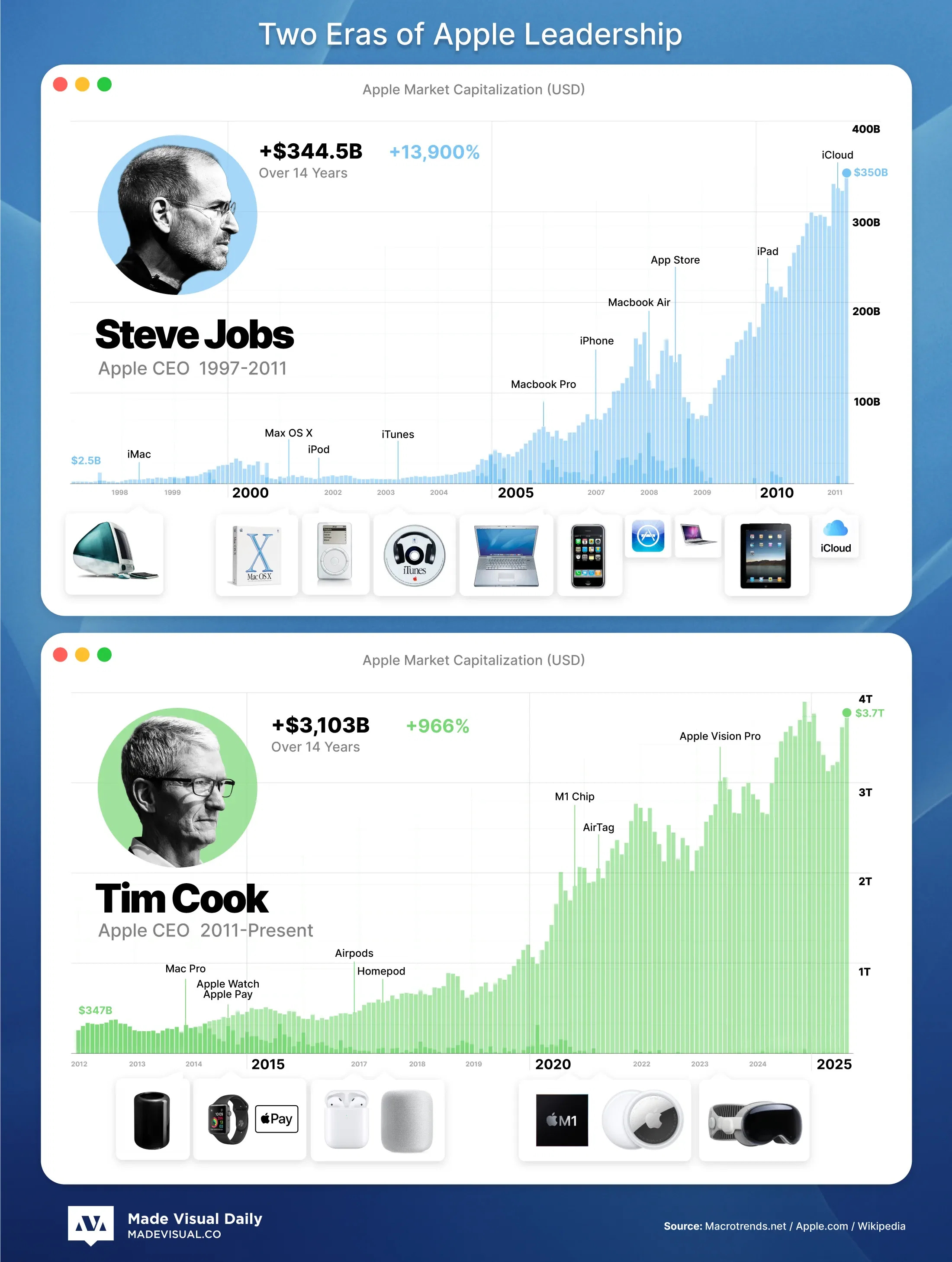
When Steve Jobs returned to Apple in 1997, the company was on the brink of collapse. Its market capitalization hovered around $2.5 billion, its product line was bloated, and its identity was unclear. Over the next 14 years, Jobs transformed Apple into an innovation juggernaut, adding an astounding $344.5 billion in market value, a 13,900% increase, according to Macrotrends data (infographic below).
Jobs’s philosophy was simple but transformative: build the products that change how people live. That principle drove a succession of iconic launches — from the iMac (1998) and Mac OS X (2001) to iTunes (2001), iPod (2001), iPhone (2007), and iPad (2010). Each represented a moment when Apple didn’t just enter a market; it redefined it.
Under Jobs, Apple’s culture thrived on risk and rebellion. His perfectionist insistence on hardware–software integration, intuitive design, and emotional resonance created not just products, but cultural events. The launch of the iPhone, for example, was not just the debut of a device but the dawn of an entirely new industry.
By 2011, when Jobs passed away, Apple’s market cap had reached $350 billion, cementing it as the most valuable tech company in the world. Yet, Jobs’s style of leadership — visionary, intense, and uncompromising — was not built for scalability. It was a model of creative chaos that required a singular figure at its helm. With Jobs gone, the question was whether Apple could evolve without losing its soul.
The Cook Era (2011–Present)
Tim Cook, Apple’s COO turned CEO in 2011, inherited both an empire and a burden. Where Jobs thrived in disruption, Cook excelled in optimization. His leadership brought a new kind of discipline — a transformation from a cult of innovation to a machine of execution. Over his 14-year tenure, Apple’s market capitalization has skyrocketed from $347 billion to $3.7 trillion, a staggering $3.1 trillion increase, or roughly 966% growth.
The contrast between the two eras could not be sharper. Jobs’s Apple was about creating markets; Cook’s Apple has been about maximizing them. Consider the innovations under Cook’s watch: Apple Watch, AirPods, Apple Pay, M1/M2 chips, AirTag, and most recently, the Apple Vision Pro. These are not the seismic disruptions of the iPhone era, but they represent a masterclass in ecosystem expansion, deepening consumer lock-in, and driving recurring revenue through services.
Indeed, one of Cook’s most profound contributions has been the pivot toward services. From iCloud and Apple Music to Apple TV+ and the App Store, services now generate over $85 billion annually (Apple, FY2024 report), creating predictable cash flow and softening reliance on hardware cycles. This strategic shift has transformed Apple from a cyclical hardware company into a diversified digital platform.
The Market’s Verdict: Innovation vs. Optimization
The chart comparing the two eras tells a compelling visual story. Jobs’s tenure saw Apple’s market cap soar from near insignificance to hundreds of billions, propelled by breakthrough moments that reshaped entire industries. Cook’s era, by contrast, depicts a steadier but exponentially larger climb — driven by scale, supply chain efficiency, and shareholder returns.
Jobs was the inventor; Cook is the steward. And yet, both were necessary. Without Jobs’s vision, there would be no iPhone, and without Cook’s operational genius, there would be no trillion-dollar Apple. Critics argue that Cook’s Apple has become too cautious, prioritizing incremental updates and margin preservation over daring leaps.
The Apple Vision Pro, launched in 2024, was hailed as a return to form — Apple’s first new product category in nearly a decade, but its adoption remains slow, and questions linger about its mainstream appeal. Still, the market’s renewed optimism in late 2025 reflects growing confidence that Apple’s fundamentals — brand loyalty, global distribution, and ecosystem stickiness — remain unmatched.
Apple in 2025: The Return of Momentum
Apple’s recent rally suggests that the narrative of stagnation may be overblown. Analysts at Loop Capital cited “resilient iPhone demand and an improving upgrade cycle” as key reasons for their bullish outlook. The company’s deepening integration of AI features into iOS and iPhone hardware, combined with its ongoing expansion in services and custom silicon, has rekindled enthusiasm among investors.
Moreover, Apple’s recent focus on on-device AI positions it strategically against competitors like Google and OpenAI, which rely on cloud-driven models. In an era increasingly concerned with privacy and personalization, Apple’s approach could prove to be both innovative and market-savvy, a rare combination that harks back to its Jobsian roots.
Two Visions, One Legacy
It’s tempting to pit Jobs and Cook against each other — the visionary versus the pragmatist. But Apple’s enduring success is precisely because it has evolved between these two poles. Under Jobs, Apple became a company people fell in love with. Under Cook, it became one that investors could trust.
Together, they’ve built not just a brand, but a system — one that continues to thrive even as the broader tech landscape shifts toward AI, mixed reality, and sustainability. As 2025 winds down, the real question may not be whether Apple can still innovate — but whether it can define the next cultural moment in technology as it once did. After all, Apple has always been most powerful when it turns tools into touchstones.
Originally Published on Substack.






