ETF flows remain choppy after the Fed’s rate cuts, but liquidity conditions are supportive. Will BTC’s seasonal strength turn consolidation into another leg higher?
For seasoned Bitcoin watchers, one truth has held remarkably consistent: the fourth quarter often delivers fireworks. Historically, Q4 has been among the strongest periods for Bitcoin, especially during bull market phases. Last year was no exception—Bitcoin exchange-traded funds (ETFs) saw their largest inflows in Q4, propelling the cryptocurrency from around $60,000 to above $100,000 in just a few weeks.
Now, as 2025 enters its final stretch, many investors are asking whether Bitcoin can pull off a similar rally. The data shows that while the setup is promising, the road ahead may lack the singular catalyst that turbocharged inflows last year. Instead, much depends on liquidity conditions, investor sentiment, and the ability of Bitcoin ETFs to attract sustained inflows once again.
Q4 Seasonality and Bitcoin’s Historical Strength
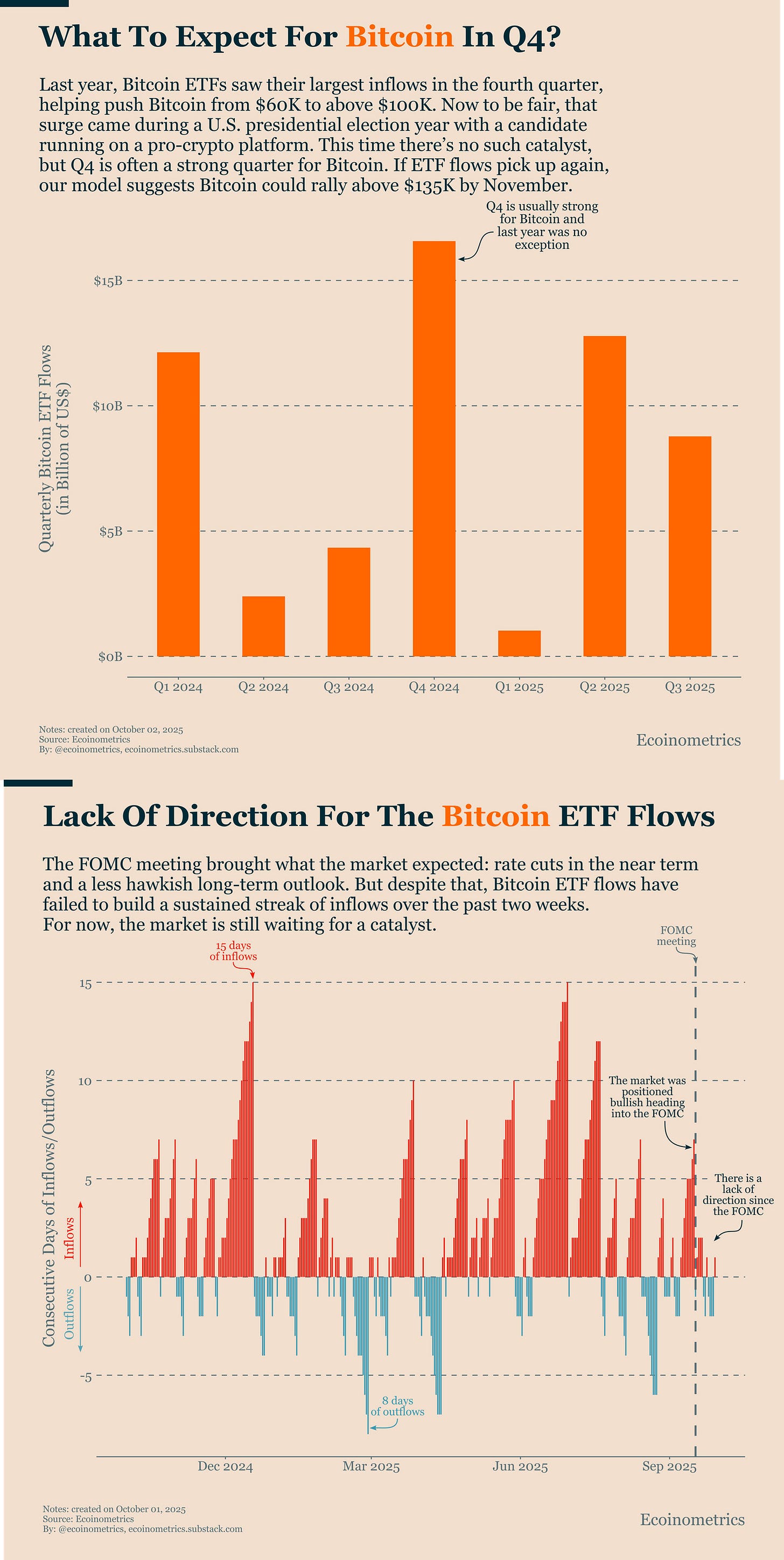
To understand the current moment, it’s important to revisit last year’s extraordinary rally. The fourth quarter of 2024 was defined by a surge in Bitcoin ETF inflows, peaking at nearly $15 billion in fresh capital (see chart below). This wave of demand coincided with a U.S. presidential election cycle, where a candidate with pro-crypto policies created a sense of urgency for market participants to position ahead of potentially favorable regulation.
That alignment of political momentum and liquidity drove Bitcoin higher with remarkable speed. From a baseline near $60,000, Bitcoin rallied to above $100,000—an all-time high at the time. The ETF flows were not just a reflection of retail enthusiasm but also institutional validation that crypto had reached another level of mainstream adoption.
But this year, conditions are different. There is no immediate political catalyst, no election-driven speculation. Instead, the potential for another strong Q4 rests on whether ETF inflows can revive against a backdrop of favorable liquidity conditions.
ETF Flows: A Barometer of Sentiment
ETF flows matter because they represent one of the cleanest measures of institutional demand. Unlike futures contracts, which can be hedged, or spot markets, which are fragmented across exchanges, ETFs consolidate activity in a transparent, regulated structure. Looking at the data from the past 18 months, flows have been anything but consistent.
-
Q4 2024: The standout quarter, with nearly $15B in inflows, fueling Bitcoin’s sharp rally.
-
Q1 2025: A lull, with inflows dropping near negligible levels as the post-election euphoria faded.
-
Q2 2025: A rebound in inflows, though not at the levels seen the previous year.
-
Q3 2025: Solid, but still shy of the blockbuster Q4 levels.
This volatility in flows reflects a market still searching for direction. ETF inflows surged when political and macro catalysts aligned, but have struggled to sustain momentum in quieter times.
The second chart tells the story more vividly. Consecutive days of inflows and outflows reveal the stop-and-go nature of sentiment:
-
At one point, Bitcoin enjoyed 15 consecutive days of inflows, signaling strong bullish positioning.
-
Conversely, there were also stretches of 8 straight days of outflows, underlining fragility in conviction.
-
Following the Federal Open Market Committee (FOMC) meeting in September 2025, flows fell into a state of indecision. Despite the Fed delivering rate cuts and a less hawkish outlook, Bitcoin ETFs failed to attract consistent demand.
The Fed, Liquidity, and Market Expectations
The Federal Reserve’s September 2025 meeting reinforced what markets already anticipated: modest rate cuts in the near term and a gentler long-term trajectory for policy. That was bullish for risk assets in theory, but the muted reaction in Bitcoin ETF flows suggests much of it was already priced in. Here lies the paradox: the macro backdrop is, in many ways, supportive of Bitcoin.
Liquidity is flowing into risk-on assets, real yields have softened, and traditional safe havens like the U.S. dollar appear less attractive than they did a year ago. Yet without a fresh catalyst, Bitcoin is treading water. This disconnect highlights an important truth about Bitcoin markets: macro tailwinds create a supportive environment, but they rarely spark rallies on their own. It takes flows, new capital entering the space, to transform favorable conditions into upward momentum.
Why Q4 Still Holds Promise?
Despite the lack of a political catalyst, there are compelling reasons to believe Q4 could once again deliver.
-
Seasonality and Psychology: Q4 has historically been a strong quarter for Bitcoin, both in bull and recovery phases. Investors remember last year’s rally and may look to front-run a repeat performance.
-
Institutional Participation: ETFs have made it easier for pension funds, asset managers, and advisors to allocate to Bitcoin. If inflows pick up, they could quickly snowball, as seen in Q4 2024.
-
Favorable Liquidity: With the Fed easing its stance and global markets positioning for rate cuts, liquidity conditions are broadly supportive of risk assets. Bitcoin tends to thrive in such environments.
-
Sideways Stretch Could Spark Momentum: Bitcoin has been consolidating in recent months, with no decisive trend. Historically, such consolidation periods often precede major moves. If ETF flows flip positive, the market could rapidly turn higher.
A Model Suggests $135K by November
According to the Econometrics model cited in the data, a repeat of strong ETF flows could drive Bitcoin above $135,000 by November. That would represent not just a new all-time high but also a powerful confirmation of Bitcoin’s status as a maturing macro asset. Such a rally would likely draw new entrants into the market, perpetuating a feedback loop of higher flows and higher prices. Conversely, if flows remain muted, Bitcoin risks drifting sideways, with liquidity alone insufficient to drive a breakout.
Risks and Counterpoints
Of course, it would be remiss to paint only the bullish case. Several risks remain on the horizon:
-
Geopolitical Tensions: Events in Europe, the Middle East, or Asia could shift capital back toward safe havens like gold or the U.S. dollar, dampening Bitcoin demand.
-
Regulatory Uncertainty: While ETF approvals in the U.S have boosted Bitcoin, regulatory scrutiny, particularly in Europe & Asia, could weigh on sentiment if policymakers turn more cautious.
-
Investor Fatigue: After a strong multi-year bull run, some institutional players may simply be waiting for deeper pullbacks before allocating fresh capital.
Waiting for the Spark
The setup for Bitcoin in Q4 2025 is one of cautious optimism. The historical precedent is clear: Q4 has often been the stage for Bitcoin’s strongest rallies, with last year providing a textbook example. Liquidity conditions remain favorable, and the ETF structure offers a robust channel for capital inflows.
But without a new catalyst—political, regulatory, or otherwise—the market remains in a holding pattern. The Fed’s dovish tilt is supportive, but not sufficient. Investors will be watching ETF flows closely; if they begin to mirror last year’s Q4 surge, the path higher becomes increasingly plausible. In short, the stage is set. All Bitcoin needs now is the spark.
Originally Published on Substack.