
Visualizing the strong negative correlation between the global reserve currency and the premier digital coin recently
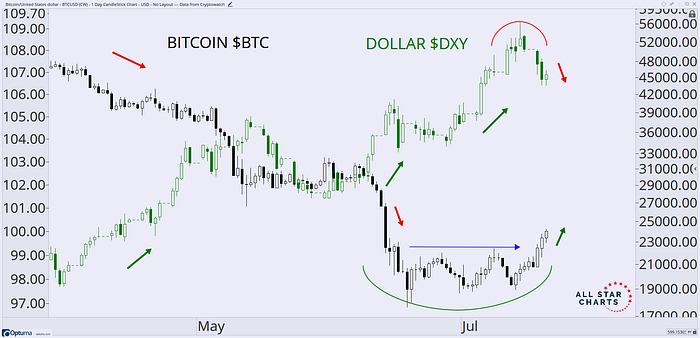
Historically speaking, the US Dollar acts as a safe haven asset and investors scramble to the safety of the global reserve currency in times of turbulence — something that we have seen exhibited in the financial markets this year. Whenever risk assets come under pressure, the dollar index (DXY) rallies. DXY is a benchmark index for the Greenback used to measure the value of the dollar against a basket of six foreign currencies — the Euro, Swiss franc, Japanese yen, Canadian dollar, British pound, and Swedish krona.
Although today’s chart (above) highlights the strong inverse relationship between DXY and crypto pioneer Bitcoin, this relationship is evident in other segments too. Earlier, I wrote about Greenback’s inverse relationship with International stocks playing out, where the latter is considered as risker assets. We have seen risk assets remain under constant pressure this year and as expected, the US dollar has benefitted.
Bitcoin, which is considered one of the riskiest assets, has plummeted in the first half of the year — in tandem with the U.S stocks. As we can see from the chart above, Bitcoin (BTC) was falling as the U.S. Dollar Index (DXY) rallied in April, indicating an inverse correlation. However, there’s been a little change in sentiment recently. Bitcoin moved sideways despite another leg higher from DXY. This indicated that BTC was started showing resilience to any further weakness.
Now that DXY has turned lower, Bitcoin is experiencing an explosive rally. The same is true for stocks as well. So far BTC has rebounded to over $24k while Ethereum pierced above $1600. While Tesla selling 75% of its Bitcoin holdings for cash has created a dent in these recent crypto gains, a falling dollar might be pointing to a bear market rally in risk assets, to say the least.
Originally Published on Medium
Email | Twitter | LinkedIn | StockTwits | Telegram | Newsletter






