
Cyclicality is a feature of financial markets but its extreme nature reflects itself a little more evidently in cryptos led by Bitcoin
The Cryptoverse was rocked earlier this month when one of the biggest crypto exchanges, FTX, squeezed by a liquidity crunch, declared bankruptcy. Binance CEO Changpeng “CZ” Zhao had tried to save its rival by purchasing it but pulled out after seeing its financial condition. The crash of FTX and its token, FTT, sent prices for other cryptocurrencies plunging on fears of a sector-wide contagion. Bitcoin, for example, sank to a two-year low.
Zhao then moved to put together the fund in order to prop up other firms that might face a similar crisis. Referred to as Web3 Industry Recovery Initiative (IRI), CZ has already committed more than $2 billion to the fund. Zhao explained that the fund would consist of Bitcoin (BTC), Binance’s token (BNB), and Binance USD (BUSD), which is tied to the U.S. dollar. Zhao indicated that about 150 firms have already applied for assistance through the IRI.
In the wake of this major contagion event, Bitcoin and the associated cryptos saw price declines that approached their June lows. This is not the first time we have seen such massive volatility in cryptocurrencies. This extreme cyclicality is an inherent feature of the system. Previous market cycles have seen the industry’s value decline 80–90% in a matter of months — on multiple occasions.
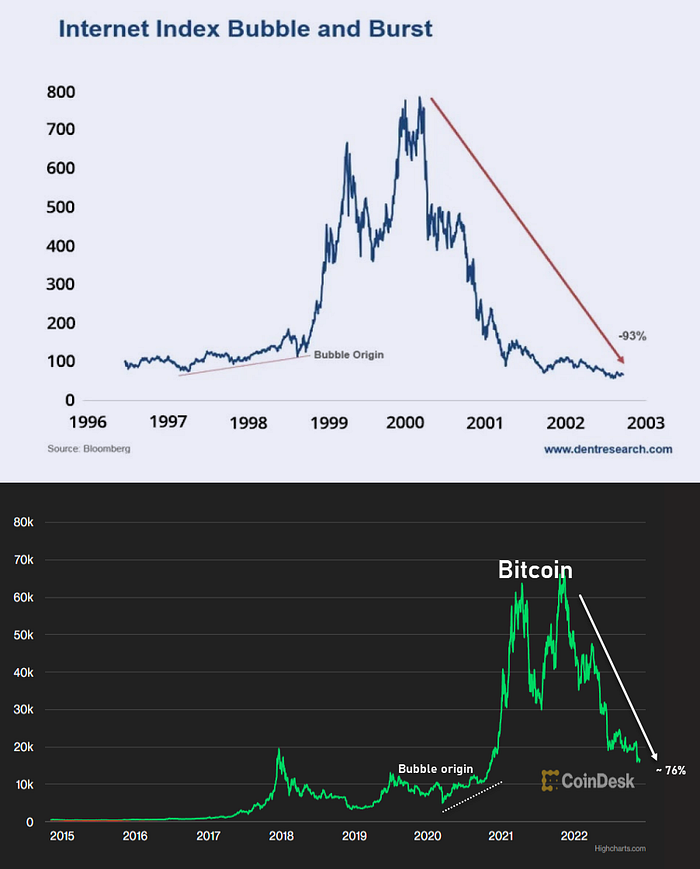
In fact, the current decline from the most recent high posted in late 2021 stands at around 76% in Bitcoin (BTC) — at the time of publishing. The irony is that every time the price of BTC appreciates, it is labeled as a bubble but the skeptics. We saw this happen in 2017 when the price touched $20k. Even at that time, there was a lot of FUD about BTC crashing to zero, but it survived.
My contention with the above narrative is that bubbles get created all the time in financial markets and one of the most well-known ones was the early 2000’s dot-com bubble — perhaps a little more relevant and comparable to the tech transformation we are seeing now. As you can see in the chart above, Bloomberg Internet Index cratered by roughly 90% in a two-year span. Many of the early boomers of the internet revolution didn’t survive the crash but it didn’t kill the movement.
Similarly, the whole blockchain movement is not built around cryptos — actually, it’s the other way around. And yes, probably a majority of the cryptocurrencies might not survive (21,865 listed on coinmarketcap), but that doesn’t mean we are going to see an untimely demise of the blockchain tech. In fact it is growing by leaps & bounds. As I covered in my recent piece, 77 of the top 100 global public companies are using blockchain technology with an expected 5-year growth rate of 60.2%.
As for digital assets, the terms cryptocurrencies and volatility go hand-in-hand. Extreme speculation is driven by a lack of central governing authority, which leads to price action that is heavily influenced by human emotion. Add to this social feedback loop, and you have a perfect recipe for boom-and-bust cycles, as the ones we have seen already. And just like the internet, blockchain too will survive.
Originally Published on Medium
Email | Twitter | LinkedIn | StockTwits | Telegram | Newsletter








