
How IBM’s entry into institutional crypto custody could redefine trust, tokenization, and the next chapter of digital finance.
From pioneering mainframes in the 1960s to shaping the cloud computing era, Big Blue has long been a bellwether for technological inflection points. Now, IBM is entering another frontier: digital assets. IBM announced the launch of its “Digital Asset Haven” — a crypto platform designed for US institutional clients, including businesses, governments, and financial entities. The platform promises to provide crypto custody, settlement & payment infrastructure by year’s end, marking one of IBM’s strongest forays yet into blockchain-based finance.
In a world where traditional finance (TradFi) is converging with decentralized finance (DeFi), IBM’s move isn’t just opportunistic; it’s strategic. It signals the maturation of blockchain as an enterprise-grade financial tool and highlights how large technology firms are positioning themselves to service the next generation of capital flows.
A Platform Built for Institutional Trust
IBM’s new platform will enable direct access to on-chain yield from DeFi protocols spread across 40 public blockchain networks, including Ethereum, Polygon, Solana, and Avalanche. The goal: to simplify how institutions engage with decentralized markets while maintaining regulatory compliance and risk transparency.
Unlike most retail-oriented crypto exchanges, Digital Asset Haven is designed to meet the complex token compliance needs of institutions, encompassing KYC, AML, tax reporting, and regulatory audit trails under one standardized framework. For banks and asset managers wary of the fragmented crypto ecosystem, this integrated model could be a game-changer.
TradFi’s Gradual March Toward Tokenization
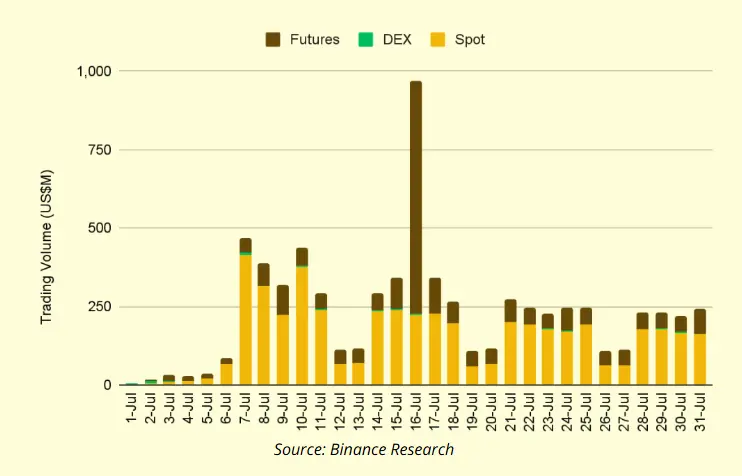
IBM’s entry comes at a pivotal moment. The broader financial sector is rapidly experimenting with tokenized assets, where real-world instruments like bonds, equities, and real estate are represented as digital tokens on a blockchain. According to Binance Research, tokenized stock trading volumes surged 220% in July, a growth trajectory reminiscent of the early DeFi boom between 2020 and 2021, when the sector’s total value locked (TVL) skyrocketed from $1 billion to $100 billion in under two years.
The attached chart (below) shows the rising momentum of crypto trading volumes, particularly Futures and Spot markets, across July. Notably, spikes around mid-July coincide with the period when institutional inflows into tokenized instruments intensified, suggesting that the demand for structured, compliant digital assets is more than a passing phase.
This shift is no longer confined to crypto-native firms. Heavyweights like BlackRock, JPMorgan, and Goldman Sachs are already running tokenization pilots and blockchain-based settlement systems. IBM’s Digital Asset Haven, therefore, arrives not as an experiment, but as an infrastructure backbone for what many are calling “the Internet of Value.”

The Institutionalization of DeFi
DeFi’s early years were marked by innovation and chaos. Protocols offered double-digit yields with little oversight, and billions were lost to hacks and exploits. But as the space matures, institutional DeFi or “DeFi with guardrails” is becoming a legitimate market segment. Platforms like IBM’s will likely focus on permissioned DeFi, where access is restricted to verified institutional wallets operating under regulated frameworks.
This could finally reconcile two competing forces: the transparency and efficiency of decentralized systems, and the accountability demanded by regulators. Furthermore, by offering cross-chain interoperability across 40 blockchains, IBM is addressing one of DeFi’s most persistent bottlenecks — fragmentation. A unified platform that aggregates yield opportunities across networks without sacrificing compliance could accelerate adoption among corporate treasurers, investment funds, and even municipal governments.
IBM’s Strategic Advantage: From Enterprise Blockchain to Digital Finance
IBM is no stranger to blockchain. Its Hyperledger Fabric, launched under the Linux Foundation in 2015, remains one of the most widely used permissioned blockchain frameworks globally. Over the past decade, IBM has built blockchain solutions for supply chain traceability, trade finance, and digital identity, collaborating with major institutions like Maersk, HSBC, and Walmart. But the Digital Asset Haven marks a decisive evolution: a transition from building blockchain systems to hosting blockchain-based financial services.
This positions IBM as a potential rival to existing institutional crypto players like Anchorage Digital, Fireblocks, and Coinbase Institutional, all of which cater to similar clientele but lack IBM’s deep-rooted enterprise trust. Moreover, IBM’s ability to integrate blockchain infrastructure into hybrid cloud environments could give it a scalability advantage. As tokenized assets become embedded in global payment and settlement rails, the need for cloud-native, interoperable systems will grow, an area where IBM’s existing clients already rely on its infrastructure.
Macro Context: From Crypto Winter to Institutional Spring
The timing of IBM’s launch is notable. The crypto industry has spent the past two years weathering scandals, bankruptcies, and regulatory uncertainty. Yet, the broader sentiment is shifting. Institutional interest in digital assets is quietly rebounding. BlackRock’s spot Bitcoin ETF now holds over $20 billion in assets, while firms like Franklin Templeton and Fidelity are experimenting with on-chain mutual funds.
Meanwhile,global regulators, including the U.S. Treasury and the European Central Bank, are exploring tokenized bonds and central bank digital currencies (CBDCs). As TradFi inches toward blockchain integration, IBM’s move reflects a deeper thesis: the next crypto cycle will not be driven by retail speculation but by institutional infrastructure.
The Road Ahead: Collaboration or Competition?
While IBM’s Digital Asset Haven could usher in a new era of institutional participation, it also raises key questions:
- Will traditional banks partner with IBM to access tokenized markets or develop their own competing systems?
- Can IBM’s platform maintain true decentralization while complying with regulatory mandates?
- And most critically, how will DeFi’s open ethos evolve when it meets the demands of institutional oversight?
These questions are not merely technical; they go to the philosophical core of what blockchain represents. IBM may have the technology, but the market will decide whether its model aligns with the decentralized future it seeks to serve.
IBM’s Calculated Leap into the Future of Finance
IBM’s Digital Asset Haven is more than a new product; it’s a signal. A signal that blockchain has matured from hype to infrastructure, from experimentation to execution. Just as cloud computing transformed how enterprises handle data, tokenization and digital assets may redefine how they handle value. If IBM can successfully merge compliance with innovation, it could position itself not only as a technology provider but as a foundational pillar of the next financial era.
Originally Published on Substack.






