
Bitcoin’s history of 4-year cycles, marked by explosive growth and subsequent corrections, suggests a potential bull run in 2025.
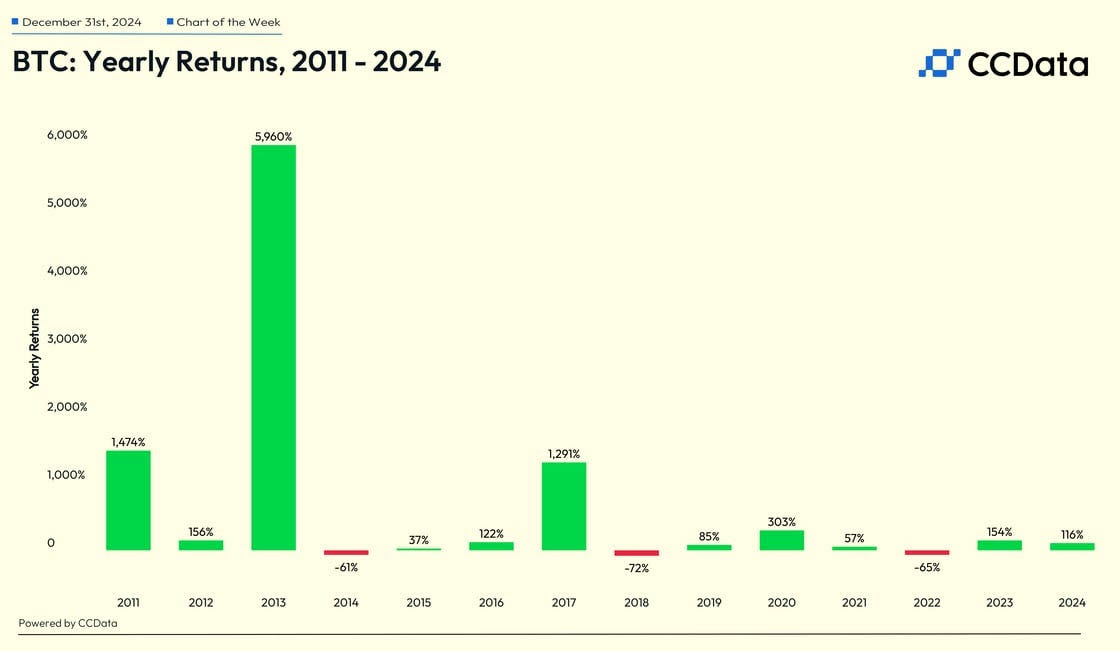
The cryptocurrency market witnessed a remarkable resurgence in 2024, with Bitcoin leading the charge as the premier digital asset. Clocking in an impressive 116% yearly return, Bitcoin’s performance cemented its status as the ultimate store of value and a critical component of the evolving financial ecosystem. This resurgence follows a challenging bear market in 2022, where Bitcoin shed 65% of its value, only to rebound with a 154% rally in 2023 and a continuation of gains into 2024.
But before we delve deeper into Bitcoin’s four-year cycles and what they mean for 2025, let’s briefly analyze how the broader crypto market performed in 2024. Memecoins dominated 2024, delivering a staggering 371% return fueled by tokens like DOGE, SHIB, and BONK. Exchange tokens (+60.6%) and Layer-1s (+44.2%) also saw strong gains, reflecting renewed retail interest in established blockchains.
RWA (Real World Assets) tokens (+41.8%) benefited from the institutional focus on tokenization, while AI tokens (+38.7%) capitalized on the AI boom. However, Layer-2s (-24.4%), DeFi (-12.5%), and Staking (-34.6%) faced challenges. A more favorable regulatory environment could revive interest in these sectors in 2025.
Decoding Bitcoin’s 4-Year Cycle
Bitcoin’s historical performance reveals a pattern of cyclical behavior, driven largely by the halving mechanism. The previous halving events in 2012, 2016, and 2020 have all been followed by substantial bull runs, and 2024 is expected to be no different. The halving event in April 2024 reduced Bitcoin's block reward from 6.25 BTC to 3.125 BTC, creating a new perspective due to the reduction in Bitcoin supply, which was expected to put upward pressure on prices
The chart (below) of yearly returns from 2011 to 2024 paints a vivid picture of alternating boom and bust periods:
🔵 Bull Cycles: Historically, the year following a halving has seen significant upward momentum. The 2013 bull run, with an astronomical 5,960% return, and the 1,291% rally in 2017; both followed halving events. These explosive gains have established the post-halving year as a critical period for investors.
🔵 Consolidation and Bear Markets: Following periods of rapid growth, Bitcoin often experiences corrective bear markets. The declines in 2014 (-61%), 2018 (-72%), and 2022 (-65%) were part of natural market cycles, allowing the asset to reset before the next rally.
🔵 Recovery and Reaccumulation: Recovery years, such as 2015, 2019, and 2023, have typically set the stage for the next major rally. These years tend to offer steady returns and increased adoption, building momentum for future growth.
What 2024 Tells Us About 2025
The strong performance of Bitcoin in 2024 aligns perfectly with its historical four-year cycle. The 116% gain marks it as a year of significant accumulation and optimism, reflecting increased institutional interest and favorable macroeconomic conditions. Key developments, including the growing interest in Bitcoin ETFs, global regulatory clarity, and increased adoption as a hedge against inflation, have bolstered market confidence.
Given Bitcoin’s historical tendency to perform exceptionally well in the year following a halving, 2025 is poised to be another standout year. The next bull cycle could mirror the explosive gains seen in 2013 and 2017, potentially taking Bitcoin to new all-time highs.
Catalysts for a Bullish 2025
👉 Supply Shock from the 2024 Halving: The halving reduces the daily issuance of new Bitcoin, creating a supply-side scarcity that has historically driven prices higher.
👉 Institutional Adoption: With major financial institutions entering the crypto space, the narrative of Bitcoin as a legitimate asset class continues to gain traction.
👉 Regulatory Developments: Clear regulations in key markets, including the United States and Europe, are likely to reduce uncertainty and attract a broader investor base.
👉 Macroeconomic Environment: Bitcoin’s role as a hedge against inflation and a store of value could become more pronounced in a high-debt, inflationary global economy.
👉 Technological Advancements: Ongoing developments in blockchain technology, such as layer-2 solutions and decentralized finance (DeFi), could further enhance Bitcoin's utility and attract new users.
A Word of Caution
While the historical data paints a promising picture, it’s crucial to remember that historical returns are not a guarantee of future performance. Bitcoin’s volatility remains a defining characteristic, and external factors such as regulatory actions or macroeconomic shocks could impact its trajectory. Diversification and a long-term investment perspective remain key strategies for navigating the crypto market. Nonetheless, the lessons of the past serve as a compelling guide for the future.
Disclaimer: This article is for informational purposes only and should not be considered financial advice. Please conduct your due diligence based on your risk profile.
Originally published at Substack.






