
Discover how the world's wealth is concentrated in a few regions, leaving billions behind.
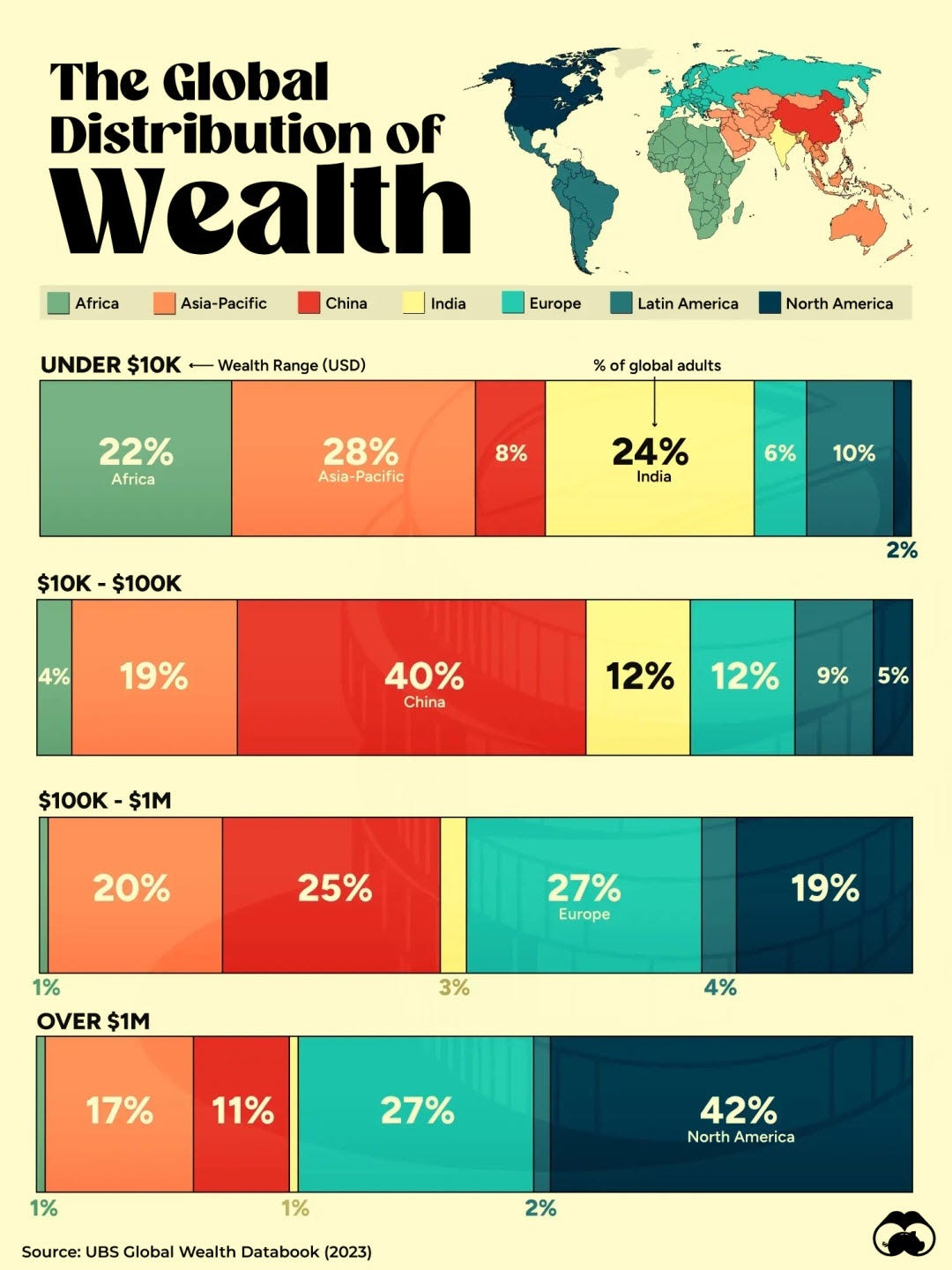
The global wealth distribution, as represented by data from the UBS Global Wealth Databook (2023), paints a concerning picture of the deep and persistent economic inequalities that exist among regions worldwide. The chart categorizes wealth distribution into four brackets—under $10,000, $10,000 to $100,000, $100,000 to $1 million, and over $1 million. Let’s start off with analyzing the data, before moving on to the implications of the wealth divide and how to address it.
Key Observations
Wealth Under $10K: In the wealth range of under $10K, Africa and the Asia-Pacific region have the highest percentages of global adults, with 22% and 28% respectively. India also has a significant portion, with 24% of its population falling into this category. This indicates that a large proportion of the population in these regions lives with minimal financial resources, struggling to meet basic needs.
Between $10K and $100K: The wealth range of $10K to $100K shows a different distribution. China leads with 40% of its population in this category, reflecting its growing middle class. Europe and North America have lower percentages, at 12% and 5% respectively, indicating that a smaller portion of their populations falls into this middle wealth range. This suggests that these regions have a more polarized wealth distribution, with more individuals either below or above this range.
Between $100K and $1M: In the $100K to $1M range, Europe and North America show higher percentages, with 27% and 19% respectively. This indicates a substantial middle-to-upper class in these regions. The Asia-Pacific region and China also have significant portions, at 25% and 20% respectively, reflecting the economic growth and increasing affluence in these areas.
Wealth Over $1M: The wealthiest category, over $1M, is dominated by North America, with 42% of its population falling into this range. Europe follows with 27%, while the Asia-Pacific region and China have 17% and 11% respectively. This highlights the concentration of wealth in North America and Europe, where a significant portion of the population holds substantial financial assets.
Implications of Global Wealth Inequality
-
Economic Disparity: The unequal distribution of wealth exacerbates economic disparities between regions, leading to limited access to healthcare, education, and other essential services in poorer regions.
-
Social and Political Instability: Extreme wealth inequality can fuel social unrest and political instability, as marginalized populations may feel excluded and disenfranchised.
-
Environmental Impact: Unequal access to resources and wealth can lead to unsustainable consumption patterns and environmental degradation in developed countries, while poorer regions may bear the brunt of the negative consequences.
Addressing Wealth Inequality
❖ Progressive Taxation: Governments should implement and enforce progressive tax systems to ensure the wealthy contribute a fair share toward societal development. This includes closing loopholes that enable tax avoidance.
❖ Global Wealth Redistribution Initiatives: International organizations can establish frameworks for redistributing wealth through grants, aid, and low-interest development loans to underserved regions.
❖ Debt Relief: Providing debt relief to heavily indebted countries to free up resources for development and poverty reduction.
❖ Strengthening Labor Rights: Enhancing labor laws to ensure fair wages, particularly in regions with high levels of poverty, can reduce wealth concentration and uplift low-income populations.
❖ Support for Small Businesses: Governments and private organizations should provide funding and mentorship to small and medium-sized enterprises (SMEs) in developing regions, fostering local economic development.
❖ Addressing Corruption: Corruption often siphons resources away from public services. Combating corruption through transparency initiatives and digital governance can ensure equitable resource allocation.
❖ Social Safety Nets: Strengthening social safety nets, such as unemployment benefits, healthcare, and pensions, can provide a financial cushion for those in need and reduce the economic disparity.
The global wealth distribution chart serves as a sobering reminder of the economic divides that persist in our world. Addressing these disparities requires a collective effort from governments, international organizations, and civil society. By taking concrete steps to redistribute wealth and create opportunities for all, we can strive for a more equitable and inclusive global economy.
Originally published at Substack.






