
Grayscale’s GSOL and Bitwise’s BSOL are redefining crypto investing by combining regulated ETFs with Solana’s proof-of-stake rewards.
The competition in the rapidly expanding crypto ETF market just intensified. Cryptocurrency asset manager Grayscale Investments has launched its staking-enabled Solana spot exchange-traded fund (ETF), marking another major step toward bringing institutional-grade exposure to Solana’s ecosystem. The Grayscale Solana Trust ETF (GSOL) began trading this week on the New York Stock Exchange Arca, signaling not only investor confidence in Solana but also the growing acceptance of staking as a mainstream investment feature.
Grayscale’s launch follows closely on the heels of Bitwise’s Solana ETF (BSOL), which debuted just a day earlier. Both products are structured to allow investors to participate indirectly in Solana’s proof-of-stake (PoS) network—meaning the underlying Solana tokens are used to help secure the blockchain while generating staking rewards.
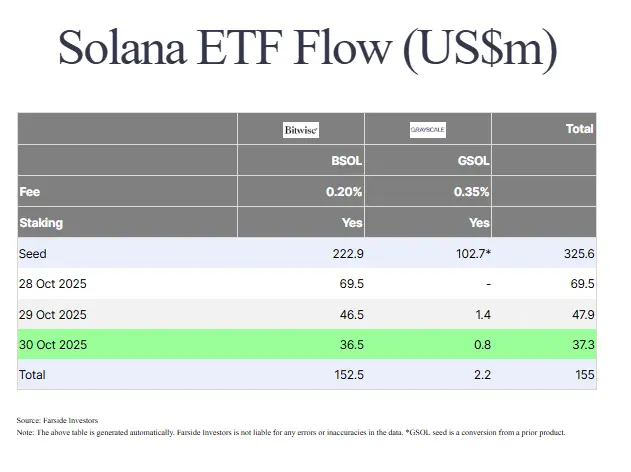
According to data compiled by Farside Investors, the two ETFs collectively seeded the U.S. Solana ETF market with $325.6 million in capital. Bitwise contributed $222.9 million, while Grayscale’s seed capital stood at $102.7 million, partially converted from an existing product. As of October 30, 2025, total inflows have reached approximately $155 million, with Bitwise leading in daily flow momentum.
Staking as a Catalyst for Yield-Driven Crypto ETFs
What sets these ETFs apart from traditional crypto products is the integration of staking functionality—a first-of-its-kind approach among major U.S. digital asset managers. Unlike spot ETFs for Bitcoin or Ethereum, which simply hold the underlying asset, these Solana ETFs actively stake their holdings to earn yield.
For investors, this represents a dual opportunity: price appreciation of Solana (SOL) and the added benefit of staking rewards. Grayscale’s GSOL redistributes 77% of staking rewards to investors while retaining 23% for operational costs. Bitwise’s BSOL, meanwhile, passes through 72% of rewards to investors, keeping 28% for itself.
This differentiation could play a significant role in attracting different investor profiles—Grayscale appealing to those prioritizing higher reward distribution, and Bitwise appealing to those seeking a lower management fee (0.20% vs. Grayscale’s 0.35%).
A Broader Shift in Institutional Crypto Adoption
The introduction of Solana ETFs with staking reflects a larger trend: institutional investors are increasingly seeking yield within regulated crypto vehicles. While Bitcoin ETFs have dominated headlines since their approval, Solana’s inclusion signals recognition of its high-performance blockchain and strong developer ecosystem.
It also marks the first time U.S.-based ETFs have embedded staking rewards into a publicly traded product—something that regulators had previously approached with caution. By combining yield generation with transparent governance and custody, both Grayscale and Bitwise are helping to bridge the gap between traditional finance and blockchain-native returns.
The Road Ahead
If early inflows are any indication, investor appetite for Solana exposure is substantial. Should market momentum continue, these ETFs could pave the way for similar staking-enabled products tied to other proof-of-stake assets such as Cardano, Avalanche, or Polkadot.
Grayscale’s entry solidifies the Solana ETF race as one of the most closely watched developments in digital finance this quarter. More importantly, it underscores a shift in investor mentality—from mere price speculation toward participation in blockchain economics itself.
As the lines blur between passive investment and active network participation, one thing is clear: the future of ETFs is not just about holding crypto—it’s about earning with it.





