
Clean energy exports now bring China more revenue than America’s oil and gas — signaling a new era of industrial dominance.
In the global race to dominate the future of energy, two giants stand on opposing sides of the economic spectrum. The United States wants the world to keep buying its fossil fuels — oil and gas exports that have long been a cornerstone of its global influence. China, on the other hand, is betting that the world’s next wave of prosperity will be powered by clean energy — and it wants to be the one selling it.
For now, there is a clear frontrunner. According to data compiled by Ember, China already earns more from exporting solar panels, batteries, electric vehicles (EVs), and other green technologies than the United States does from its oil and gas exports. The numbers tell a compelling story of economic transformation — and a geopolitical power shift in progress.
A Tale of Two Export Economies
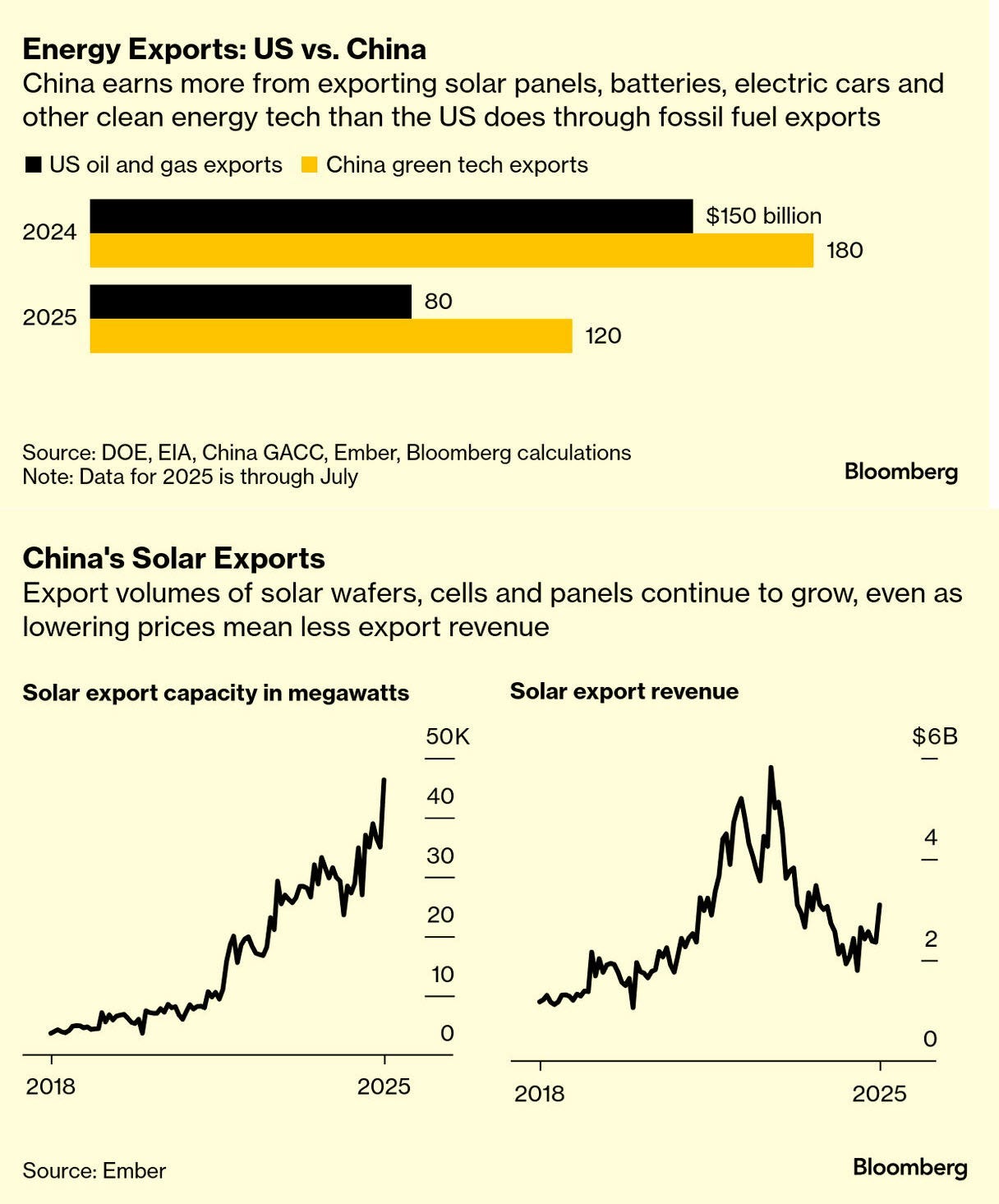
In 2024, U.S. oil and gas exports brought in around $150 billion, while China’s green technology exports reached $180 billion (Bloomberg charts below). The gap is expected to persist into 2025, with China projected to earn $120 billion through July, compared with the U.S.’s $80 billion in fossil fuel exports.
These figures underscore a remarkable reality: a country that still imports much of its oil and gas is now the world’s largest exporter of clean energy technology. What once began as an industrial policy to reduce dependence on foreign energy sources has evolved into a cornerstone of China’s global economic strategy.
China’s Green Export Machine
China’s dominance in clean technology exports is no accident. Over the past decade, Beijing has invested hundreds of billions of dollars into renewable energy research, manufacturing capacity, and global supply chains. From lithium-ion batteries to solar wafers, from EV components to rare earth materials, China controls nearly every link in the clean energy value chain.
In August 2025, Chinese clean tech exports hit a record $20 billion in a single month, according to data from Ember. Yet, the headline number tells only part of the story. The price of solar panels has fallen dramatically, a result of both efficiency gains and intense global competition. Lower prices mean that while export revenue has fluctuated, the volume of exported goods has soared.
Indeed, China shipped 46,000 megawatts (MW) of solar power capacity abroad in August alone — a historic high. This trend is reflected in Ember’s charts, where China’s solar export capacity has skyrocketed from under 10,000 MW in 2018 to nearly 50,000 MW by 2025, even as export revenues have fluctuated around $2–$4 billion per month.
Emerging Markets: The New Frontier
What makes China’s clean energy export dominance even more significant is where these products are going. More than half of China’s electric vehicle exports in 2025 have gone to non-OECD nations, a clear signal that the developing world is rapidly embracing Chinese technology. Countries across Africa, Southeast Asia, and Latin America are increasingly reliant on Chinese solar panels, wind turbines, and EVs to build their energy infrastructure.
Beijing’s Belt and Road Initiative has further cemented these relationships by tying low-cost financing to clean energy projects, ensuring that Chinese companies — from BYD and CATL to JinkoSolar and LONGi — have a ready market for their products. This strategy is about more than trade. It’s about influence. By helping power the developing world, China is securing diplomatic and economic leverage that extends far beyond the factory floor.
The U.S: Fossil Fuels and the Limits of Dominance
The United States, meanwhile, remains a fossil fuel powerhouse. The shale revolution turned it into the world’s largest oil and natural gas producer, and in recent years, it has become a major exporter of liquefied natural gas (LNG). In 2024, these exports accounted for roughly $150 billion in trade revenue — a figure that helps offset the country’s trade deficits elsewhere.
Yet, there are limitations. Unlike China’s green exports, which are expanding into new markets, U.S. oil and gas exports depend on price volatility and the global demand cycle. Fossil fuels remain lucrative but are increasingly seen as a sunset industry — vital today, but incompatible with long-term decarbonization goals.
Washington’s clean energy export ambitions are growing, but American companies still face challenges scaling up manufacturing at home. Despite initiatives like the Inflation Reduction Act (IRA), which has spurred billions in renewable investment, the U.S. lacks the manufacturing density and global supply chain reach that China commands. And the current U.S administration is adamant on rolling back all green initiatives.
The Irony of Energy Self-Sufficiency
Interestingly, both nations’ energy export strategies reflect their domestic realities. China, though the world’s largest energy consumer, remains a net importer of fossil fuels, particularly oil and natural gas. Yet it produces and exports vast quantities of clean energy technology, much of which it also deploys domestically. This year alone, China is expected to sell more electric cars domestically than the total number of cars sold in the United States, regardless of fuel type.
Its internal demand for EVs and solar installations provides the economies of scale that keep its export prices low. By contrast, the United States is largely energy independent, able to meet all its fossil fuel needs domestically. Its challenge is not demand, but transition, shifting from a fossil-based export economy to a green one without undermining energy security or industrial competitiveness. For the current administration, it’s not a priority at all.
A Clash of Economic Philosophies
At its core, this export rivalry is not just about energy — it’s about ideology. The U.S. energy export model is rooted in private-sector dynamism, open markets, and short-term profitability. China’s, by contrast, is a blend of state planning, industrial policy, and long-term strategic vision.
By subsidizing clean tech industries, controlling supply chains, and integrating environmental policy with economic growth, Beijing has created an export machine that’s hard to rival. The result is a structural advantage: as green technologies get cheaper and more widespread, China’s market share increases even if per-unit profits fall.
The Future: Volume vs. Value
Looking ahead, the United States may still earn more revenue from fossil fuel exports for several years, especially if global energy prices rise. But China’s influence is growing not in dollars, but in volumes. As more countries adopt renewable energy, China’s ability to supply the world with affordable clean tech will give it unparalleled diplomatic and economic sway.
This transition from fossil fuels to green energy exports mirrors a deeper global transformation — one where economic power may increasingly flow to those who can decarbonize the fastest and at scale. In other words, while the U.S. sells the fuel of the past, China is selling the tools of the future.
The New Energy Order
The global energy export landscape is undergoing a profound shift. Fossil fuels are still profitable, but clean technology is becoming strategically indispensable. The contest between the U.S. and China is not just about trade; it’s about who defines the rules of the next energy era.
China’s export surge in solar panels, EVs, and batteries represents more than industrial success; it’s a geopolitical statement. Meanwhile, the U.S. remains anchored to an energy model that powers today’s world but may not dominate tomorrow’s. The question for policymakers and industry leaders alike is clear: Will the world’s next energy superpower be the nation that drills deeper or the one that builds greener?
Originally Published on Substack.






