
Macro noise may be masking the real story: Bitcoin demand is strengthening and laying the groundwork for the next cycle.
As of this writing, Bitcoin has once again climbed above the $70,000 threshold. On the surface, the market appears to be hesitating, even stalling. Price action feels indecisive, with momentum struggling to break convincingly higher. Yet focusing solely on price risks misses the more important structural shift currently underway beneath the surface.
The past week has been dominated by macroeconomic noise. Developments surrounding the Federal Reserve, rising oil prices, and persistent geopolitical tensions have all contributed to short-term volatility. These factors tend to distort price signals, creating an environment where market participants react tactically rather than strategically. But such noise often obscures the underlying fundamentals that ultimately drive longer-term cycles.
Looking Beyond Price: The Importance of Demand
To understand where Bitcoin may be heading, it is essential to shift focus from price fluctuations to demand dynamics. Structural demand, particularly through institutional channels, offers a clearer signal of market health than daily price movements.
One of the most critical developments in recent months has been the resurgence of inflows into spot Bitcoin exchange-traded funds (ETFs). After a period of stagnation and drawdowns, ETF flows are not only recovering but doing so consistently. In fact, recent data indicates the longest streak of net inflows in months, suggesting renewed institutional interest and confidence.
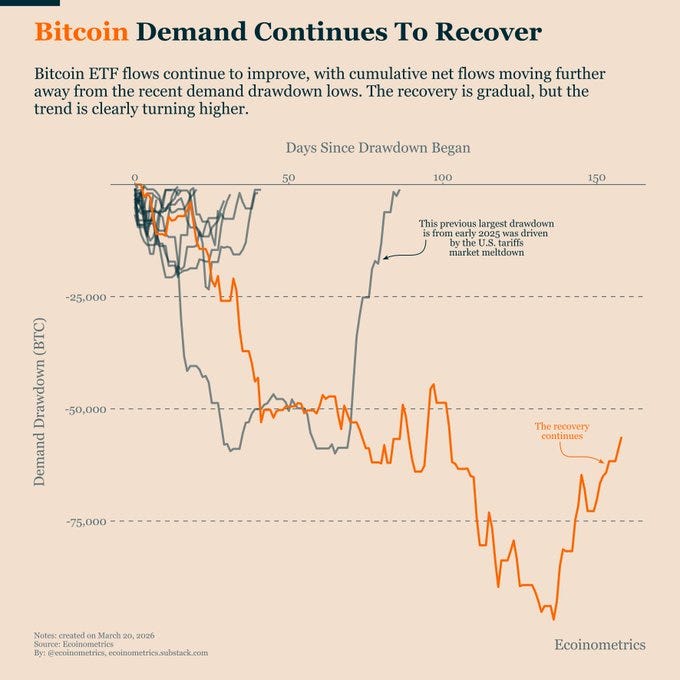
This trend is illustrated clearly in the attached chart (below). The data tracks Bitcoin demand drawdowns in BTC terms and measures recovery trajectories over time. The orange line, representing the current cycle, shows a pronounced decline followed by a gradual but steady recovery. While still well below prior peaks, the direction is unmistakably upward.
Interpreting the Chart: A Gradual Shift in Momentum
The chart highlights several important insights:
-
First, cumulative ETF flows are moving decisively away from the lows of the recent drawdown. This marks a transition from net distribution to accumulation. Historically, such inflection points signal the early stages of a new market phase.
-
Second, the recovery is not abrupt. Unlike previous cycles characterized by sharp reversals, the current trajectory is gradual. Demand is rebuilding steadily rather than surging. This aligns with a more mature market structure, where institutional participation dampens volatility while extending cycle duration.
-
Third, the comparison to earlier drawdowns is instructive. The chart notes that the Federal Reserve's macroeconomic tightening drove the previous major drawdown. In contrast, the current recovery is occurring despite continued macro uncertainty, underscoring the resilience of underlying demand.
Why This Does Not Signal an Immediate Breakout
It is tempting to interpret improving demand as a precursor to a rapid price surge. However, historical patterns suggest otherwise. Demand recoveries of this nature typically lead to prolonged consolidation phases rather than immediate rallies. Even in bullish scenarios, the transition from recovery to expansion is gradual. Capital flows rebuild confidence, liquidity deepens, and market participants reposition over time.
This process can take months, not weeks. As a result, expectations of a swift move toward psychological milestones like $100,000 may be premature. Instead, what we are witnessing is the formation of a base. Price may continue to oscillate within a range, influenced by external macro factors, while the underlying demand foundation strengthens.
From Headwind to Tailwind
Perhaps the most important takeaway is the shift in Bitcoin’s demand profile. For much of the recent period, demand acted as a headwind, with outflows and declining participation exerting downward pressure on price. That phase now appears to be ending. The data suggests a transition from deterioration to stabilization, and now to early recovery. This progression is critical.
Markets rarely move directly from bearish to bullish extremes. Instead, they evolve through intermediate stages, with each phase laying the groundwork for the next. In this context, improving ETF inflows and cumulative demand trends signal that Bitcoin is entering a more constructive phase. While not yet indicative of a full bull market, these developments reduce downside risk and increase the probability of sustained upward movement over time.
The Quiet Beginning of a New Cycle
Bitcoin’s return above $70,000 may not feel like a breakout moment. The price action lacks the explosive energy typically associated with bull markets. Yet this apparent calm should not be mistaken for weakness. Beneath the surface, the structural picture is improving. Demand is returning, institutional flows are strengthening, and cumulative metrics are trending upward.
These are the early signals of a market transitioning into a new cycle. The road ahead is unlikely to be linear. Volatility driven by macro events will persist, and progress may feel like stalling in the short term. But cycles are not defined by their speed; they are defined by their direction. And for Bitcoin, that direction is becoming increasingly clear.
Originally Published on Substack.






