A deep dive into the metrics showing Bitcoin’s shift from a volatile outsider to a respected store of value.
Over the past decade, Bitcoin has evolved from a fringe experiment into a multi-trillion-dollar asset class. Yet, perhaps the most compelling transformation is unfolding now, not in price alone, but in behavior. Once the poster child of wild market swings, Bitcoin is steadily shedding its reputation as a volatile asset.
In 2025, it is becoming something far more significant: a mainstream, institutional-grade store of value. The data now points to two unmistakable trends: a rapid decline in volatility and a surge in ETF inflows. Together, these developments are not only reshaping Bitcoin’s image but also its role within the broader financial system.
From Wild Swings to Stability
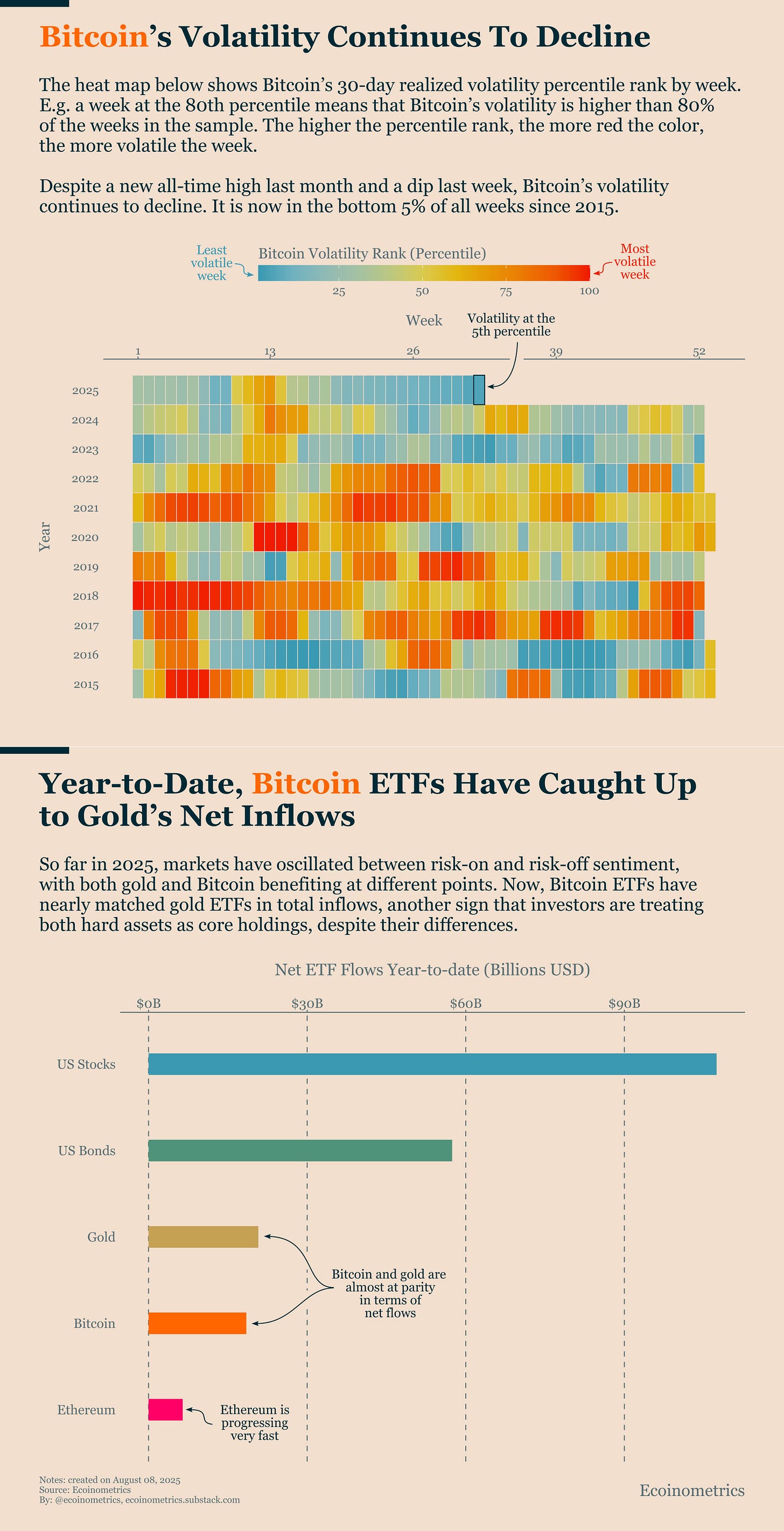
For years, Bitcoin’s volatility was a double-edged sword. On one hand, it fueled incredible rallies, attracting speculative capital and generating life-changing returns. On the other hand, it kept institutional investors at bay, concerned about the risks of exposure to an asset that could swing 20% in a single day. But as of August 2025, that narrative is rapidly shifting. According to a recent chart by Ecoinometrics, Bitcoin’s 30-day realized volatility has fallen to the bottom 5th percentile of all weeks since 2015.
That means the current volatility level is lower than 95% of the historical weekly observations in the past decade. The heatmap (top chart) illustrates this trend vividly. From 2015 through 2021, Bitcoin’s weekly volatility often reached high percentiles, reflected by frequent bursts of red and orange in the chart. But beginning in 2022 and accelerating into 2024 and 2025, the color palette shifts dramatically toward blues and greens, indicating weeks of increasingly lower volatility.
Even more remarkable, this trend holds despite a new all-time high last month and a modest price dip last week. Such low volatility during a rally is unusual in Bitcoin’s history. In previous bull markets, price gains were often coupled with explosive and chaotic trading behavior. This time, the rally is different—it’s orderly. The most plausible reason? Institutional participation.
Institutional Adoption: The Catalyst Behind the Calm
Bitcoin’s reduced volatility is not occurring in a vacuum. Its correlation to U.S. tech stock indices—while not perfect—has become moderately strong, suggesting that Bitcoin is behaving more like a maturing macro asset. As it becomes part of diversified portfolios, hedged alongside equities, bonds, and gold, its idiosyncratic volatility is being absorbed by broader market dynamics.
This is a defining feature of asset maturity. When once-volatile assets start to trade in sync with more traditional instruments, it signals deeper integration into institutional investment frameworks. In Bitcoin’s case, this shift is being driven by one vehicle in particular: Exchange-Traded Funds (ETFs).
ETF Inflows: Matching Gold, Surpassing Expectations
The second chart (above) from Ecoinometrics underscores the scale of Bitcoin’s institutional momentum. As of August 2025, Bitcoin ETFs have caught up to gold ETFs in total net inflows year-to-date. This is a watershed moment. Gold has long been the safe-haven asset of choice for institutions. For Bitcoin to achieve parity in ETF inflows is a signal that it is no longer viewed as merely “digital gold,” but rather as real gold’s institutional peer.
In the breakdown of year-to-date ETF flows:
-
U.S. Stocks dominate with the largest inflows.
-
U.S. Bonds follow, buoyed by shifting interest rate expectations.
-
Gold and Bitcoin are nearly tied, indicating that both are being treated as hard-asset hedges amid a backdrop of geopolitical uncertainty and economic transition.
-
Ethereum is emerging fast, drawing in 35% of Bitcoin’s ETF flows, hinting at its own path to institutionalization.
For Bitcoin, this level of ETF interest is a profound endorsement. It reflects confidence from asset managers, family offices, pension funds, and endowments that now see Bitcoin not just as a speculative play, but as a durable component of modern portfolios.
A Macro Asset in the Making
When asset managers allocate capital, they do so with an eye on predictability, liquidity, and long-term value. Until recently, Bitcoin failed on at least two of those three. But things are changing. Lower volatility, especially during an uptrend, makes Bitcoin more appealing for long-term capital. ETF access reduces custody risk and increases liquidity.
And growing acceptance in mainstream and regulatory clarity, especially in North America and parts of Europe, is improving Bitcoin’s value proposition as a macroeconomic hedge. What we are witnessing now is a major behavioral shift. Bitcoin is becoming less of a "momentum trade" and more of a strategic allocation. That makes it attractive not just to high-frequency traders or crypto-native funds, but to wealth managers and institutional allocators.
Ethereum: The Next Chapter?
While Bitcoin is taking a victory lap toward macro legitimacy, Ethereum is quietly building momentum of its own. The data from Ecoinometrics shows that Ethereum ETFs have attracted 35% of Bitcoin’s inflows so far this year. For an asset that has long been seen as “too complex” for traditional finance, this level of interest is remarkable.
Ethereum’s appeal lies in its versatility: a programmable blockchain that powers decentralized finance, NFTs, and smart contracts. But until now, institutional investors lacked the regulatory and infrastructural clarity to confidently allocate. With ETF structures now in place and performance picking up, Ethereum may be entering a new phase of growth.
The question isn’t whether Ethereum will rally—it’s whether it will finally graduate from “tech narrative” to “core allocation.”
Bitcoin Has Changed. Permanently.
Over the last 2.5 years, Bitcoin has evolved beyond recognition. It no longer needs dramatic volatility to gain attention. It no longer sits on the fringes of finance. Its integration into institutional portfolios is helping it behave more like gold and less like a meme stock. And in 2025, that transformation is backed by data: volatility is at historic lows, and ETF inflows rival those of gold.
Bitcoin may still be young in the eyes of the financial world, but it’s growing up fast. For investors seeking long-term exposure to scarce, non-sovereign assets with increasing institutional legitimacy, the message is clear: Bitcoin is no longer the future of finance. It’s part of the present.
Originally Published on Substack.