
ETF inflows show institutions are returning to Bitcoin, but Ethereum’s muted ETF recovery highlights how cautious investors still are toward broader crypto exposure.
For years, Bitcoin was dismissed by traditional finance as a speculative fringe asset driven largely by retail enthusiasm, momentum cycles, and volatility. That characterization is becoming increasingly outdated. Today, Bitcoin is behaving far more like a mature macro asset than an isolated speculative trade.
Institutional capital flows, ETF demand, monetary policy expectations, and broader risk sentiment are now shaping price action in ways that increasingly resemble traditional financial markets rather than the crypto cycles of the past decade. But while Bitcoin itself is regaining strength, the broader crypto market is not moving with the same conviction.
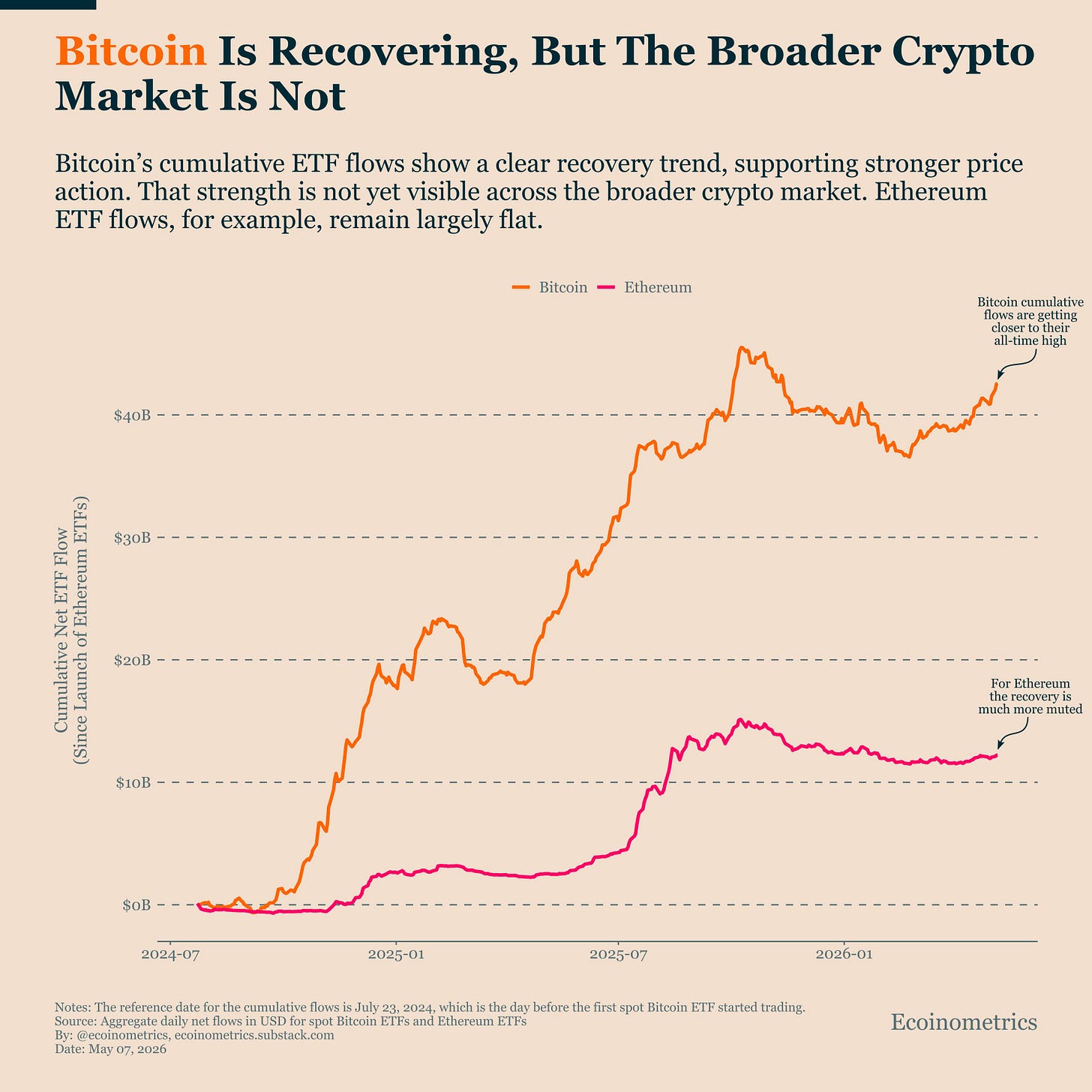
That divergence matters. Recent ETF flow data tells a remarkably clear story: institutional appetite is returning, but it remains highly selective. Investors are buying Bitcoin. They are not yet aggressively rotating into Ethereum or the wider digital asset ecosystem. That distinction may define the next phase of the crypto cycle.
Bitcoin is No Longer Trading in Isolation
The approval of U.S. spot Bitcoin ETFs fundamentally changed the structure of the crypto market. Institutional allocators who previously faced operational, regulatory, or custody barriers now have a familiar and regulated vehicle through which they can gain exposure to Bitcoin. The result has been profound. ETF flows are increasingly acting as a major driver of Bitcoin price discovery.
Analysts now regularly monitor daily ETF inflows the same way equity traders monitor bond yields, liquidity conditions, or Federal Reserve commentary. This shift has transformed Bitcoin from a largely retail-driven narrative asset into something closer to a macro-sensitive institutional instrument. And the current market backdrop is reinforcing that transition.
As inflation pressures ease modestly, equities stabilize, and expectations around future monetary policy become less chaotic, institutional investors appear more comfortable re-entering selective risk assets. Bitcoin has become one of the primary beneficiaries of that shift. Over recent weeks, spot Bitcoin ETFs have seen a renewed improvement in inflows, with major funds once again attracting significant institutional demand.
Importantly, however, this is not yet a broad crypto recovery.
The ETF Flow Divergence is Becoming Impossible to Ignore
The contrast between Bitcoin and Ethereum ETF flows is striking. While cumulative Bitcoin ETF inflows are now moving back toward previous highs, Ethereum ETF flows remain comparatively muted. The chart (below) accompanying this discussion illustrates the widening gap clearly: Bitcoin is recovering institutional momentum far faster than Ethereum.
That divergence reveals something important about the current state of investor psychology. Capital is returning to what institutions perceive as the safest and most established segment of the crypto market. Bitcoin, increasingly viewed as “digital gold” or a macro hedge, fits that profile. Ethereum and the broader altcoin ecosystem still carry significantly higher perceived risk.
Even where Ethereum ETF inflows have improved modestly, the scale remains far smaller relative to Bitcoin. In practical terms, this means the market is still operating in a selective risk environment rather than a full speculative expansion. Historically, broad crypto bull markets tend to involve aggressive capital rotation outward from Bitcoin into altcoins and higher-risk digital assets. That dynamic is not yet visible in any sustained way.
Instead, institutions appear concentrated almost entirely on Bitcoin exposure.
The Federal Reserve Remains the Central Variable
The timing of this selective recovery is not accidental. The Federal Reserve itself is entering a transitional phase. Markets remain uncertain about the trajectory of future rate cuts, inflation persistence, and broader liquidity conditions. Investors are attempting to price in a world where monetary policy is no longer aggressively restrictive, but also not yet decisively accommodative. That ambiguity matters enormously for crypto.
Bitcoin has increasingly demonstrated sensitivity to macroeconomic expectations, particularly around real yields, dollar strength, and liquidity conditions. When markets anticipate easier financial conditions, Bitcoin tends to perform well. When the Fed adopts a more hawkish posture, ETF flows and risk appetite often weaken quickly. This helps explain why institutions are currently favoring Bitcoin over more speculative crypto exposure.
In uncertain macro environments, investors typically concentrate capital in the most liquid and institutionally accepted assets first. Within crypto, Bitcoin occupies that role almost exclusively. Ethereum may still benefit later if macro conditions improve further, but current positioning suggests institutions are not yet ready to aggressively expand risk exposure deeper into the digital asset market.
A More Mature Market Does Not Mean a Simpler One
There is an irony in Bitcoin’s maturation. For years, crypto advocates argued that Bitcoin would eventually become integrated into the global financial system. That process is now clearly underway. Yet integration also means Bitcoin increasingly inherits the same macro sensitivities that drive traditional assets. ETF flows, central bank policy, institutional positioning, and liquidity conditions now matter more than ever.
This is no longer a market driven purely by retail speculation or social media enthusiasm. It is increasingly influenced by pension funds, asset managers, sovereign capital, and macro hedge funds evaluating Bitcoin through the lens of portfolio construction and monetary conditions. That evolution strengthens Bitcoin’s long-term legitimacy. But it also means crypto markets may become more dependent on global liquidity cycles than many participants anticipated.
For now, the message from institutional capital is relatively clear: confidence in Bitcoin is returning, but confidence in the broader crypto market remains cautious and selective. Until that changes, Bitcoin may continue to outperform the rest of the digital asset ecosystem, not because speculative appetite is booming, but because institutional investors are still treating this as a measured macro allocation rather than the beginning of a full-scale crypto risk rally.
Originally Published on Substack.






