
Three spot Bitcoin ETFs now rank among the largest 100. IBIT is nearing GLD’s AUM, and that’s changing everything—from asset allocation to price volatility.
What was once dismissed as a speculative bubble or a tool for niche tech communities has now taken its place among financial heavyweights. A striking new development underlines this transformation: three Bitcoin ETFs are now ranked among the top 100 ETFs by Assets Under Management (AUM). This signals a seismic shift in how institutions, asset managers, and everyday investors view Bitcoin.
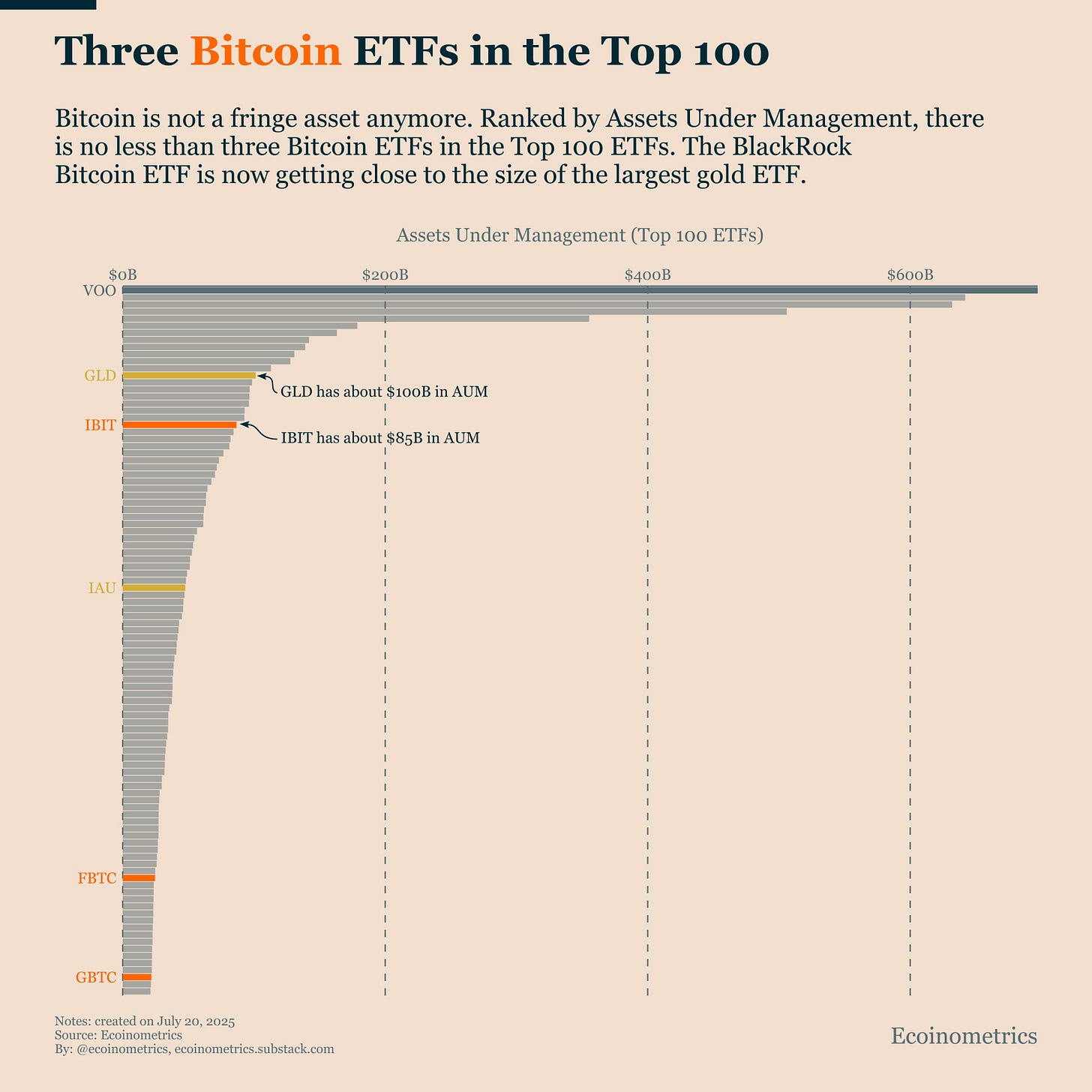
As of July 2025, the largest of these—BlackRock’s iShares Bitcoin Trust (IBIT)—has amassed approximately $85 billion in AUM, rapidly closing in on State Street’s SPDR Gold Shares (GLD), which remains the largest gold ETF at around $100 billion. The other two Bitcoin ETFs in the Top 100 are Fidelity’s Wise Origin Bitcoin Fund (FBTC) and Grayscale’s Bitcoin Trust ETF (GBTC).
This development is more than symbolic. It represents a turning point in the mainstream financial acceptance of digital assets, with enormous implications for market dynamics, investor behavior, and the broader macroeconomic landscape.
The Rise of Bitcoin ETFs: A One-Year Transformation
The journey to this moment began in earnest with the long-awaited approval of spot Bitcoin ETFs by the U.S. Securities and Exchange Commission in early 2024. For over a decade, regulators had rejected multiple proposals, citing concerns over market manipulation and investor protection.
But growing institutional pressure, a more mature crypto infrastructure, and improved custody solutions finally tipped the scales. Within months of launch, products like IBIT and FBTC began attracting massive inflows. By mid-2024, BlackRock’s IBIT had already crossed $30 billion in AUM.
Fast forward to today, and it sits at $85 billion, just $15 billion shy of GLD, which has been the go-to gold ETF since 2004. To put this in perspective, IBIT’s rapid ascent makes it one of the fastest-growing ETFs in history. Alongside it, FBTC and GBTC have maintained strong inflows, reinforcing that this isn’t a one-off anomaly but part of a broader structural shift.
Bitcoin is Now Part of the Institutional Toolkit
The inclusion of three Bitcoin ETFs among the top 100 (chart below) by AUM means that Bitcoin exposure is no longer relegated to crypto-native exchanges or futures contracts. Instead, it’s seamlessly accessible via traditional brokerage accounts, 401(k) plans, and institutional trading desks.
From a portfolio construction standpoint, this has profound implications:
-
Diversification: Bitcoin is increasingly viewed as a non-correlated or weakly correlated asset, making it attractive in diversified portfolios, especially as concerns about inflation and currency debasement resurface.
-
Liquidity and Accessibility: The ETF wrapper brings with it the regulatory oversight, liquidity, and ease of access that large asset managers demand.
-
Credibility: The backing of firms like BlackRock and Fidelity lends credibility to the asset class in the eyes of more conservative investors.
Bitcoin vs. Gold: A Generational Shift?
The comparison with gold is no accident. Bitcoin has often been dubbed “digital gold” for its fixed supply and deflationary nature. With IBIT now within striking distance of GLD, the long-standing narrative of Bitcoin as a store of value is gaining empirical validation. Gold has been a trusted store of value for centuries, and GLD has long served as its most prominent investment vehicle.
But the rapid adoption of Bitcoin ETFs suggests that younger investors, digital-native asset allocators, and even sovereign funds may be shifting their focus. What makes Bitcoin particularly attractive in this context is its programmability, portability, and verifiable scarcity—qualities that gold simply cannot match in the digital age.
ETF Flows Now Drive Bitcoin Market Dynamics
Another crucial shift is underway: ETF flows are now central to Bitcoin price action. Since the ETFs’ launch, we’ve observed a strong correlation between net ETF inflows and Bitcoin’s price movements. Daily price charts often mirror the direction of ETF fund flows. When IBIT or FBTC record strong net inflows, Bitcoin’s price typically surges.
Conversely, net outflows can trigger short-term price dips—even in the absence of major crypto news or macroeconomic developments. This correlation isn’t surprising. ETFs provide a transparent, regulated, and highly liquid channel for institutional capital to enter or exit Bitcoin. In essence, they have become the new barometer of market sentiment and a leading indicator for short- to medium-term price movements.
As more analysts and traders factor ETF data into their models, we can expect the feedback loop between ETF flows and spot prices to grow even tighter.
A New Era for Market Structure
The rise of Bitcoin ETFs doesn’t just benefit Bitcoin holders—it’s transforming the market structure itself:
-
Price Discovery is Shifting: Whereas price discovery once happened primarily on crypto exchanges like Binance or Coinbase, we are now seeing traditional markets—like the NYSE or Nasdaq—play a larger role.
-
Volatility May Decline: As institutional ownership grows and ETFs hold more of the supply, Bitcoin’s notorious volatility has moderated over time, sitting in the same range as large-cap growth stocks
-
New Products on the Horizon: With the success of spot ETFs, asset managers are now exploring derivative-based ETFs, multi-asset crypto funds, and even ESG-screened Bitcoin strategies.
The Road Ahead
So, where do we go from here? A few likely developments:
-
IBIT Surpasses GLD: If the current momentum continues, IBIT could overtake GLD in AUM by early 2026. That would be a milestone not just for BlackRock but for Bitcoin’s positioning as a primary alternative asset.
-
Regulatory Clarity Improves: The success of ETFs has sparked renewed efforts to create a more coherent regulatory framework for digital assets. The Passing of the Genius Act in the U.S is a big step in this direction.
-
Broader Retail Access: Expect to see Bitcoin ETFs integrated into more retirement accounts, robo-advisors, and passive index strategies.
-
Geopolitical Implications: As Bitcoin becomes part of sovereign and institutional reserves, its role in the global financial system—and geopolitical strategy—will grow.
Digital Asset Integration
This evolution reflects not just changing attitudes toward digital assets, but a broader transformation in how we think about money, value storage, and portfolio construction in the digital age. As Bitcoin ETFs continue to attract capital and influence market dynamics, they serve as harbingers of a financial future where digital and traditional assets coexist within integrated investment frameworks.
Originally Published on Substack.






