With macro uncertainty, sticky inflation, and a softening labor market, both Bitcoin and gold are weakening together, defying traditional safe-haven dynamics.
Over the past couple of years, Bitcoin’s integration into mainstream finance has been largely driven by exchange-traded funds (ETFs). These vehicles brought institutional money, enhanced liquidity, and cemented Bitcoin as a legitimate asset class. But as recent market dynamics show, the very ETFs that once propelled Bitcoin higher are now contributing to downward pressure.
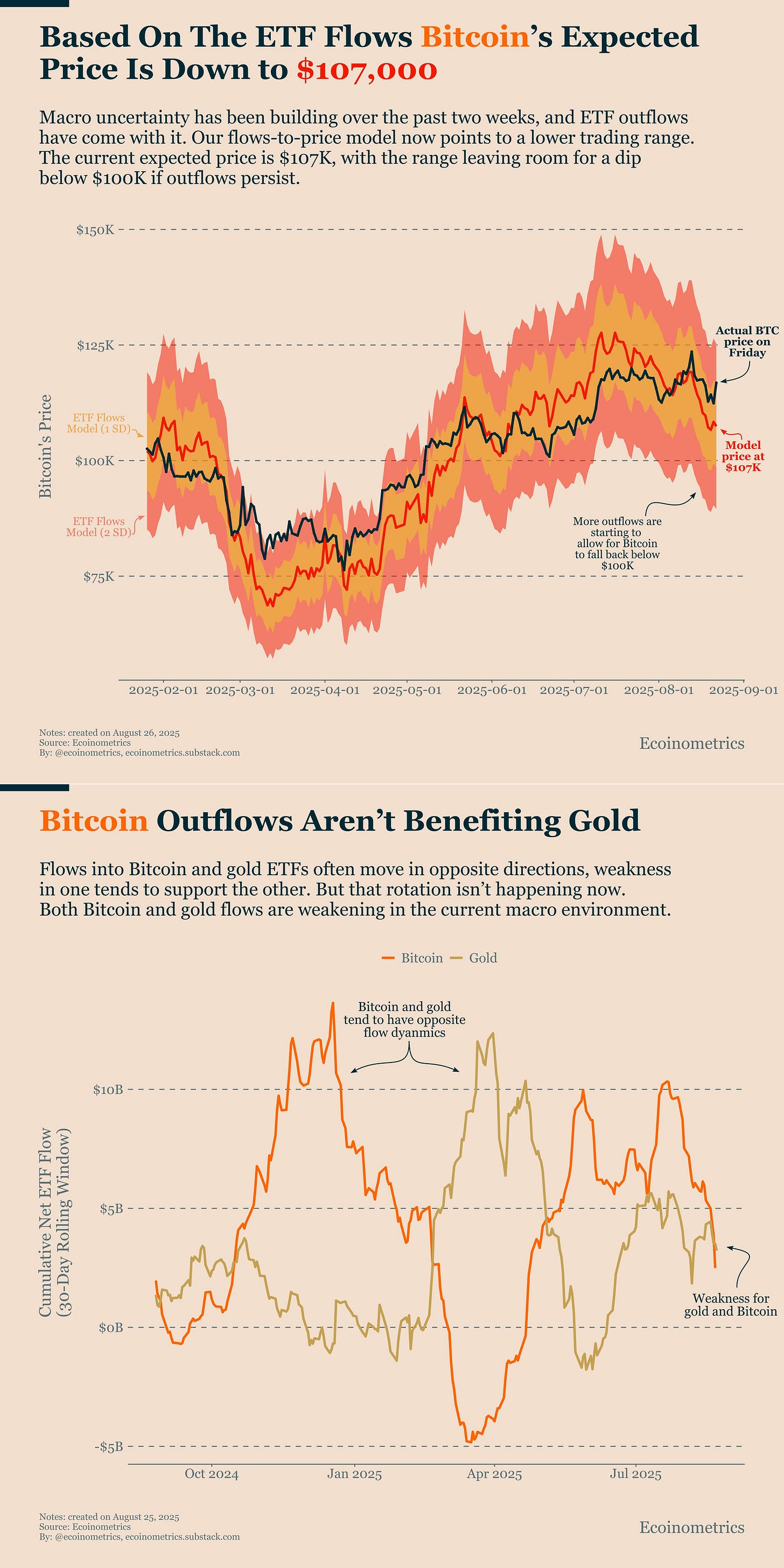
According to Ecoinometrics (first chart below), the flows-to-price model now places Bitcoin’s expected value at $107,000, with a real possibility of dipping below $100,000 if outflows continue.
ETF flows reflect more than just capital movement; they are an indicator of sentiment. Inflows amplify demand and can fuel rallies, while persistent outflows act as a drag on momentum. Over the last two weeks, rising macro uncertainty has triggered a wave of redemptions, putting Bitcoin under pressure and signaling fragility across broader financial markets.
Macro Backdrop: Why Outflows Are Building
The backdrop for these outflows is defined by sticky inflation, weakening labor market data, and a Federal Reserve without a clear path forward. Inflationary pressures have proven resistant to policy tightening, while indicators like declining job openings and slowing wage growth suggest that the labor market is cooling. The result is a policy stalemate: tightening further risks recession, easing too soon risks reigniting inflation.
For investors, that uncertainty makes risk-taking less attractive. In such an environment, Bitcoin, which thrives on clear directional narratives, whether of inflation hedging or monetary debasement, has struggled to hold its ground. Instead of being seen as a safe haven, it is increasingly treated as a risk asset sensitive to liquidity conditions.
Bitcoin and Gold: Parallel Weakness
Perhaps more striking than Bitcoin’s decline is the fact that gold, traditionally a refuge during uncertainty, is also weakening. Historically, Bitcoin and gold ETF flows have often moved in opposite directions, with one benefiting when the other falters. This time, both are experiencing outflows. Several factors may explain why gold, despite its long-standing reputation as a crisis hedge, is not attracting capital:
-
High Real Yields: With bond yields elevated, investors can earn returns on Treasuries without taking on commodity or crypto risk. Gold, which provides no yield, becomes less appealing when real interest rates are positive.
-
Liquidity Constraints: In times of uncertainty, investors often prioritize cash over long-duration hedges. Instead of rotating into gold, capital may simply be retreating into short-term money market instruments or sitting on the sidelines.
-
Competing Safe Havens: Assets like U.S. Treasuries are currently absorbing demand for safety, leaving gold with less of the traditional flight-to-quality bid.
This confluence of factors helps explain why both Bitcoin and gold, two assets usually seen as alternatives to fiat money, are weakening together. The retreat suggests a market dynamic not of rotation but of withdrawal.
The Fed’s Crossroads
The Federal Reserve’s current predicament magnifies this issue. Inflation’s persistence alongside a cooling economy means policy mistakes on either side carry high costs. Without clarity, investors find it difficult to build conviction in any asset class that relies on macro tailwinds, including Bitcoin and gold. This is why we are witnessing weakness in tandem rather than the usual substitution between the two.
For hard assets to regain strength, the Fed will need to deliver a clearer trajectory. Either inflation must convincingly subside, opening the door for easing, or growth must stabilize enough to remove fears of recession. Until then, the lack of conviction is likely to continue weighing on flows.
Implications for Investors
For Bitcoin, the key signal is the flows-to-price model’s projection of $107,000, with room for further downside below $100,000. This reinforces the central role ETF flows now play in setting price dynamics. For gold, the lesson is more nuanced: traditional crisis-hedge assumptions may not hold in a world where high yields, a strong dollar, and liquidity constraints redirect capital elsewhere.
Investors would do well to recognize that the current environment challenges the old playbook. Hard assets, once reliable hedges in uncertain times, are struggling to perform that role when policy paralysis and elevated real yields dominate the landscape.
Navigating the New Reality
Bitcoin and gold, often viewed as natural hedges, are both caught in the same storm. ETF outflows have pushed Bitcoin’s expected trading range sharply lower, while gold’s usual safe-haven bid has been undermined by high yields, and liquidity preferences. The Federal Reserve’s policy gridlock only compounds the uncertainty, leaving investors without a clear refuge in either digital or traditional hard assets.
For now, caution should guide allocation strategies. As the data from Ecoinometrics underscores, flows matter as much as fundamentals. Until macro conditions shift decisively, both Bitcoin and gold may remain vulnerable in ways that defy conventional investor wisdom.
Originally Published on Substack.