
Record-breaking AI investments are powering Big Tech’s dominance while smaller firms struggle to compete or survive.
The technology sector, once celebrated as the great equalizer where scrappy startups could challenge established giants, is experiencing a dramatic transformation. As artificial intelligence (AI) reshapes the competitive landscape, we are witnessing an unprecedented divergence between large and small tech companies—a split that may fundamentally alter the industry's future.
The rapid commercialization of AI is creating a winner-takes-most market, one where only the largest companies have the financial resources to compete. Microsoft alone is expected to spend $86 billion on AI investments next year. For perspective, that’s almost the same as the annual GDP of countries like Slovakia or Luxembourg, and it’s just one company’s AI budget. For small and mid-cap tech firms, those numbers are not simply daunting; they are existential.
The Growing Divide: Data Speaks Volumes
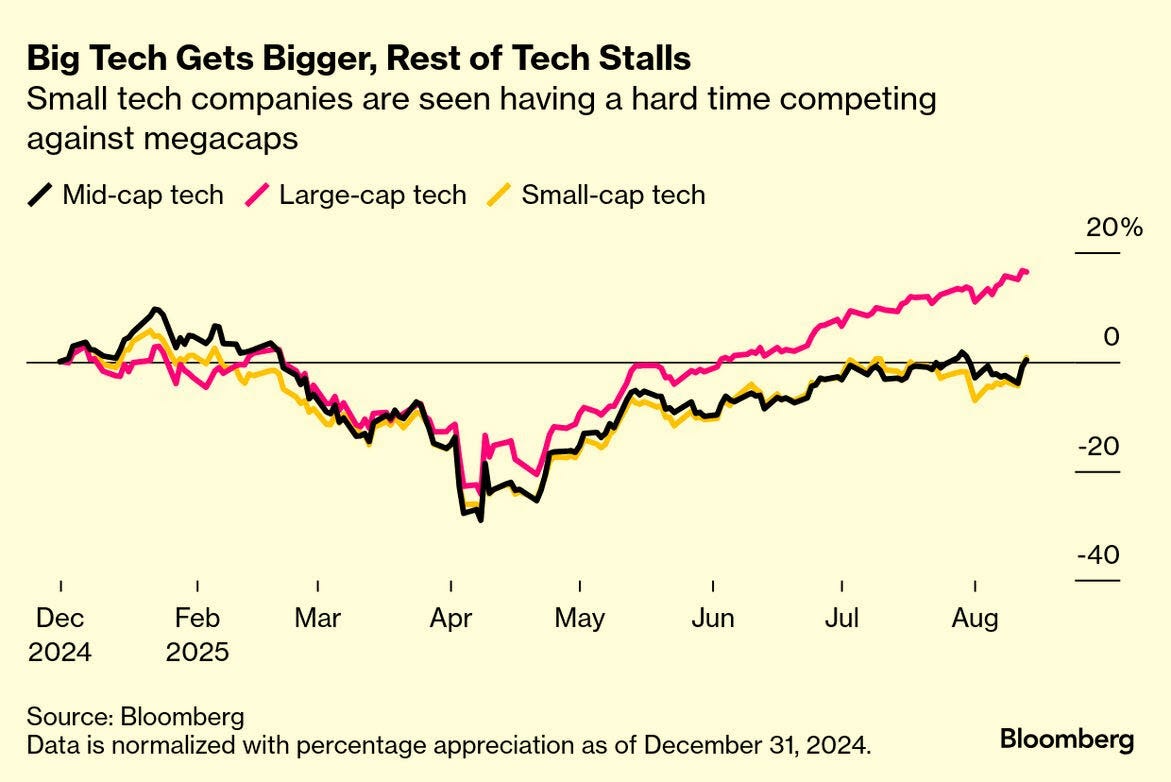
The Bloomberg chart below tracks the performance of small-, mid-, and large-cap tech shares since the end of 2024. The trends are stark:
-
Large-cap tech (magenta line) has surged roughly 16% year-to-date, driven by the meteoric rises of stocks like Microsoft (+24%) and Nvidia (+36%).
-
Mid-cap tech (black line) and small-cap tech (yellow line) are barely treading water—small-cap tech is actually down 1% in 2025, while mid-caps have been volatile but remain near zero growth.
The divergence became particularly pronounced in May, when AI-related earnings beats and strategic announcements sent large-cap names soaring. Smaller companies, meanwhile, saw little benefit—either because they lacked the AI narrative or, worse, because they were directly threatened by it.
Why AI Favors the Giants?
The core reason for the gap is simple: AI is expensive—not just to develop, but to deploy at scale. Advanced AI models require vast computing resources, high-end GPUs, enormous datasets, and teams of highly paid engineers and researchers. The upfront capital and ongoing operational expenditures are staggering.
For example:
-
Microsoft’s $86 billion AI budget covers everything from data center construction to AI chip purchases, model training, and integrating AI features into products like Office, Azure, and GitHub Copilot.
-
Nvidia’s surge reflects its dominance in AI chips—a sector where capacity is scarce, and prices are high. Large buyers secure priority access, leaving smaller firms with longer lead times and higher costs.
Small and mid-sized tech companies simply cannot match this spending pace. While they might develop niche AI solutions, they cannot compete with the infrastructure, marketing, and integration muscle of the giants.
The Casualties: Obsolescence Looms
AI’s rise is not just creating winners—it’s creating losers. Some companies face the grim reality that their core products may be rendered obsolete. Take Wix.com, the website-building platform. AI tools from Microsoft, Google, and emerging startups can now generate entire websites—including text, design, and even e-commerce integration—within minutes. The value proposition of a do-it-yourself website builder shrinks considerably when AI can do it for you.
Similarly, Chegg, the education and tutoring platform, has been hit hard by AI chatbots like ChatGPT, which can answer student questions in real-time. Chegg’s shares have tumbled as users increasingly turn to AI for homework help, test prep, and study guidance—often at no cost. The message is clear: in the AI era, entire business models can be disrupted overnight.
Investor Psychology: Flight to Safety and Scale
The investment community has taken note of this divergence, and capital flows are reinforcing it. Large-cap tech stocks have become the “safe havens” of the AI boom—trusted to innovate, execute, and monetize AI effectively. Earnings reports from the big players have largely been met with optimism, sending share prices higher.
Smaller firms, by contrast, face a credibility gap. Even when they announce AI-related initiatives, investors question whether they can truly compete. The result: capital is concentrating at the top, creating a self-reinforcing cycle where large companies get larger, while small ones struggle for attention and resources.
The Rise of New Giants
Interestingly, the AI era is also producing new large-cap players—companies like Palantir, which has leveraged its expertise in big data and analytics to position itself as a key AI defense and enterprise partner. Palantir’s ascent shows that while the barriers to entry are high, they are not insurmountable—at least for firms with a unique niche and government or enterprise contracts to back them. But such success stories are rare. For every Palantir, dozens of mid-cap firms are seeing their growth stall or reverse.
Macro Implications: Concentration and Competition
The widening performance gap raises important questions for the broader economy. The concentration of market power in a handful of tech giants has implications for competition, innovation, and even regulation. If small and mid-sized companies cannot access the resources needed to compete in AI, innovation could become concentrated in the hands of a few.
While this might accelerate the pace of certain breakthroughs, it risks stifling the diversity of ideas and approaches. Regulators in the U.S. and Europe are already eyeing the AI sector for potential antitrust concerns, but the technology’s complexity makes intervention challenging.
The Road Ahead: Can Smaller Players Survive?
While the odds seem stacked against smaller tech firms, survival is not impossible. The key lies in differentiation and agility:
-
Specialization – Targeting niche markets or industry-specific AI applications that are too small or specialized for the giants to prioritize.
-
Partnerships – Collaborating with larger firms, cloud providers, or AI platforms to access infrastructure without massive capital expenditure.
-
Speed – Leveraging their smaller size to pivot quickly in response to market changes, a luxury that large corporations often lack.
However, even with these strategies, the reality is that the AI era will be less forgiving to companies that cannot carve out a defensible position.
Navigating the New Reality
The data is unambiguous: AI is accelerating the divide between large and small tech companies. With deep pockets, massive infrastructure, and brand trust, large-cap tech is pulling away from the rest of the market. Smaller companies face the dual threat of being outspent and out-innovated—sometimes to the point of obsolescence.
For investors, the lesson is clear: in this AI-driven market, scale is not just an advantage, it’s a prerequisite for survival. For policymakers, the challenge will be ensuring that innovation remains vibrant and not the sole province of a few trillion-dollar corporations. As the AI gold rush continues, one truth stands out: the spoils are going to those who can afford the most powerful shovels.
Originally Published on Substack.






