
The AI revolution is rewriting the rules of cloud computing, and Oracle is rewriting its legacy.
In the annals of Silicon Valley, few names carry the same weight as Larry Ellison. The billionaire co-founder of Oracle has added another milestone to his storied career: Ellison became over $110 billion richer in a single day, following Oracle’s dramatic cloud growth projections for the next five fiscal years. According to Forbes data, this surge places Ellison within striking distance of Elon Musk in the global wealth race; an achievement that speaks not only to his personal fortune but also to Oracle’s surprising resurgence in the high-stakes world of cloud computing.
This remarkable windfall did not occur in a vacuum. It reflects a tectonic shift in the broader technology sector, where demand for cloud services has reached unprecedented heights. With the rise of artificial intelligence (AI), companies like OpenAI and xAI are scrambling to secure massive computing capacity, fueling an industry-wide spending spree in the hundreds of billions annually. Oracle, once considered a legacy software giant, now finds itself at the epicenter of this transformation.
Oracle’s Pivot to the Cloud
For decades, Oracle was synonymous with enterprise databases and enterprise software. While Microsoft, Amazon, and Google were often perceived as the vanguards of cloud innovation, Oracle was sometimes dismissed as a laggard. Yet, under Ellison’s watchful eye, the company has quietly repositioned itself. Over the past several years, Oracle has doubled down on cloud infrastructure, carving out a distinct niche with its focus on high-performance, enterprise-grade solutions.
Oracle’s recent announcement outlined cloud growth projections that far outpace its historical performance. Investors took notice immediately. The company’s stock soared nearly 70% in the past year, far exceeding peers such as Amazon (+39%), Microsoft (+24%), and Salesforce (+3%). This remarkable growth, captured vividly in recent market charts, underscores the shifting dynamics in the cloud ecosystem.
At the heart of Oracle’s momentum lies its ability to meet the insatiable demand for computing power. As AI models continue to grow larger and more sophisticated, the need for robust infrastructure has never been greater. Oracle’s aggressive investments in data centers and partnerships with AI leaders have positioned it as an unexpected but formidable competitor in the race for cloud dominance.
The AI Arms Race and Cloud Economics
The explosion of generative AI has redefined the economics of the cloud. Training advanced models requires staggering amounts of computational capacity, and maintaining them at scale demands even more. As a result, AI companies are pouring hundreds of billions into securing long-term infrastructure contracts. Oracle has smartly capitalized on this wave. By aligning itself with emerging AI players, the company has transformed its cloud services into indispensable tools for organizations racing to innovate.
This isn’t just about hosting data or applications; it’s about providing the raw computational horsepower that fuels breakthroughs in language models, robotics, and beyond. In this sense, Oracle’s story mirrors a broader industry reality: the convergence of cloud and AI is no longer optional but existential. For companies like OpenAI and xAI, access to cloud infrastructure isn’t merely a competitive advantage; it is the very foundation of their survival.

Larry Ellison’s Visionary Gamble
Ellison has never been one to shy away from bold moves. From challenging Microsoft in the 1990s to making early bets on internet databases, his career has been defined by an instinct to spot opportunities where others see risk. His latest triumph demonstrates that his vision remains as sharp as ever. The Oracle co-founder’s newfound wealth is virtually unprecedented. But what it signifies is perhaps more important: Oracle has firmly planted itself in the conversation about the future of technology.
Ellison is not merely catching up to Musk in wealth; he is asserting Oracle’s role in shaping the next era of innovation. Critics may argue that Oracle’s surge is a product of hype or temporary demand spikes. However, the scale of projected cloud growth suggests otherwise. Unlike fleeting trends, the AI revolution is poised to reshape industries from healthcare to finance, manufacturing to education. And as long as AI demands scale, Oracle’s cloud services will continue to be in high demand.
Broader Implications for the Tech Industry
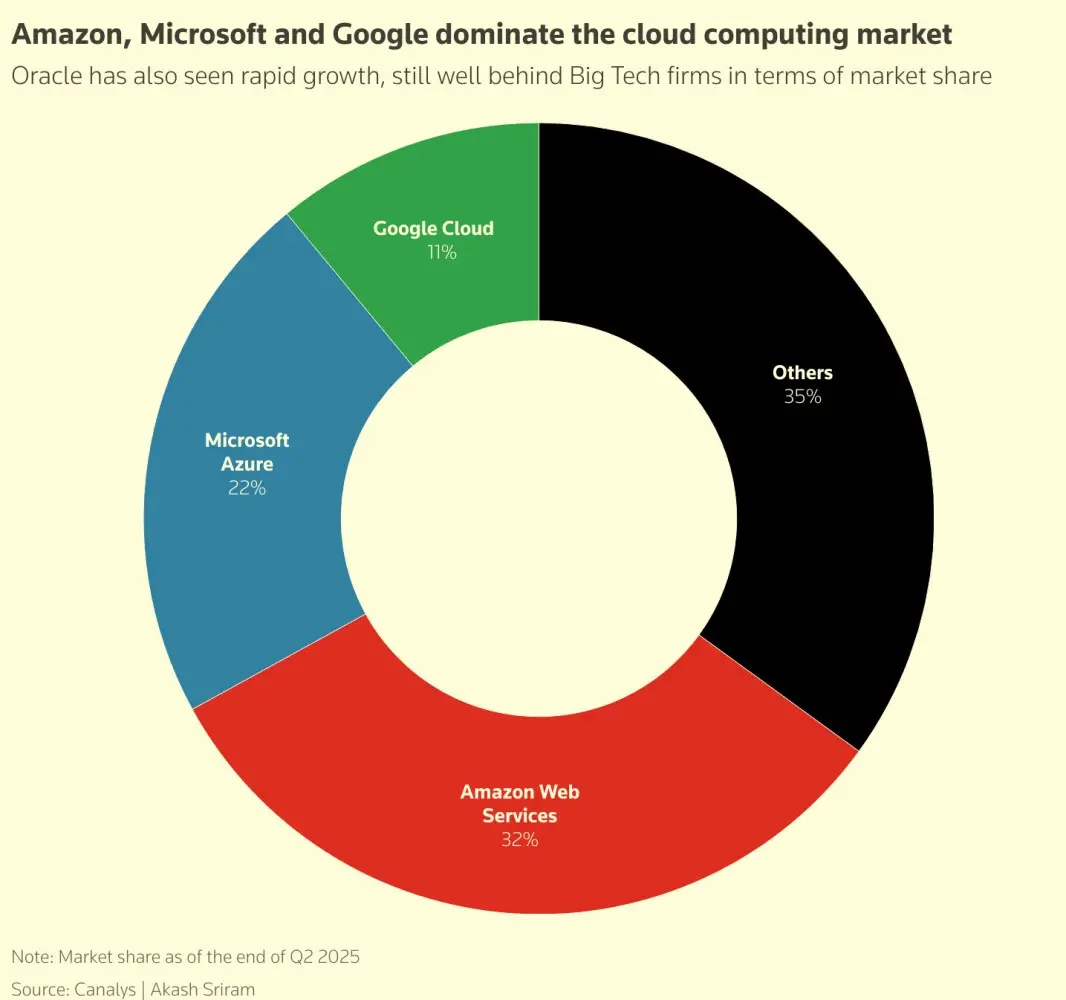
Oracle’s ascent raises critical questions about the balance of power in the cloud industry. For years, Amazon Web Services (AWS), Microsoft Azure, and Google Cloud dominated headlines. Now, Oracle has inserted itself into this elite circle with a growth story that rivals or exceeds its peers. The company has struck deals with Amazon, Alphabet, and Microsoft to let their cloud customers run Oracle Cloud Infrastructure (OCI) alongside native services. The revenue from these partnerships rose more than 16x in the first quarter.
This development also highlights the growing centrality of infrastructure in the AI economy. While consumer-facing applications such as ChatGPT grab attention, the real battle is being fought behind the scenes, where cloud providers supply the computational muscle that makes such tools possible. Whoever controls the cloud infrastructure controls the pace and direction of AI advancement.
Moreover, the rise of Oracle underscores a potential recalibration of investor sentiment. If a company once thought of as a slow-moving incumbent can reinvent itself and capture market share, it suggests that the technology sector remains fluid and unpredictable. Legacy players are not necessarily doomed to obsolescence; with the right strategy, they can thrive in the most competitive landscapes.
A New Era of Competition
The implications extend beyond Oracle itself. As AI-driven demand reshapes cloud markets, we may see intensified competition not just among providers but also among nations. Cloud infrastructure is increasingly being framed as a strategic asset, akin to energy or natural resources. Governments may step in more forcefully to regulate, incentivize, or even directly invest in cloud capacity, recognizing its role in economic competitiveness and national security. In this environment, Oracle’s success becomes more than a corporate victory. It symbolizes the dawn of a new era, where the intersection of cloud and AI dictates the global balance of technological power.
The Question for the Future
Larry Ellison’s astonishing $110 billion windfall is more than a story of personal wealth. It is a reflection of the seismic shifts underway in technology, finance, and society at large. Oracle’s dramatic resurgence, fueled by cloud growth and AI demand, positions it as a key player in shaping the future. But the bigger question remains: as cloud providers consolidate their dominance and AI drives ever-greater demand for computing power, how will this concentration of infrastructure shape innovation, competition, and even global politics in the years ahead?
Originally Published on LinkedIn.






