
With $3.8 Billion stolen overall, the decentralized finance businesses were the main culprit
Individuals and businesses have suffered billions of dollars in losses as hackers continued to attack a rapidly evolving Cryptoverse. As you can see in the chart above, crypto losses to hacking have continued to pile up since 2016. Last year saw the largest amount lost to hacking, to date. According to the data from Chainalysis, 2022 saw a 6% increase over the previous year — with the total value of cryptocurrency stolen totaling $3.8B, up from $3.6B in 2021. While the number of attacks decreased a little, the value of stolen cryptos increased.
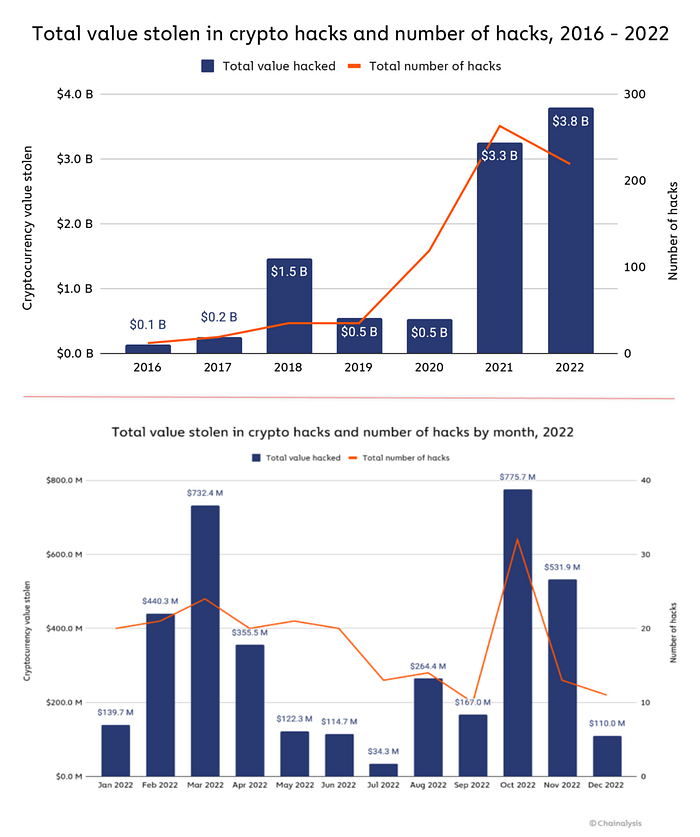
Looking at the monthly picture (bottom chart above), hacking activity ebbed and flowed throughout the year. That being said, huge spikes were seen in huge spikes in March and October — with $775.7 million stolen in 32 separate attacks, the latter became the biggest single month ever for cryptocurrency hacking. Except for July 2022, all remaining months saw stolen crypto coming in at more than $100 million.
Another trend that started to show up in 2020 was magnified even further. I am talking about decentralized finance (DeFi) protocols. They once again became the primary target of interest for hackers — the second year in a row. The cryptocurrency stolen by hackers in 2022 primarily came from DeFi protocols, accounting for 82.1% of the total stolen amount which was $3.1 billion.
This is an increase from the previous year, where DeFi protocols were victims in 73.3% of all cryptocurrency hacking cases. Out of the $3.1 billion stolen, a significant portion, 64%, was taken from cross-chain bridge protocols. Why they were so tempting for hackers? Well, they act as huge, centralized repositories of funds backing the assets that have been bridged to the new chain & any error in its underlying smart contract code or other potential weak spot is almost sure to eventually be found and exploited by bad actors.
DeFi is one of the fastest-growing, most compelling areas of the crypto ecosystem. The transparency that makes DeFi so tempting in turn also becomes its vulnerability — owing to the public viewed smart contract code. One of the possible remedies that analysts suggest to fix this situation is to conduct code audits by third-party providers like Blockchain cybersecurity firm Halborn.
The company has a great track record, as no DeFi protocol to pass a Halborn audit has subsequently been hacked. Others suggest looking at security measures implemented by legacy financial institutions too. These could include testing the platforms with simulated attacks, monitoring mempools (available transactions before they are confirmed on the blockchain) & implementing circuit breakers (pausing transactions on first hints of suspicious activity).
Originally Published on Medium
Email | Twitter | LinkedIn | StockTwits | Telegram | Newsletter







