
I come from a publishing background, and it's shocking how reliant online publishers are on Google. They are often in a position where most of their organic (non-paid) search traffic comes from Google search, and most of their paid search traffic comes from Google Ads. In addition, most of their users - on desktop and on mobile - will be using Google's Chrome browser. So Google has a near-monopoly in three interrelated areas.
That's not even mentioning the fact that many publishers then use Google products to monetize their site, whether that's through Google AdSense or other tools such as Google Ad Manager (formerly called Doubleclick for Publishers, or DFP). So they get their audience through Google, then make money from that audience... through Google.
Risky business
Google having so much power is bad for publishers not because Google itself is somehow evil or wrong (at least, I'm not one of those who think that) but because of risk. With crypto, we all know that holding just one coin or holding all your coin in one place is incredibly risky - and that we can mitigate risk through diversification. We hold a wider range of assets, and we hold them in more places. That way, should something go wrong, its impact is limited.
The same is true for audience generation: if all your traffic comes from one source (Google), that poses a huge risk. Should your site be blacklisted by Google, or should you accidentally fall foul of an algorithm change, that can have a massive impact on your traffic and ultimately your bottom line.
I have to say here that I don't dislike any individual Google product - some of them, such as Google Data Studio, are rather excellent. But I do welcome and support anything that challenges Google's hegemony. I believe it creates a healthier environment for online publishers and for all of us.
Like many other people I suppose, I got into crypto through the Brave browser. But it wasn't so much the opportunity to earn Basic Attention Token (BAT) as a user that interested me - though I didn't turn my nose up at that! It was Brave's unusual advertising model, allowing users to reward and support publishers directly with BAT they had earned. That encourages a closer relationship between user and publisher and, ultimately, better quality content.
Competition is good
And just as I support Brave taking on Google in the browser sphere, I support any competition when it comes to organic or paid search. That's why I use Presearch as my search engine of choice. (Although again, I don't turn my nose up at the opportunity to earn PRE!)
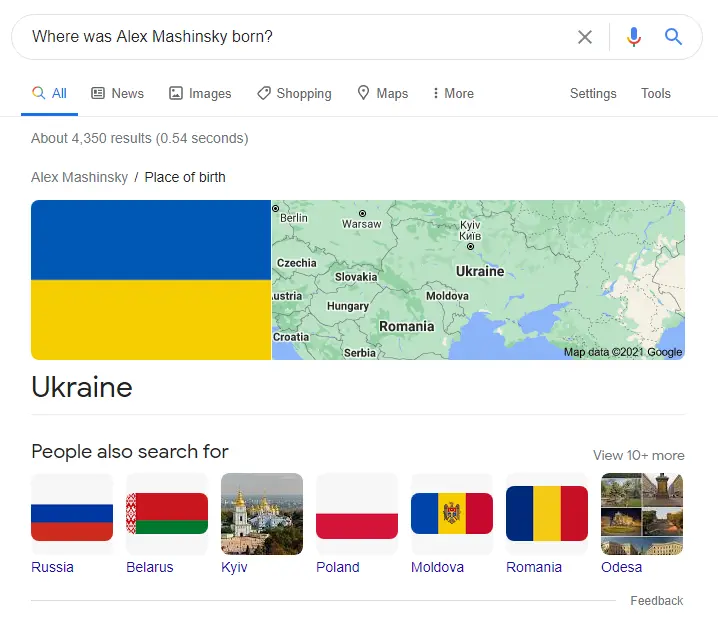
What's fascinating when you switch search engines is that you suddenly become more aware of how your previous search engine worked and the design decisions behind it. Moving to Presearch helped me realise just how many factual queries Google answers directly through its Knowledge Graph panels. For example, if I Google 'Where was Alex Mashinsky born?', Google shows me this:
But when I make the same search on Presearch, its default search engine DSearch shows me this:
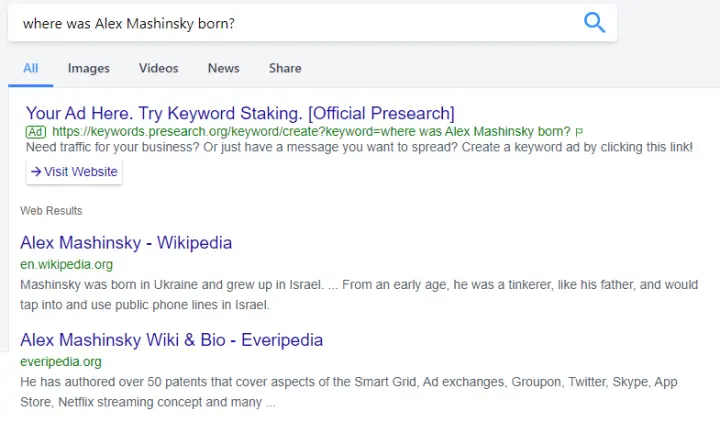
Google foregrounds the answer very clearly, making it unnecessary for me to click through to an external site. And I couldn't really do that if I wanted to: clicking on the map takes me to Google Maps, clicking on the flag takes me to Google Image Search, and clicking on the 'people also search for' section takes me to other Google search results pages. Google has effectively kept me on Google.
Presearch, conversely, does give me the answer in the first snippet, but also provides me with a clear opportunity to click through to external sites. There is no attempt to keep me on Presearch.
As a user, the Google approach is probably better - assuming that the Knowledge Graph result is accurate, of course, which isn't the case with every search. It's certainly quicker when I'm after a simple answer to a factual query.
But as a publisher, it's incredibly painful. The more search queries that Google answers itself, the less traffic it sends through to publishers (and other sites generally). And the less organic traffic that publishers receive, the more reliant they become on paid traffic - which means that Google ultimately profits. Or to look at it another way: it's arguably in Google's interests not to send searchers through to publishers' sites.
It's similar in a way to how Facebook has reduced the organic reach of a lot of publishers' content, pushing them towards paid promotion instead. (There are a lot of parallels between publishers' relationship with Google and their relationship with Facebook, but that's for another article.)
What's at stake
For me, then, Presearch has an interesting balancing act to make. How can it best serve the needs of searchers while also providing value to publishers and other content creators?
One way that Presearch successfully addresses this is by enabling publishers to advertise against particular keywords by staking PRE tokens. This is rather different and potentially more cost-effective than the traditional keyword advertising model. However, with keyword staking currently being free to anyone with enough PRE, it means that publishers are also more likely to be competing for keywords against enterprising individuals promoting affiliate schemes and so on.
Presearch provides a simple 'staking dashboard' to enable publishers and others to see which keywords already have tokens staked against them. A search of 'Bitcoin' shows the following:
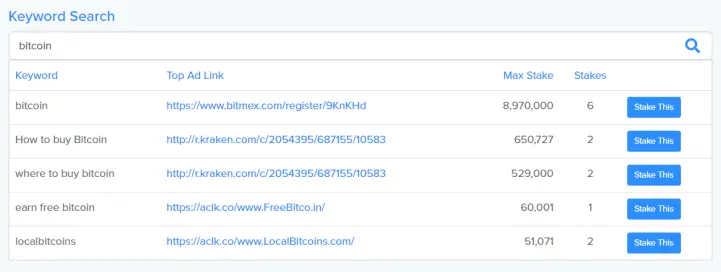
But plenty of keywords still have no stake, especially outside the sphere of crypto and blockchain. For example I write about web analytics on my personal website, Technically Product, and I can see from the dashboard that no one is staking tokens against 'analytics' keywords yet.
This creates an opportunity to drive traffic to my site completely free of cost when doing the same on Google Ads would soon become expensive for a private individual. (I haven't taken advantage of that opportunity as I haven't quite accumulated enough PRE to do so.)
Tools for publishers
For me, Presearch could develop the 'staking dashboard' further to indicate the traffic volumes that particular keywords receive (on Presearch itself). This would enable publishers - and others - to make more informed decisions about which keywords to stake their tokens against. And yes, it sounds a little like the 'keyword planner' that is available in Google Ads.
Because it's worth recognising that Google excels in two areas (apart from having all the traffic): providing publishers with tools that give them insightful information, and connecting those tools together in a coherent ecosystem. For example, website owners can use Google Search Console to understand their organic search performance, and connect both their Search Console account and their Google Ads account to Google Analytics. Their paid and organic search data can then be visualized in Google Data Studio, and so on.
So while users may look to Presearch for an excellent search experience, for rewards, for privacy and for decentralization - all of which are hugely important - publishers have rather different requirements, both as content creators and as advertisers. Yes, they need a large and engaged audience. But they also need a suite of tools to understand that audience and be able to target them appropriately. They need to be told how their site is performing and how to optimize that.
Can Presearch deliver? I'm not sure, but its roadmap is promising. In Q2 we are promised "better ad targeting options and insights for advertisers". Later in the year we'll see "increased rewards for users who opt in to personalization" as well as the opportunity to "earn PRE for identifying ads that violate the TOS". Each of these three changes will bring benefits to publishers. With my crypto hat on, I'm curious. With my publisher hat on, I'm - dare I say it - hopeful.
- Interested in trying Presearch? Sign up here to receive a 25 PRE bonus





